The first adaptive project that I can recall was in Jersey City in the 1980s, and it was a big one; the transformation of the 100+-year-old, 600,000-square-foot factory complex that housed the former Joseph Dixon Crucible Company, maker of the iconic yellow Dixon Ticonderoga #2 pencil, into 470 rental units (later re-cast as condominiums).
Fast forward to Giving Tuesday, December 3, 2024, and an informative fund-raising session/breakfast for nonprofit HomeWorks Trenton (homeworkstrenton.org), a free after-school residential program that offers academic and leadership enrichment activities to high school girls in need.
One of the keynote speakers was architect Joshua Zinder, principal of JZA+D in Princeton. Zinder spoke about one of his firm’s most recent adaptive reuse design projects, the groundbreaking to kick off the conversion of a historic farmhouse in Trenton’s Parkside neighborhood, parts of which date back to the 1740s into a dormitory and learning center that will serve as the HomeWorks headquarters and provide room and board, counseling services, and a place for quiet study for its teen scholars during the school week.
Zinder’s enthusiastic presentation of the HomeWorks project led to a subsequent one-on-one discussion about his firm’s other adaptive reuse projects and about the pros and cons of adaptive reuse in general. (Note: Joshua Zinder’s remarks have been edited and condensed to meet space requirements.)
The first order of business was to elicit a working definition. “It’s taking an existing structure and using it for a different purpose than it was originally designed or intended,” he explains. “Take Nomad Pizza at the Princeton Shopping Center, for example. “That building, formerly a gas station [and one of his firm’s projects], was converted into Nomad Pizza.”
What in Zinder’s view are the advantages and disadvantages or potential pitfalls of adaptive reuse?
“The biggest advantage? One of the core tenets of sustainability is that you use what you have,” he says. “On a really basic level, it’s a good way to sequester carbon, the structure that’s been built and the carbon that went into building it is staying within that building. Another is ‘use what you have and reuse what you have.’
“So you’re expanding the length of that carbon containment, plus the fact that a lot of older materials have a higher level of finish,” he continues. “Some of the material that we used on another JZA+D project, at 30 Maclean Street in Princeton, was old-growth timber, and so it has this wonderful aesthetic to it that you just can’t get these days. So, from a sustainability point of view there are a lot of advantages to adaptive reuse.”
And the potential downside? “In building, the single biggest challenge ends up being cost,” he says. “In many cases, it’s easier for a developer, a builder, or an architect to come in, clear the site, and build something from scratch. There are fewer surprises, fewer unknowns. When you adaptively reuse a building, inevitably there are surprises; something you couldn’t see behind a wall, asbestos, all sorts of things that you encounter that you just don’t expect.
“For example, at 30 Maclean, when we were digging the hole for the elevator pit, we struck a spring, which is not uncommon in Princeton. You can dig almost anywhere in Princeton and hit water flow. Often there are a lot of benefits, but for developers the benefits often don’t outweigh the increase in costs. There are some potential cost savings; you don’t need to build an exterior wall system for example. It really depends on balancing all those factors.”
A recent letter in Town Topics pointed out some intangible benefits of adaptive reuse, such as preserving an architectural record of the history of a community, of what came before. Do you see any intangible benefits in adaptive reuse?
“I’m a big advocate for adaptively reusing buildings,” Zinder says, “and I’m also a big advocate for recognizing that buildings that are in our historic district should be maintained. But all of Princeton is not historic, and we should be maintaining a quilt that represents all time periods in Princeton, including today. I think people forget that sometimes, and they want to lock into one time period, but Princeton’s been occupied as a community for so long that there’s no single style, there’s no single time period. Even our historic districts have overlapping time periods, they’re not set.
“But there is something to be said for looking at the fabric of a community,” he continues. “At 30 Maclean, we retained the exterior of the Masonic Lodge, which has been around for a hundred years, has been a part of the fabric of the community. Keeping it in the community extends its legacy and builds familiarity, and makes people feel that it’s still their home.”
How does an owner / developer go about assessing a candidate for adaptive reuse, and at what point does a firm like JZA+D typically get involved in the process?
“When we’re looking at a site, the first thing we’ll assess is the structures on the property, and if they can be used, how to go about using them,” he explains. “I think that there are a lot of opportunities coming up in town for people to adaptively reuse their structures in creative ways.
“For a developer, it’s about the dollar and demonstrating that it’s a viable project to do. A lot of developers will cross a project like that off their list because it doesn’t fit into their business model. Many developers have a set model; it’s how they make money, and there’s nothing inherently wrong with that. The question is when you’re applying for zoning approvals or planning approvals, is that something that’s going to be OK for the community they’re looking at?
“Often it’s not, and so in those instances then there’s value-added for a developer to propose to adaptively reuse that building. And you do see even big developers like Toll Brothers do adaptive reuse projects in instances where they would not be able to do the project otherwise.”
Tell our readers about the transformation of the Amoco station into Nomad Pizza at Princeton Shopping Center.
“I looked at that building and before we were working with the current shopping center, with the previous owner,” Zinder says. “I became enamored with that building as a modernist piece of architecture, a 1930s modernist structure, its clean lines. It was built for its intended use, as a gas station, but back then you wanted to draw attention to your gas station, and there was something to be said for making gas stations that were sleek, clean, modern, because that was the future.
“And so even though it had been painted over a couple of times and was an odd brown color when we started working on it, I looked at it and I saw those lines and thought to myself that it could be a really great restaurant.
“I reached out to the owners and to a bunch of restaurants. We’ve done restaurants around the country, and that’s how I was looking at it. And there were studies. I think Princeton Future did a study on redeveloping the shopping center before EDENS bought the property, I had mentioned my interest in it, and they had mentioned that they were working on aligning Nomad to the space, so there was a good synergy there.”
Since it had been a gas station since the 1930s, were there any particular environmental challenges in adapting the site?
“As I recall, we didn’t encounter any hazardous materials there or anything like that,” he says. “The biggest problem was the structure. The base of the structural columns on the side that had the roll-down doors on it had been exposed to the weather for so long had rusted out, and some additional structural modifications had to be made that weren’t expected.”
Talk a bit about how the Nelson Glass project on Spring Street came about.
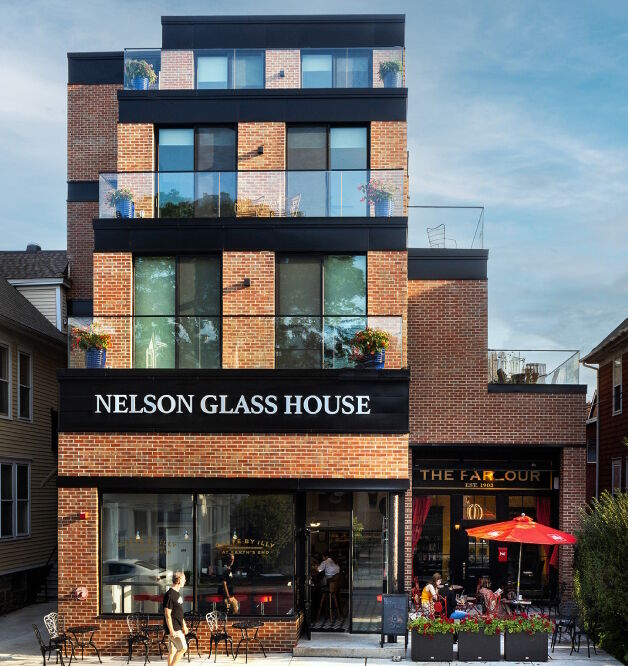
“Robbie Nelson had a desire to follow through on her father’s vision, which was to add on to the Nelson Glass and Aluminum building that her father had added onto the adjacent residential structure,” Zinder says, “and she talked to us about it. We normally come up with a couple of different design ideas, but understanding Princeton we looked at that project and recognized that the building was to a certain extent a modern brick building on a street that is predominantly 1920s to 1940s traditional structures, so there was a little bit of a disconnect there. So the key to designing the addition was how to de-emphasize it while maintaining the existing context?
“The bottom floor was kept as commercial space,” he explains, “changing from the glass shop to the coffee shop and cigar club that it is now. To add three floors on to it, we stepped those three floors back to maintain light and air, working with Robbie to ensure that glass and aluminum was part of the design. The fascias were fashioned of aluminum, and we retained the brick and did our best to match the brickwork that her father had originally picked out, and incorporate glass rails on all the balconies, which step back and maintain focus on the lower level.
“If you sight along the building, the lower level aligns with the porches along the street, and then if you look at the next floor up, it aligns with the face of the buildings along the street and then step back to be out of the visual plane. Adaptive reuse is not only about keeping the structure, but ensuring that what you’re adding on to it is complementary.”
We then moved to another of Zinder’s in-town projects, the building that formerly housed a Masonic Lodge at 30 Maclean Street.
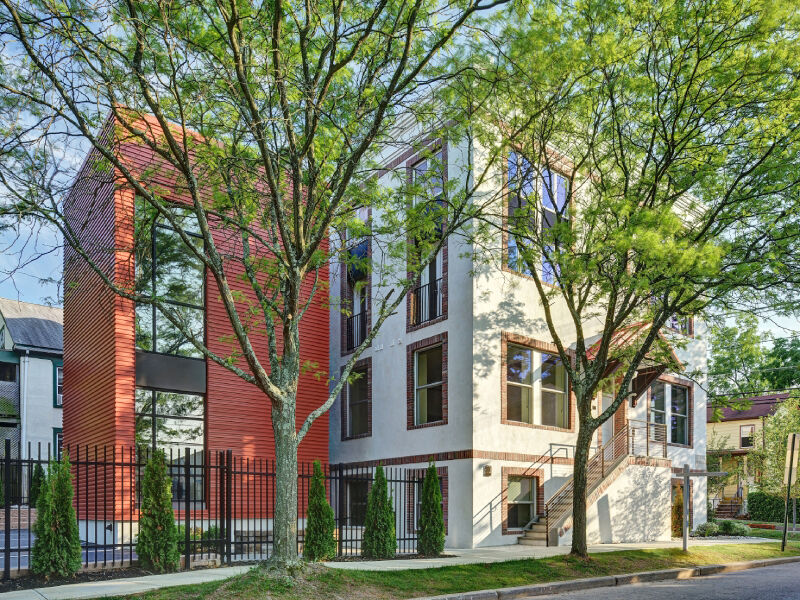
“30 Maclean is actually a passion project for me,”Zinder says. “I’m part owner of the building, and I guess part of the challenge there was that we wanted to demonstrate that you could do a project that was sustainable, that met sustainable goals, that fit into a historic context, and that could still be successful.
“I think that’s what we’ve demonstrated there, by taking what had been a Masonic Lodge and converting it into 10 apartments, two of which are affordable. We achieved that by effectively keeping the outside shell and re-purposing the inside space. There used to be a two-story meeting room on the second floor, and by recombining the space we were able to get four duplex apartments on the third and fourth floors, one duplex on the ground floor, and flats on the remainder of the ground floor and second floor.
“We added on an elevator tower to meet our egress and access needs,” he continues, “and because the Secretary of the Interior standards for historic places state that if you’re going to do an addition to a building it should be differentiated so it’s clearly not part of the historic structure. Originally we looked at using brick for the elevator tower but decided it could give a false sense of history to the building, so we ended up doing orange brick colored metal panels on the outside of the tower, so it’s clearly a modern element that’s been added on to the historic structure.”
Zinder also noted that the property has earned a Gold LEED (Leadership in Energy and Environmental Design) certification.
Were there any particular challenges there?
“Oh, lots and lots of challenges there,” he chuckles. “We had an asbestos issue on that project, and we had water bubbling up from the basement so we needed to do extensive waterproofing. On the lower levels there were challenges with the exterior wall system of three-layer terracotta block, which is not something that’s done today, so finding a structural engineer that would work on it was a challenge. Finding a contractor that would do what the structural engineer was asking for was an even bigger challenge.
“The project is done, but it’s still caught up in ‘Covid echo,’” he observed, “meaning that it’s fully occupied, but during Covid the State of New Jersey eliminated most of the elevator inspectors, delaying inspections and approvals for elevators. We’re in the final stages of that process, and until that’s complete the tenants have to use the stairs.”
The project actually facilitated some unexpected adaptive reuse as well. “As part of the elevator project, we salvaged some of the wood that was part of 30 Maclean and repurposed it as some of the wall surfacing in the lobby,” Zinder explains. “And we also took some of the wood, and working with Ron Menapace and his wife Kristin at Homestead Princeton down the street from my office at 300 Witherspoon, we designed some furniture using the 30 Maclean timber that they offered for sale at their shop.
With the ongoing conversation about preservation versus new construction, what in Zinder’s view needs to change in order to encourage more adaptive reuse projects in Princeton?
“Some of this comes down to the ability of the town to modify their zoning,” he notes. “We didn’t do the design work, but we were involved with the Graduate Hotel project, because our offices had been there. I think that’s a good model for how the town could look at projects like the former Triumph Brewing Company building.
“If the zoning modifications that I’ve been advocating for a number of years were in place, changing the current FAR (Floor Area Ratio, the ratio of a building’s total floor area to the area of the land on which it’s built) from the current 1.5 to a 3.5 or even a 4 would make a significant difference. The challenge in Princeton is that the FAR of most of the buildings in Princeton’ central business district are over 2.5, and the current zoning was put in place in large part to restrict future development.
“What that’s done is forced people who live in the central business district out of the central business district, so people no longer live above the shops and stores that they owned and worked in. They’ve moved out to the periphery, and those spaces were converted to offices for the most part. The apartments downtown tend to be very high-end and expensive. Buildings like Triumph could be converted to so many uses and still retain the existing structure.
“There are so many buildings in town that approach to adaptive reuse could apply to, like ‘missing middle’ housing (between single-family homes and high-rise construction). That’s what’s missing to a large extent in our community. And affordable housing can be a part of that solution.
“All that said, I am a big proponent of the historic quilt of our community,” Zinder concludes. “I don’t like things being preserved just because they are historic in nature unless there is true value to be said for it, that it is really recognized as something that’s historic. At the same time, I don’t think that putting a 10-story building into some of our historic neighborhoods is appropriate. I wouldn’t advocate for that, but I do think that doing an addition to a structure, something that’s clearly of today, could be perfectly appropriate to add on to a historic building. But the key there is to keep the historic building. That’s why I think adaptive reuse is so important.”
JZA+D, 254 Witherspoon Street. joshuazinder.com or 609-924-5004.
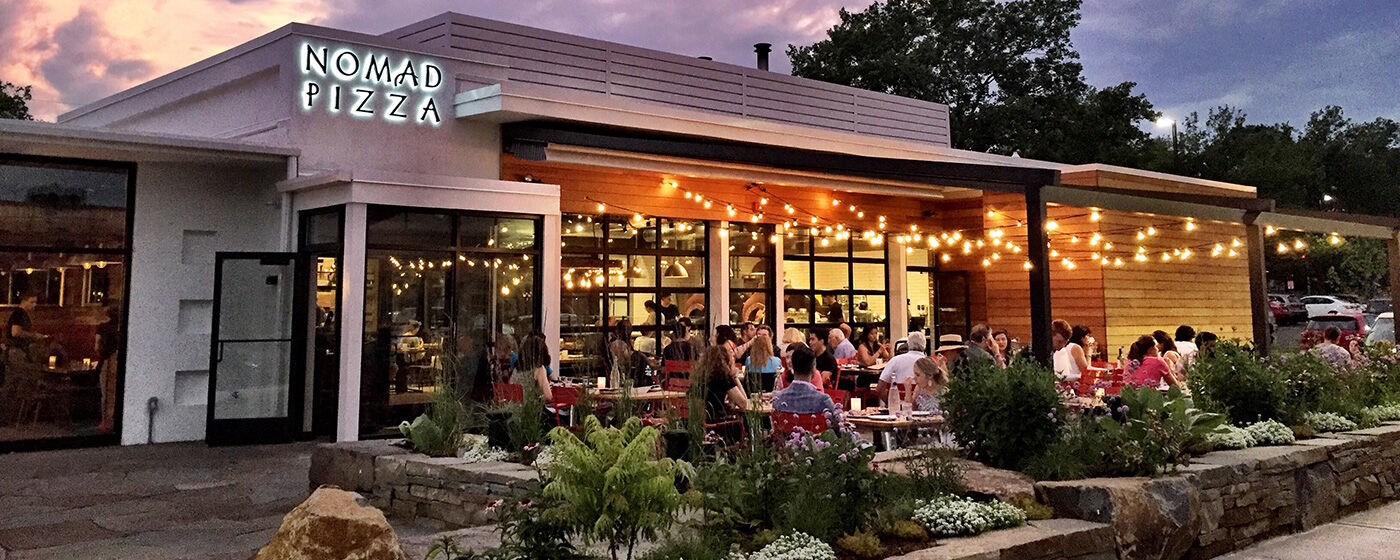
A 1930s-era gas station at Princeton Shopping Center was transformed into Nomad Pizza's Princeton location.,