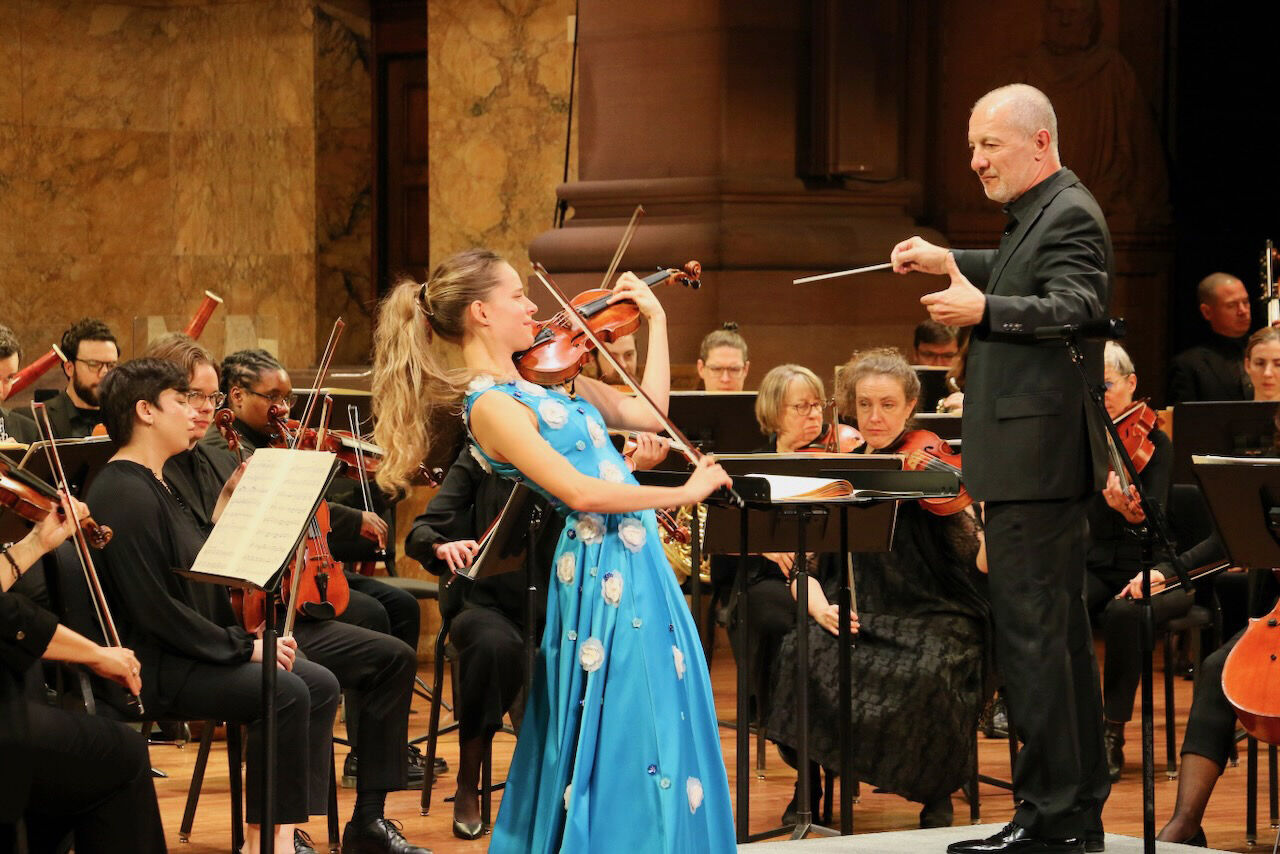
So nice, they asked her twice.
That is, violinist Aubree Oliverson played so beautifully with the Princeton Symphony Orchestra in 2024, the PSO invited her back to open the 2025-’26 season — a concert featuring Oliverson performing Antonin Dvorak’s Violin Concerto in A Minor.
Music director and conductor Rossen Milanov led the concerts this past weekend, which also featured “Orpheus’ Comet” by Dobrinka Tabakova, and Johannes Brahms’ Piano Quartet No. 1 in G Minor, orchestrated by Arnold Schoenberg.
It was a fascinating and varied evening of music. I had never heard of Bulgarian-British composer Tabakova (b. 1980) but was captivated by her 2017 piece, “Orpheus’ Comet.”
One of the influences of the composition is an ancient book partially about the lives of bees, and indeed Tabakova worked the sound of buzzing bees into the opening and throughout the piece.
Beginning in the horns and strings, we heard this vivacious droning, punctuated by unusual chords and percussion accents. This activity calmed and softened into a songlike passage. Then, flute and clarinet solos hovered above the subdued buzzing, as the tempo rose and brasses joined in. Just at the end, Tabakova inserted her homage to the opening of Claudio Monteverdi’s opera “L’Orfeo.”
Oliverson then took the stage, in a long flowing dress in regal shades of purple. She spoke briefly about how Dvorak, a Czech composer, made his people proud by incorporating rhythms and tonalities of folk music from Moravia and his native region of Bohemia.
We heard numerous references to the melodies and moods of this part of the world right from the start in the violin’s romantic, expressive lines. Technically superb, Oliverson explored the entire range of her instrument with perfect intonation.
She said in her introduction that she feels this entire piece in her bones, and you could tell from her posture and facial expressions, even leaning into the violin tenderly at times, as though she and her instrument were whispering to each other.
The solo violin was in lively conversation with the flute — gorgeous work by Sooyun Kim — and traded a few phrases with the French horns as well.
The orchestra played with vigor and precision, laser focused, as the Dvorak closed with the third movement, Allegro Giocoso (“fast and playful”).
This pastoral and folksy segment of the composition bursts with joy, and Oliverson smiled as she played the opening passages, swaying to the Bohemian rhythms.
The piece swung into a gigue-like danceable passage, as the full orchestra joined in, the volume rose and we heard the opening melody again. Oliverson played the final moments of the concerto (such a fast tempo) with great control, but also great delight. The nimble PSO was right there with her the whole time.
Enthusiastic applause followed, and the audience wouldn’t let her leave quite yet. Oliverson returned to perform the classic song “Autumn Leaves.” The arrangement, by Olivia Marckx, was a combination of impressionism and a touch of Stephane Grapelli-style jazz, and she played it brilliantly.
In 1937 Schoenberg took Brahms’ Piano Quartet in G Minor (the chamber work of piano, violin, viola, and cello) adding modern colors to it, as well as utilizing several instruments that Brahms would not have known — e-flat clarinet, bass clarinet, contrabassoon, and xylophone.
As soon as the PSO launched into this significant work, you could hear the blend of Brahms’ romantic gusto with Schoenberg’s vivid tonal imagination. The full orchestra, especially the lower brasses, powered the first movement.
The Intermezzo backed off the volume a little and allowed clarinetist Nuno Antunes to shine with his spirited playing. A lovely English horn entered, with the melody passing through the flute, clarinet, oboe, bassoon, and bass clarinet. The winds in particular made this movement lighter in feel than the first.
Schoenberg’s arrangement and the modern instruments made the third movement bright and upbeat. Solo bassoon, e-flat clarinet, and sprightly xylophone brought a sense of whimsy, which shifted into grandeur as the full brass section entered.
Finally the fourth movement, Rondo alla zingarese, evoked energetic Romani music, with the PSO’s strings and tuned percussion especially getting a workout. There was an interesting mix of meters, a pause, a slower passage, then back to the high-speed tempo.
Sparkling sounds in the winds and percussion led to another virtuosic clarinet solo, then a dazzling conversation between the first violin, viola and cello. The PSO concluded the Brahms/Schoenberg with virtuosity and flair.
The Princeton Symphony Orchestra’s next concert the weekend of November 8-9 features music by Rossini and Mendelssohn. Pianist Maxim Lando performs Tchaikovsky’s Piano Concerto No. 2. 609-497-0020 or www.princetonsymphony.org.