Mel Leipzig, the renowned painter and educator who brought humanity and color to generations of students and art lovers from his adopted hometown of Trenton, died in his sleep Nov. 1 at age 90.
The Brooklyn-born artist, whose realist portraits of family, students and fellow artists captured the quiet poetry of daily life, passed away at Carnegie Assisted Living in Princeton, his daughter said.
His death came 18 years to the day after that of his wife, Mary Jo Leipzig, who died Nov. 1, 2007 at 68.
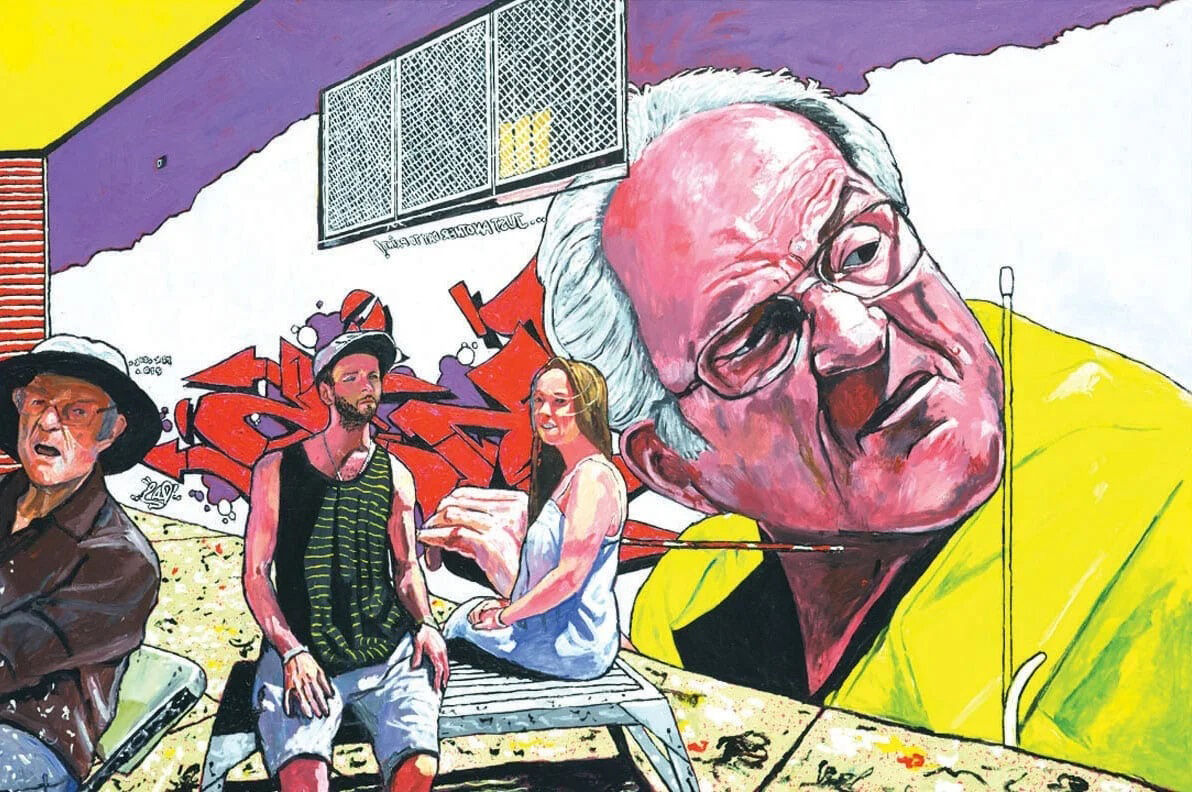
For more than half a century, Leipzig chronicled the world around him through paintings that were at once intimate and monumental.
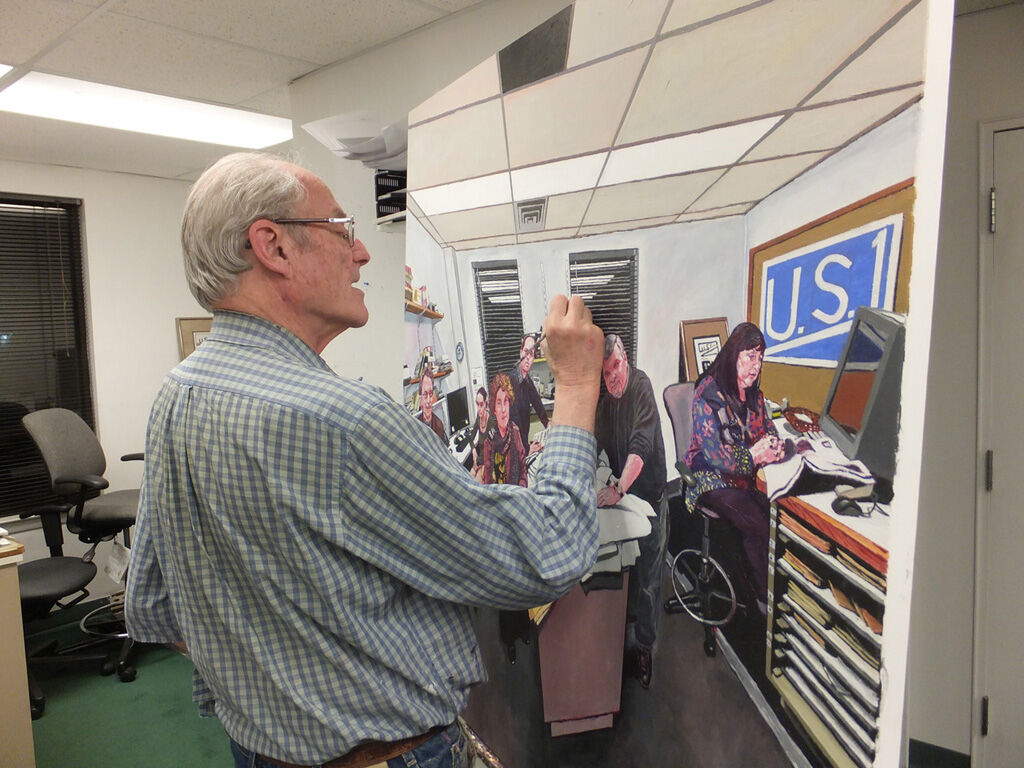
His work often depicted friends, colleagues and students surrounded by the environments that defined them — classrooms cluttered with art supplies, homes filled with books and memories, offices lined with mementos and the traces of work.
His approach, which he described as “designing with reality,” rejected photographic shortcuts in favor of direct observation. Leipzig never painted from photos, believing that doing so “would dilute the intensity of feeling” he sought.
Instead, he worked in real time, often over weeks or months, visiting his subjects’ homes, studios, and workplaces with paints, brushes, and canvases packed in the back of his car.
“Everything is paintable,” he once said. “The real world is visually exciting.”
Leipzig’s subjects included his wife, Mary Jo; their children, Francesca and Joshua; his students at Mercer County Community College; and many of those who defined central New Jersey’s creative landscape.
His portraits of the architect Michael Graves, photographer Lou Draper, and numerous Trenton artists exemplied his belief that environment reveals character as surely as facial expression does.
Leipzig’s impact extended far beyond his canvases.
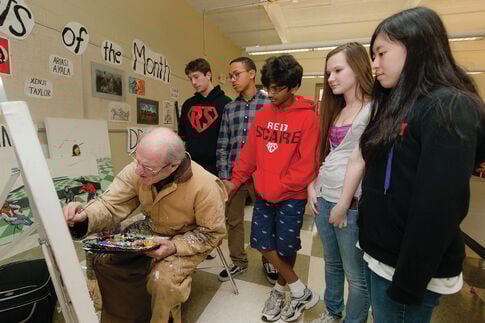
For 45 years, from 1968 until his retirement in 2013, he taught painting and art history at Mercer County Community College, where he became a cornerstone of the visual-arts department and a mentor to thousands of students.
Leipzig’s students often spoke of his intensity, generosity, and insistence that they find their own artistic voices. His former students went on to teach, exhibit and shape art communities across the region, many returning to honor him in exhibitions like “Generation Mel” at Mercer County Community College.
His influence helped sustain Trenton’s artistic ecosystem long after his classroom days ended.
Born in 1935, Leipzig grew up in Brooklyn and knew from an early age he would be an artist. At 13, classmates gave him his first set of oil paints for his Bar Mitzvah, and he never looked back.
He studied at the Cooper Union School of Art, earned a BFA from Yale, and completed an MFA at Pratt Institute, where he developed the realist style that became his signature.
He later received a Fulbright Grant to study in Paris, though he described that year as a time of artistic struggle, often destroying his own unfinished works.
It was not until the early 1970s, back in the United States, that Leipzig found his footing.
His painting Reading the Newspaper — the first of his domestic realist scenes — marked a turning point. From then on, he pursued realism with unwavering devotion, eventually completing more than 600 paintings over his lifetime.
When Leipzig and Mary Jo moved to Trenton in 1968, he embraced the city as his muse. Their home in the Glen Afton neighborhood became both a family hub and a recurring backdrop in his work.
He also immersed himself in civic arts initiatives, founding the Trenton Artists Workshop Association (TAWA) in 1979.
In a memoir written for TAWA’s 45th anniversary in 2023, Leipzig credited two women — Dr. Mary Howard and Latta Patterson — with first conceiving of the organization.
With the help of colleagues and students, including Mary Yess, he helped build TAWA into one of New Jersey’s most vibrant artist collectives, hosting exhibitions at the Trenton City Museum and other venues.
TAWA became known for ambitious projects such as the 1981 “Eyes on Trenton” festival, a 50-event citywide celebration that included visual art, theater, dance, poetry, and music.
The effort drew praise from The New York Times and united artists across the region. “There was great enthusiasm and good newspaper coverage for these shows,” Leipzig recalled.
He also helped coordinate the 1989-90 TAWA-Soviet Exchange, sending New Jersey artists to Moscow and welcoming Soviet artists to Trenton — a cultural bridge that reflected Leipzig’s belief in art’s power to connect people.
Leipzig’s paintings are held in major collections, including the Whitney Museum of American Art, the National Academy Museum, and the Cooper-Hewitt Museum in New York, as well as the New Jersey State Museum, Montclair Art Museum, Morris Museum, Zimmerli Museum, and Jersey City Museum.
His work has been exhibited in more than 40 solo shows, including retrospectives at the New Jersey State Museum and Rider University Art Gallery.
Even in his later years, Leipzig remained active, painting and lecturing into his 80s. Last month, the Trenton City Museum opened “A Community Celebrates an Icon: Mel Leipzig at 90,” a citywide series of exhibitions honoring his life’s work — a celebration that was still on display at the time of his death.
“Mel at 90” included “The Revival of Realism at Ellarslie,” curated by Joan Perkes, and related exhibitions across Trenton.
“This show takes us back to the beginning of Mel’s career and through his journey in form and color to his works of today,” Perkes said. “It reflects Mel’s integral place in art, in the community, and far beyond.”
Though widely respected in art circles, Leipzig remained unpretentious and deeply tied to his teaching roots. He limited his palette to just four colors — dark red, blue, yellow, and white — a restriction he said made his paintings “more abstract, while at the same time keeping the realistic depiction of people and objects.”
He worked in acrylics rather than oils, preferring their quick-drying nature and the discipline they demanded.
“Work is actually a high form of pleasure,” he said in a 2011 interview. “Being an artist and a teacher is very life-giving. People who are creative are very lucky.”
Among Leipzig’s close friends was arts writer and former U.S. 1 Arts & Entertainment editor Dan Aubrey, who described their bond as one built on mutual creativity.
“Mel and I are friends — yes, the present tense,” Aubrey said after Leipzig’s death. “Our friendship involved active engagement in creating art, creating opportunities for artists and communities, and helping people find their ways.”
Aubrey said Leipzig will be remembered not only for his artistic accomplishments and productivity but for his unwavering support of artists of all types — not just those who painted in the style he preferred.
Leipzig’s humanity defined his art. His portraits capture not idealized figures but people at work, at rest, surrounded by their personal worlds.
Critics often compared his approach to that of Manet, Vermeer, and Thomas Eakins, artists he admired for their ability to find truth in ordinary life.
He acknowledged his debt to teachers who inspired him — and to those whose rigidity pushed him to forge his own path. He once said it took years to “purge what some teachers who were so narrow-minded had said about painters.”
His eventual triumph was not just aesthetic but philosophical: a lifelong defense of painting as a form of seeing and feeling directly.
Leipzig’s death marks the end of an era for New Jersey’s arts community, but his presence endures — in museum galleries, in the classrooms of his former students, and in the neighborhoods of Trenton that shaped and sustained him.
He is survived by his daughter Francesca Leipzig Picone and her husband, Louis Picone; his son Joshua Leipzig and his wife, Martha Schultz Leipzig; grandchildren Vincent and Leonardo Picone, and Rayona, Zev, and Ami Leipzig; niece Nicole Sage and her daughter, Georgia Leipzig Kayes.
“A Community Celebrates an Icon: Mel Leipzig at 90,” continues at the Trenton City Museum at Ellarslie through Jan. 4, 2026.
As Leipzig once reflected, “Work can help you get through a lot of heartache and troubling times. Being an artist and a teacher is very life-giving.”