Here in Burlington County, we have an illustrious history. But it is undoubtedly our Revolutionary War history that sets us apart from other places.
The people of Burlington County have always sent men and material off to war. But the American Revolution actually happened right here. While many of the stories have been largely ignored, there can be no doubt that what happened here during the revolution was consequential.
If New Jersey is the crossroads of the American Revolution, then Northern Burlington County is truly at the intersection of that crossroads.
In December 1776, the American army suffered a series of defeats in New York. Washington’s decimated army marched across New Jersey, and crossed the Delaware River into Pennsylvania, leaving the country open to pillage and plunder.
The British army was content to go into winter quarters and wait until spring before moving on to capture the rebel capital of Philadelphia. But that meant the British army would be occupying northern Burlington County, not simply ravaging the countryside before moving on. If the British were going to stay, they had to find a way to sustain themselves in a hostile country.
Gen. William Howe was in charge of the army, and had some interesting thoughts on the disposition of his troops in New Jersey. In December he wrote back to London: “… the chain I own is rather too extensive, but trusting to the general submission of the country to the southward of this chain, and to the strength of the corps placed in the advanced posts, I conclude the troops will be in perfect security.”
The general submission of the country to the south he was referring to was Burlington County. The reason he deemed the country submissive is because of the large Quaker population of Burlington County. While some Quakers took up arms against the British, many did not, and that is what Gen. Howe was counting on.
The second part of his quote is maybe more telling than the first part. The corps placed in the advanced posts were the dreaded Hessians. The Hessians were professional soldiers from Germany who were grizzled veterans of European conflicts. Along with them was the 42nd Scottish Regiment of Foot. They were commanded by Count Colonel Carl von Donop.
Col. von Donop was a nobleman from Hesse-Cassel in central Germany. Before German unification in 1871, Germany was made up of individual kingdoms, and Hesse-Cassel was one of them. Col. von Donop was in over all command of the Hessian troops in the forward positions.
On Dec. 14, he left Colonel Johaan Rall in charge of Trenton and moved his headquarters to Bordentown, where he hoped to find lodging for his army. Trenton was large enough for the 1,400 men under Rall, but Bordentown was not large enough for the 2,000 men under Donop. So, Donop’s men moved into the countryside and quartered themselves on the poor farms of Burlington County.
In a letter to Col. von Donop from Gen. Howe, dated Dec. 13, Donop is ordered to take a census of all the farmers in the region. Gen. Howe states in his letter:
“Any quantity of Salt provision or flour, exceeding what may be thought necessary for the use of a private family is to be considered as a Rebel Store, be seized for the Crown and issued to the Troops as a saving to the public.”
Many people ask, where exactly were the Hessians in December 1776. The simple answer is: everywhere. A spy reporting to Col. Reed in Bristol states:
“In Burlington County he found them scattered thro all the Farmers Houses, 8, 10, 12 & 15 in a House & rambling over the whole Country.”
So, it would seem there were so many Hessians, in so many places, that it was truly an occupation of American farms and villages by a foreign army. Col. von Donop gives us an idea of what the conditions were like for his men in those cold days of December. He states in a letter to Gen. Grant:
“As the houses here are built very poorly and as the greater part of the inhabitants have carried away their beds it will be necessary for the men to lie on straw beds upon the ground, otherwise they will perish with the cold.”
The ensuing weeks would see a reversal of fortunes for both armies. After the battles of Petticoat Bridge and Iron Works Hill, the Hessians eventually evacuated northern Burlington County. However, the material remains generated by an occupying army are still out there. Many artifacts from that desperate time in history have been found, but much still remains. So, the next time you are doing work around the house or planting a backyard garden, keep an eye out for those historic treasures that make Burlington County a special place to live.
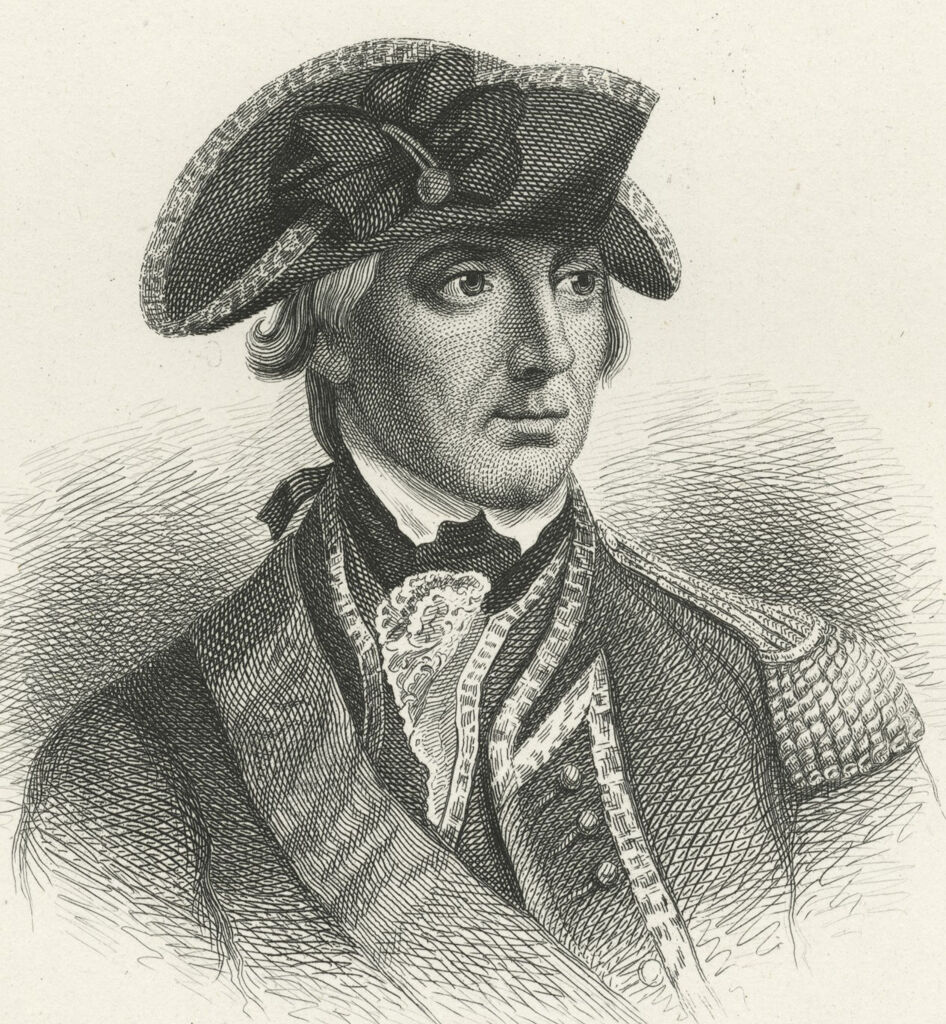
Gen. William Howe. (Engraving by Henry Bryan Hall.),

