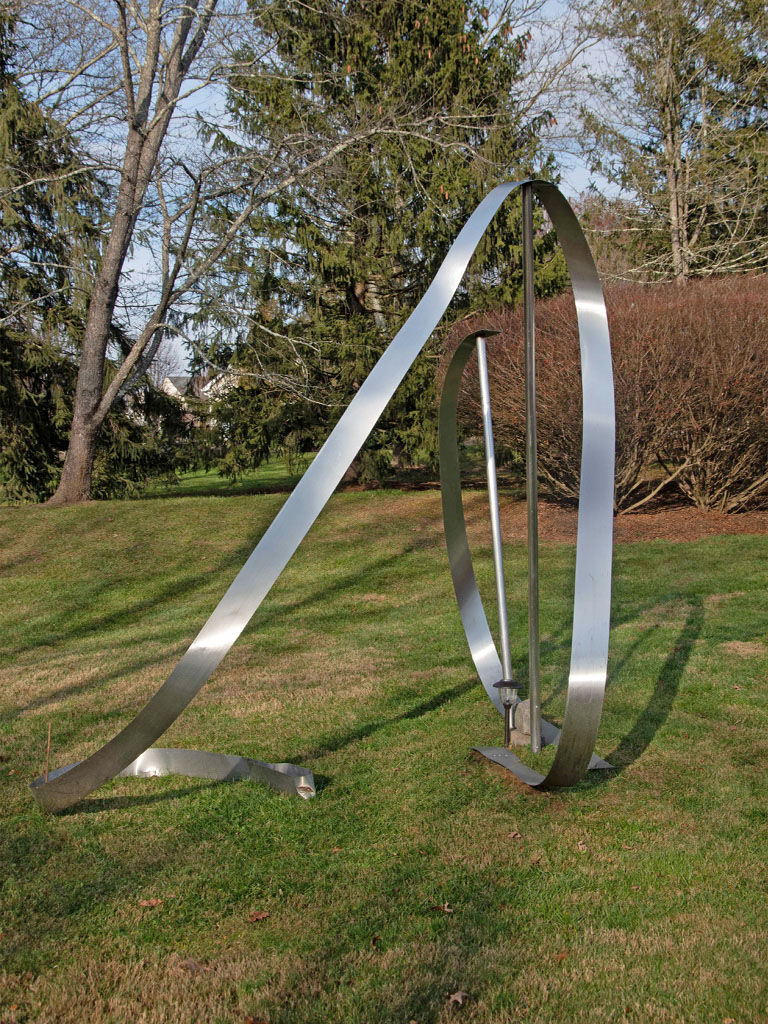
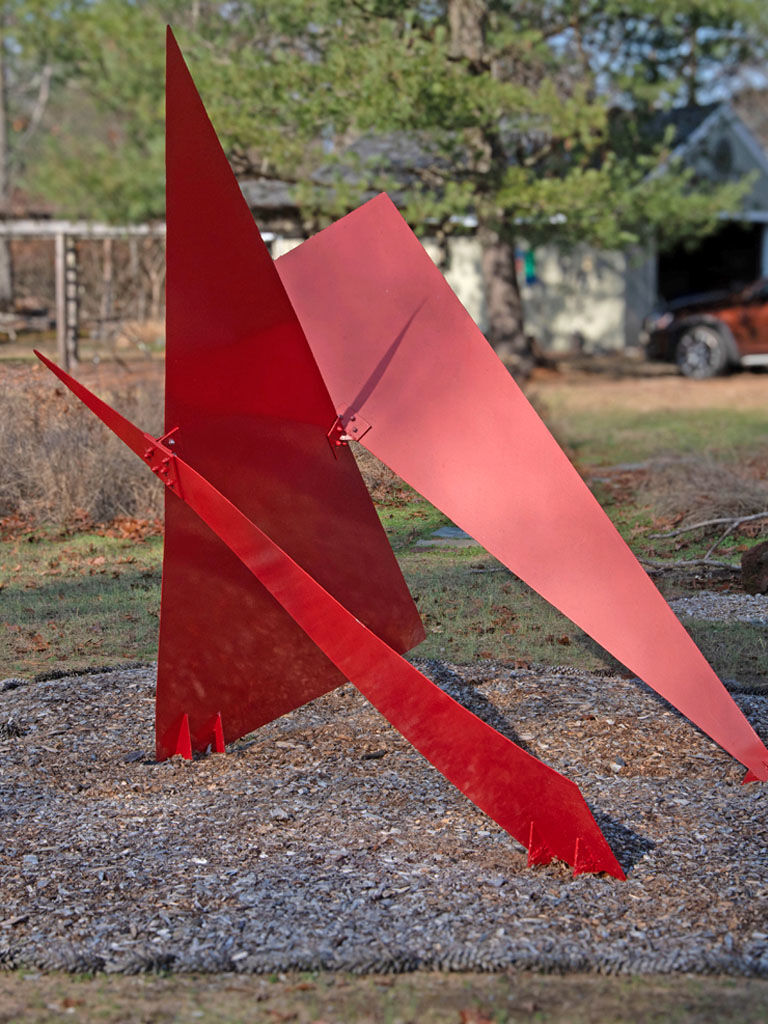
Dramatic changes in our built environment, like the construction of the new West Windsor Transit Village, can be potentially dangerous to vulnerable artistic work on the property. Two years ago, Plainsboro social worker Yvonne De Carolis noticed a chain link fence going up around three familiar sculptures that had stood for years in front of the Constitution Bank and Rush Holt’s former office on Washington Road. For her, this was a sign of their potential vulnerability, and she took action.
Her first step was to contact the tax office to get the name and address of the property’s owner. With the business’s name in hand, she drove to a substantial building on Alexander Road, but alas she did not see the name on the directory, and the security guard was unable to identify the business.
In the nick of time, Steve Goldin stepped out of the elevator, looked at the name, and said, “Yes, that’s my company, and I just sold the property to Avalon Bay. If I had met you a week ago, I would have given you those sculptures.”
Goldin called Avalon Bay for her, and De Carolis got a call from their representative the next day asking if she was “the sculpture lady”? When De Carolis identified herself as “the woman who would like to rescue these sculptures if they are going to be demolished,” he told her that his company had contacted the West Windsor Arts Council, which had rejected the sculptures for want of a place to install them. Then he said to De Carolis: “If you can remove these by end of the week, they are yours.”
The Avalon Bay representative later got back to her with the name of the sculptor, Ellen Rebarber of Highland Park, who was happy that her work had found a good home. When De Carolis gave Rebarber a call to thank her and let her know her intentions for restoring the sculptures, “She was over the moon happy that I was rescuing these things,” recalls De Carolis. “She is an absolutely amazing artist and the most warm, joyful, welcoming person. I adore being with her.”
Needing a truck to move the sculptures, and fast, De Carolis called her beekeeper, Curtis Crowell, of Bountiful Bees of Broad Street, and together they accomplished the task under the deadline.
De Carolis then set out to restore the three sculptures to Rebarber’s “original image.” It took her two months to repaint the badly rusted red sculpture, but she knew that she would need help with one of the sculptures, which had been seriously damaged in a car accident. She found Mike Benevenia, not only a sculptor but also a certified welder, via a query she had made at an Artworks event in Trenton.
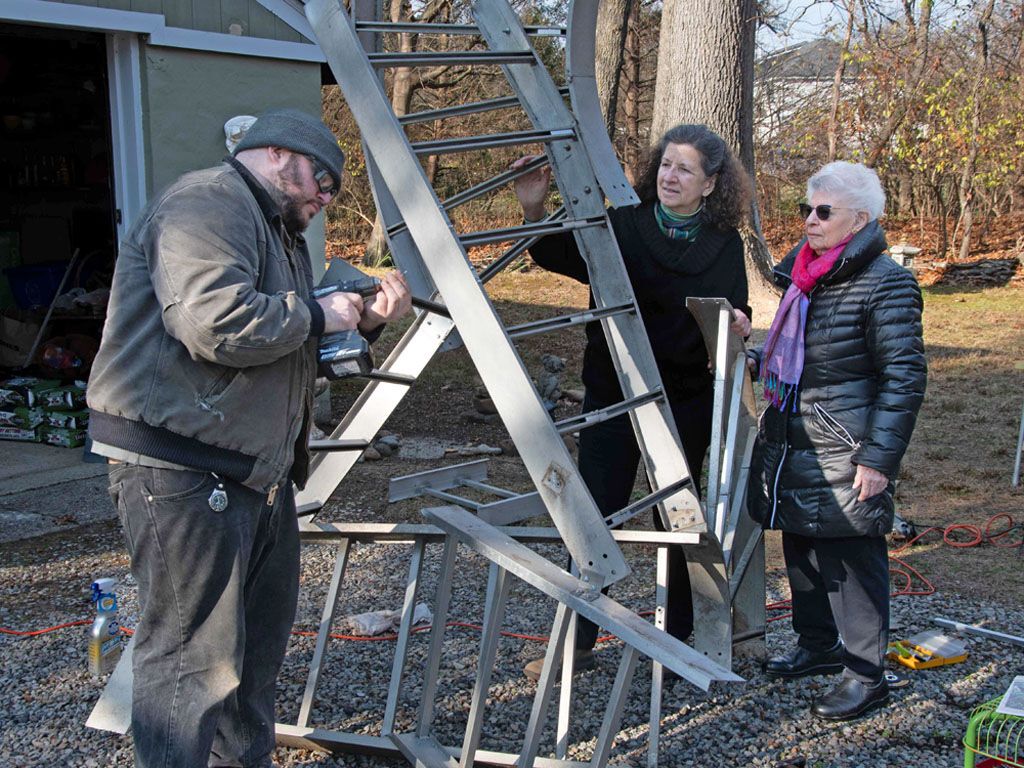
On warmish December day, De Carolis, Rebarber, and Benevenia met in front of De Carolis’s garage at 73 Grovers Mill Road and collaborated to breathe new life into the damaged piece. Its main ladderlike structure, sliced in two by the colliding car, had already been repaired, but a pile of smaller, some twisted, pieces remained to be reconnected; however, even with the help of two photographs “it was hard to figure out what went where,” Benevenia says.
It was the first time that De Carolis, Rebarber, and Benevenia had all worked together, but they did so in an aesthetic synchronization, birthing a new sculpture, slightly different from the original. “We worked in such unison with each other,” De Carolis says. “When we knew we couldn’t totally get it to where it was, we were able to brainstorm together so quickly and fluidly that I could see the process of creativity.”
Rebarber’s presence that afternoon was important. “It was great to have her there — not to get it exactly like it was but to have her reconfigure her original idea,” Benevenia says. “When just Yvonne and I were trying to do it, we were both unsure where the boundary was, where we were doing too much of our own ideas. It was good to have the artist there to have the last say.”
For De Carolis the redemption of these artistic pieces meshes with the holistic vision through which she views her property ownership, her life, and her therapy work. For example, as she sees it, her land along the Millstone River is not hers, but a place of beauty that she hopes to leave to the public when she is gone, and she is working with Linda Meade of D&R Greenway on how to do that. For her, these acres, whose natural beauty she is always enhancing with artistic touches, demand that she respect their history and earlier inhabitants.
“When I bought this house, I never felt like I owned it,” she says. “I felt like I was here for a reason. I’m not here to own this, but I’m here to do something; I wanted to preserve it.”
When the overgrown woods at the back of her land prevented her from exploring the entire property, she cleared paths through the woods that are lined with layers of intertwined fallen branches. She decorates them with cairns of beautiful stones from the property and items that give meaning to different areas. Blue wind chimes pay homage to her dad, a jazz musician, who formed “The Indigos” jazz band at East Brunswick High School.
“The trails are my art,” De Carolis says. “I tune myself with the trees, where they would like to take me. I don’t knock anything down, but I may remove anything invasive. I want to showcase the trees.” The trails, she adds, “became a mission to share it with people, not just me.”
Not only does De Carolis’s vision for the land encompass future visitors to her property, but also demands that she engage with its human history, revealed to her by artifacts like farm machinery, stones, building foundations, and grapevines—as well as by some more unexpected signs of human habitation.
She learned from a former occupant of her property that part of her current house was once a speakeasy, moved from its original setting near the Millstone River. De Carolis herself discovered a historic grave and later found a possible connection between that and the speakeasy. Noticing something white with an interesting shape near her garage, she investigated and found the fallen headstone of “Little Anna, daughter of Richard and Lucretia Crater, died Sep. 7, 1856, aged 1 year and 1 mos.” Later she learned that Little Anna’s father was a keeper of Jack, an alcoholic beverage — and she wondered whether that might in some way have connected to the speakeasy.
Curious about possible Native American use of the land, De Carolis invited archeologist Michael Stewart, emeritus professor at Temple University, about a decade ago to bring his students to dig on the property. Although he was unable to make definitive claims about who had lived there, his team did find flakes of materials from the production and maintenance of stone tools as well as a fragment of a soapstone bowl, suggesting nomadic hunter gatherers in prehistoric times.
De Carolis was born at Princeton Hospital, spent her earlier childhood in Hopewell, and then moved to East Brunswick, where she attended middle and high school. Her father, a Buffalo native, formed his own big band orchestra at age 13 and had planned a career as a musician. After losing his leg at age 18 during World War II, he switched to music therapy and music education.
Her mother’s creativity leaned more toward designing inside spaces and creating affordable, yet smart outfits for her customers at Loehmann’s department store.
The arts have always played a role in De Carolis’s life, starting as a youngster with needlepoint and drawing, then crafts, and finally to sculpture, which she pursued at Marshall University in Huntington, West Virginia. But, she says, “I realized that as much as I loved the arts, I knew arts weren’t going to sustain me financially.”
She decided on social work, inspired by two volunteer gigs, one doing art therapy with Vietnam veterans and another working with coal-mining families. In her junior year she transferred to Newark State, now Kean University, where she did a double major in social work and fine arts and a minor in English, and she got teaching certification for both English and art education.
After graduating, she spent nearly a decade doing counseling in private centers, eventually earning a master’s in social work in a one-year advanced standing program at Rutgers University.
Subsequently, De Carolis held a variety of positions, as director of residence life at Westminster Choir College, as a psychotherapist for a family counseling service, and as a school counselor at Princeton Day School. But her work at Trenton High School — from 1992 to 1996 under a state grant to the Institute for the Family to provide family counseling to students and their families — stands out as reflecting the intertwining of values so important in her personal and work life.
She brought to her student clients an approach she had developed with her therapy clients. “I consider what I do feng shui of the mind,” she explains, meaning that she works with her clients to create calm, support, and peace in their lives.
She would encourage her students to pursue whatever they liked to do, often music, art, or poetry. “They wrote poems and stories, created drawings, and I was overwhelmed by the talent that was there that they didn’t even realize,” she says. “I helped them nurture that talent to give them pride and self-confidence to help them work on other issues in their lives.”
”My passion is for bringing beauty into the world and beauty into the lives of each individual, and for them to see in themselves the beauty that I see in them,” DeCarolis says.
Today she has a private practice doing individual, couples, and family therapy.
Ellen Rebarber grew up on a chicken farm in Piscataway. Her earliest efforts in sculpture were at age 5 or 6 when she used clay she dug out from the Raritan River’s banks to make little pots for her dog and cat. But art classes did not come until much later. After graduating from New Brunswick High School and, in 1953, Newark State Teachers College, she taught elementary school for three years in Highland Park, New Jersey, raised her kids, and then taught again for 32 more years.
Her first art classes came about via a suggestion from her mother. One day her mom rang her doorbell and found a weeping daughter, completely frustrated by staying home with her sick children in the middle of winter. Her mother insisted that she sign up for a weekly class and offered to babysit for her grandchildren.
For a decade Rebarber studied at the Y in Highland Park with American painter and sculptor George Segal. “He taught me how to see,” she recalls.
After she retired in 1998, Rebarber knew that she wanted to learn to make three-dimensional large sculpture. First, she audited a class at Middlesex County Community College, but after two years topped out and moved on to the Mason Gross School of the Arts at Rutgers. Rudolph Serra, her first teacher, taught her to use both wood and metal; the students would first create small models and he would push them to make the final version “really big.”
And indeed that’s what Rebarber did: “I remember being on a 15-foot ladder, welding. That was the best time of my life.” It was in Serra’s class that she created the three sculptures that De Carolis saved; they were initially displayed in her front yard in Highland Park.
One day the developer of a property in Princeton Junction rang her doorbell and said to her, “I like your sculptures — did your husband make them?” When she said they were hers, he asked how much she would sell them for. She consulted with Serra, who suggested a substantial price, and ended up quite satisfied to get nearly 90 percent of her asking price.
Benevenia, a sculptor and certified structural welder who works at the Johnson Atelier, came to art through his father — a surgeon and artist who learned welding and taught his son to weld at age 14. Benevenia has both a bachelor’s and master’s degree in fine arts.
When Baltimore was locked down in 2015 after Freddie Gray was killed by police, Benevenia happened to visit the National Museum of Civil War Medicine in Frederick, Maryland, where he was particularly moved by the prosthetic arms and legs. He began thinking about the present repercussions of the Civil War and what is still missing from our country, and he started to create sculpture inspired by those ideas.
He and Megan Uhaze Wear, both from the Johnson Atelier, went to see the three sculptures after they got word that De Carolis was looking for a sculptor to help her out. “Seeing the sculpture made out of kind of surrogate ladders intrigued me,” Benevenia says. He also felt drawn to the project after learning that Yvonne’s father had lost his leg in the war.
As for Rebarber, she couldn’t be happier with her sculptures’ new home, as well as her budding friendship with De Carolis. “She rejuvenated the sculptures and they look so amazing! I am so proud to have my sculptures there with Yvonne, where they have a new life!”