Thirty years ago, in the summer of 1993, Anne Brener received an urgent phone call from Nancy Beck. Beck, a board member of the Princeton Adult School (PAS), told Brener that the school’s part-time administrator had just left and someone was needed to fill in the slot.
Brener, a Princeton resident who had served on numerous nonprofit boards but never in an administrative position, asked what would be required. “Well for now,” Brener recalls Beck telling her, “You’ll need to check the mail three times a week and don’t worry about anything until September.” Brener took the job.
That September 86 courses were offered, and registration was primarily done by the volunteer board. There was no office computer to ease the work involved in recording and sorting the approximately 1,000 paper slips coming in through the mail. That’s where the newly created administrative position originally came in. It had proved its worth the year before Brener came on board, and under her leadership as executive director has become crucial to the organization’s expanded and modernized existence.
As Brener sharpened her administrative skills, she came to deeply appreciate and to be thankful that she was involved with the school and its board. It is the PAS board, she emphatically states in giving credit where she thinks it due, that sets this nonprofit apart from all other organizations. She calls it the academy award of boards. The 36 volunteer members not only create courses but also seek out and convince experts to teach them. This current academic year, the Princeton Adult School is offering almost 300 courses to about 5,000 students. It is larger than many a small college and much larger than Princeton High School in terms of students and courses — but definitely not in terms of the four part-time, paid administrative staff.
Brener cannot help exclaiming over the uniqueness that applies to this community resource. She notes that there are probably no more than two other such independent entities in New Jersey. Those communities that do offer adult education — and fewer do so with each passing year — are generally under the aegis of local boards of education. And, Brener firmly believes, no other volunteer organization boasts members who have the connections and willingness to donate both expertise and time to create such a multitude of offerings.
That volunteer, independent concept goes back to the founding of PAS. As described on the organization’s website: “In January 1939, two local women, Ruth Schleifer and Laura Peskin, took their hopes for a ‘leisure hour school’ from idea to reality. With the support and encouragement of B. Woodhull Davis, Supervising Principal of the Princeton Public Schools, Harold Dodds, President of Princeton University and John Mackay, President of the Princeton Theological Seminary, Princeton Adult School was born. Its purpose as stated in the by-laws, was ‘…to offer each year to the adult residents of the Princeton area — regardless of race, color, creed, place of national origin, or sex — a variety of educational courses for their benefit and enjoyment.’”
The website continues: “On January 16, 1939 — the first evening of classes — 500 people had registered for the 20 classes offered on Tuesday nights in the public school. Difficult economic times and a world on the brink of war were reflected in the course offerings. The first lecture series was called ‘World Politics.’ Courses in literature, music, art, and French were joined by classes in boiler repair, dressmaking, typing, and modern homemaking.”
Courses in literature, music, art, and French remain offered to this day. Given the increasingly cosmopolitan nature of the Princeton area, language courses have expanded to include Chinese, German, Italian, Japanese, Russian, Spanish, and even sign language. A subject not even thought of in 1939 but now with the highest enrollment concentrates on English Language Learning (ELL). Eleven courses, from “Beginner Level” to “Advanced Conversation” are offered in what was formerly known as English as a Second Language (ESL).
Boiler repair is no longer featured in the catalogue, but “Wood Working,” “Digitizing Your Analog Files,” and “Introduction to Glassblowing” are. Modern homemaking appears under the guise of Food and Drink, where one can learn about beer tasting at the Ivy Inn, “Indian Vegetarian Cooking,” “Holiday Cookie Making,” or even join chefs from Blue Point Grill in making some of the most popular menu items at the restaurant.
The lecture series, now named in honor of the late Claire R. Jacobus, “a worker bee and former board president,” notes Brener, has been a component throughout the PAS history. Whereas the first lecture series dealt with world politics, the spring 2024 series covers another form of politics in that it highlights power and its destructive forms in our society and the world.
While the numbers of students and classes have steadily and smoothly expanded since the adult school first opened 85 years ago, COVID’s appearance resulted in a striking and permanent change. On March 4, 2020, New Jersey’s first confirmed COVID case was reported. The PAS board, having already started work on courses for fall 2020, quickly recognized that an innovative approach was needed to ensure the continuity of the school.
Enter Debbie Washington, director of operations. Four months after that first official COVID appearance, she had converted all courses — including those still being nailed down in June — into a Zoom format for the fall 2020 session. Thousands of students responded and so did the instructors. The response was so favorable that a significant portion of classes are now offered via this format. It has allowed PAS to greatly expand the geographical area of its reach for both students and instructors. While the bulk of the in-person classes remain at Princeton High School on Tuesday evenings, the virtual courses are held on many different days.
Lilianne Youssef has now joined the staff as office assistant to help those registering for and signing in to Zoom-based classes. And with funds coming in through registration and donations and going out for expenses such as security, insurance, rent, and instructor payments, Nicole Solarek handles the necessary accounting duties.
Some things, however, have remained constant over the decades. Brener still finds herself opening letters. Though about 90 percent of course registration is handled online, some students feel more comfortable using the paper form on the inside back page of the catalogue.
Under Brener‘s supervision, course catalogues are produced yearly — in both paper and digital formats. Thousands of printed copies of the Spring 2024 catalogue will soon be in the mail and sent to residents in Princeton and the greater Princeton area (about 30 percent of PAS students have come from outside Princeton over the past decades). The cover, highlighting the organization’s 85th anniversary, is designed by Sofia Schreiber, Princeton High School class of 2021. “We always try to get a PHS student, grad, or local teacher to create for us,” Brener notes.
The Spring 2024 catalogue goes online in conjunction with the paper mailing. Prospective students can view either one to select and then register for one or more classes offered this spring. Some classes fill up quickly, and there is a waitlist button on the website (but not available in the print format). Credit cards are only accepted for online registration.
For any further questions or assistance, call 609-683-1101. The exceedingly personable Brener would probably appreciate a break from opening paper registration forms.
Princeton Adult School, www.princetonadultschool.org.
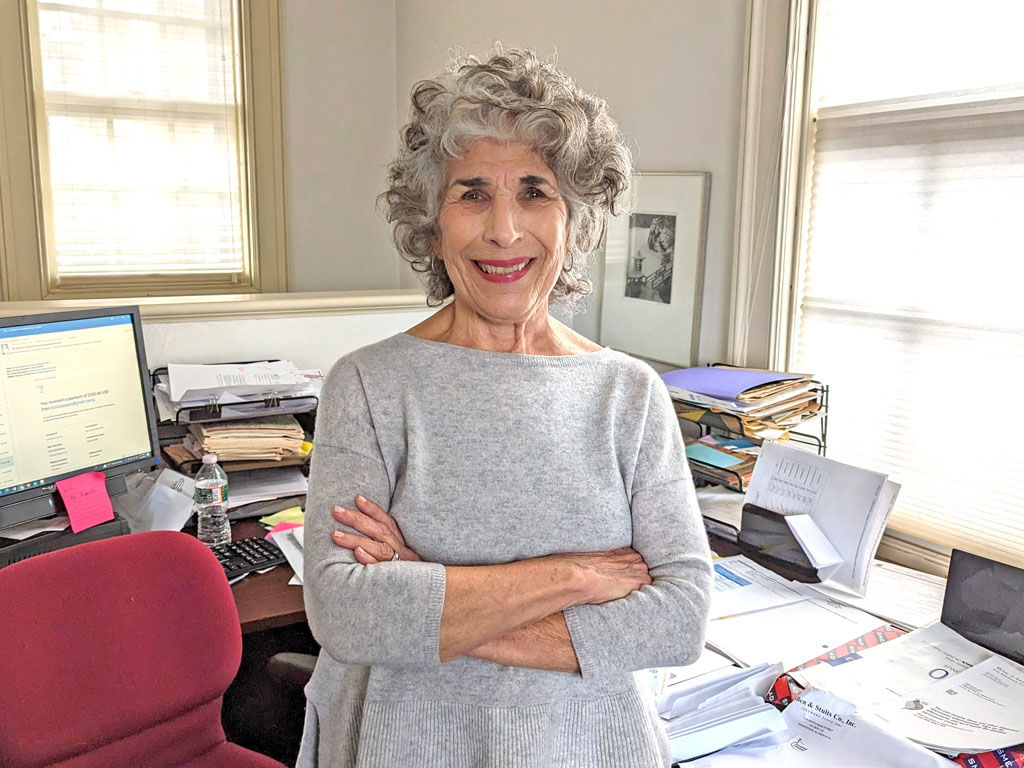
Anne Brener joined Princeton Adult School in 1983 as a part-time administrator and is now its executive director, preparing for the organization’s 2024 course offerings.,

