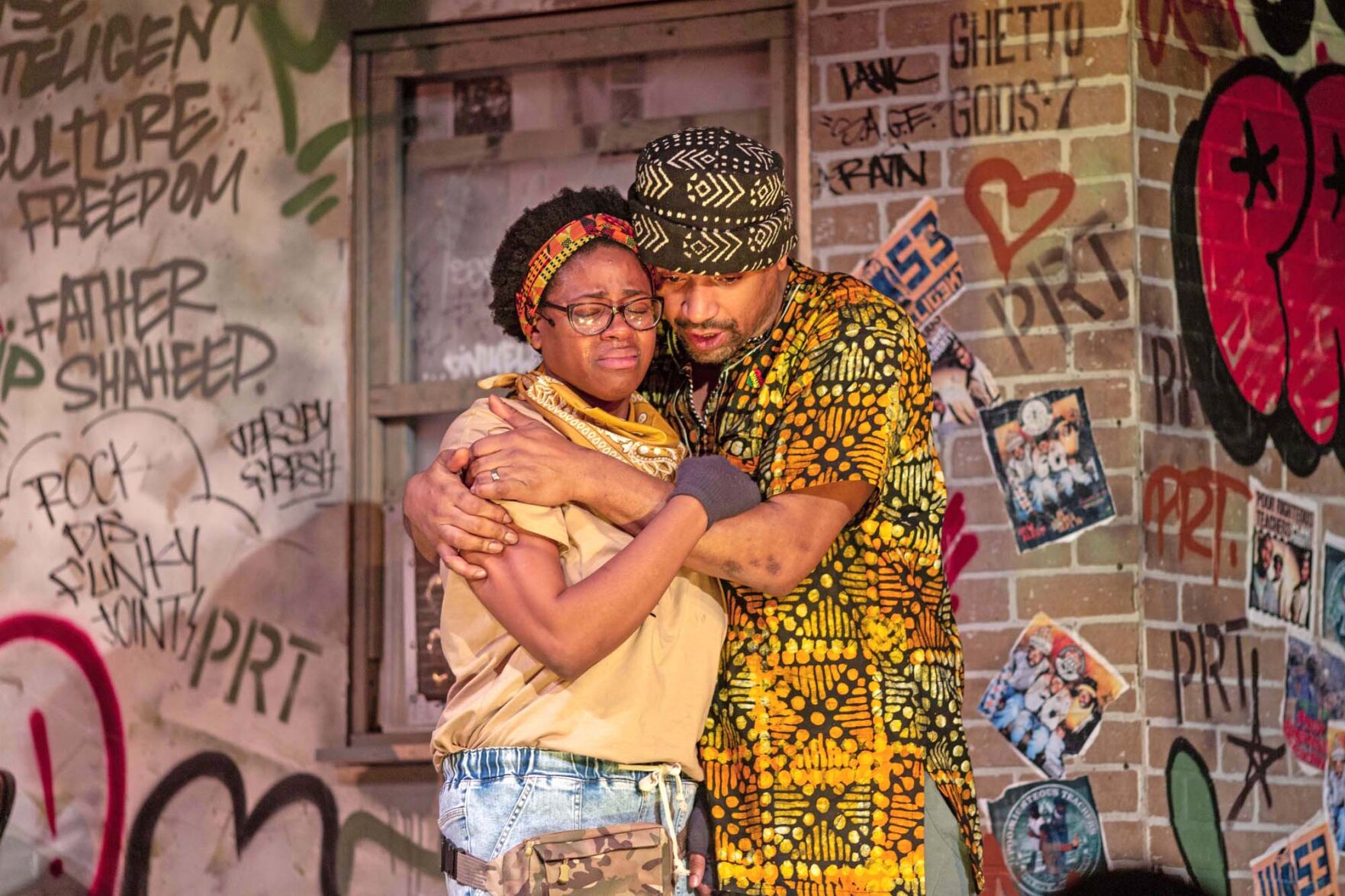
“Ghetto Gods in Divineland” is an ambitious play that imagines a future Trenton where conflict and unusual native vegetation might generate dramatic and lasting change.
The conflict comes in the form of a protest in response to a municipal public works plan that, as one leading character, Ameen (Davon Cochran) says, puts places and projects ahead of people. The vegetation, found in a massive sinkhole that has its own place in Richard Bradford and Anthony Martinez-Briggs’ thoughtful play, could have remarkable medicinal and energy-producing properties, as in providing and conducting electricity, that would, if harnessed and sustainable, supply the world with endless inexpensive energy.
Lofty romantic ideas abound in Bradford and Martinez-Briggs’ world premiere, at Trenton’s Passage Theatre through Sunday, February 25. So do raw, intense emotions. While “Ghetto Gods” offers several points worth considering, it sprawls too much to give any one of them commanding focus, takes for granted all will agree with all it conveys, and can be naïve or doctrinaire in turn as it conjures its vision and makes a case for what it regards as a righteous course.
Bradford and Martinez-Briggs keep things interesting. Sporadic lines catch your ear, some insights are provocative, and the central characters, a brother and sister who had been estranged but unite when faced with simultaneous family and natural catastrophes, each have appeal. There’s also a large dose of humor and irony. The trouble is that the authors want to impose a point of view instead of leading their audience to one. They get caught up in the social and political aspects of their play when they’re most successful when they concentrate on human dynamics and have us care about an individual affected by a large situation rather than the situation itself. “Ghetto Gods” may mirror Ameen’s complaint by putting philosophy ahead of people, in its case, its characters.
Director Ozzie Jones does a good job at keeping the production’s flow as coherent as he can. “Ghetto Gods” entertains and holds attention. Jones’ discipline is important because Bradford and Martinez-Briggs keeps adding new wrinkles to their story about a Trenton neighborhood called Divineland. The play would work better if some of those plot developments were smoothed, pared, or integrated more subtly.
“Ghetto Gods in Divineland” has several key elements that provide the structure and texture it has. One is the death of a matriarch who not only raised two unique children, one a scholar, one an activist, but kept all in her vicinity clean, fed, and educated. Her influence permeates the play in significant ways.
At the time the matriarch passes, a huge chunk of Divineland crumbles, causing a sinkhole that swallows some houses, damages others, and interrupts all power so people have no light or way to cook let alone run appliances or air conditioners. Worse, the crater is left to gape and disrupt with no remedial action forthcoming from Trenton officials.
The matriarch’s daughter, Gekiyla (Tasha Holmes), is a scientist who has traveled the world studying plants and foliage. Home from school at Philadelphia’s Temple University, she explores the sinkhole and finds unusual herbs and other vegetation growing there. She sends some of it to colleagues at Temple to have it analyzed. The results not only confirm the rarity of the sinkhole’s yield but suggest universally beneficial uses for it. One particular mushroom-like growth, called the Zion root, creates instant nutritional energy but, more amazing, gives off power that lights lamps and restores generators that peter out from rundown batteries or lack of current.
While the sinkhole festers in reality and the minds of the people who live by it, word comes via a radio program hosted by a man and woman who call themselves the Ghetto Gods (Alicia Thomas and Craig Storrod) that Trenton’s powers that be are going to renovate the famous “Trenton Makes The World Takes” bridge by attaching to it a roller coaster and diving boards via which people can take refreshing dips in the Delaware.
The colossal cost and outlandishness of the bridge project angers Ameen and spurs him to head a protest movement that involves residents of Divineland and others who object to the city’s plans occupying the bridge until officials at least come and talk to their project’s opponents. With the help of the Ghetto God deejays, word spreads about Ameen’s sit-in, which eventually arouses the attention of the police.
Filling in blanks about the late matriarch and her husband, also a powerful presence in Divineland, is Papi Shh (Carlo Campbell), who also speaks of the neighborhood’s history and how it spawned one of the first hip-hop groups to garner significant attention.
You can see how much Bradford, Martinez-Briggs, and Jones had to juggle. Some of the above threads have complete through lines, but others don’t. For instance, Papi Shh talks about how hip-hop and music in general influenced Divineland, but except for his mention of it, you don’t see why it matters.
Gekiyla makes a major discovery considering the audience sees the Zion root create energy, enough to make it glow and refresh a generator, but there’s no follow-through. Part of the inaction stems from Ameen refusing to listen to her, especially about the importance of a vegetable, and part comes from only Papi Shh having any comprehension about why Gekiyla might be excited. Meanwhile, if the Zion root does all it seems to do, it needs to go to Temple for study. It can revolutionize the way cold fusion would if could ever be stabilized and made economical to produce.
Ameen has a lot of right on his side. Stupidly renovating a bridge, and not fixing a sinkhole, is a slap to the Divineland community and does put places ahead of people. His protest is warranted, and Davon Cochran is powerfully articulate as Ameen makes his case. That case does overstate when Ameen addresses other protesters as comrades and posits his protest as a revolution.
All in Divineland have a lot to complain about and are probably right about them being poor precluding proper governmental attention. Some of the griping needs to be subtler and less bald.
One area in which “Ghetto Gods in Divineland” is strong is in Jones’ casting. Davon Cochran is giving his first professional performance in the play, yet his clarity and intensity would lead you to think he is a seasoned veteran. Cochran’s passion resonates as Ameen rallies protestors and explains why he is compelled to take action.
Tasha Holmes anchors “Ghetto Gods” as the inquisitive, intuitive Gekiyla, a woman obsessed, rightfully, with her science and who also speaks well about family ties and community needs.
Carlo Campbell lets you see Papi Shh as a character who knows and accepts his world. He is funny while providing perspective. Alicia Thomas and Craig Storrod do well as the Ghetto Gods and in myriad bit parts.
Marie Laster’s set is bleak but shows the philosophy of Divineland on graffitied walls and features a rather intricate steaming sinkhole. Sound designer Larry Fowler and lighting designer Alyssandra Docherly help us enjoy the hip-hop that is part of Divineland and the precarious power outages caused by the sinkhole. Tiffany Bacon’s costumes suit the characters while Melody Marshall does a fine job on props, especially the design and illumination of the Zion root.
Ghetto Gods in Divineland, Passage Theater, Mill Hill Play House, 205 East Front Street, Trenton. Through Sunday, February 25. Showtimes are 7:30 p.m. Thursday through Saturday and 3 p.m. Sunday. $33. www.passagetheatre.org or 609-392-0766.