To look toward the future, you may need to open your eyes to virtual reality.
Both “Future Presence” and “Scenario for a Past Future” exhibits focus on the advancing technology of VR and spatial audio, whether for an immersive orchestral concert or the latter’s digital exploration of the visual arts, to show how society might redefine itself at the convergence of creativity and computer-generated content.
Presented in partnership with Princeton University, the two immersive experiences — one ongoing, the other now past — usher in a new era that contemplates just how progress could challenge all of our known conventions of coloring on a blank canvas.
The Mahler Chamber Orchestra’s “Future Presence,” described as a “concert experience in virtual reality,” debuted in Princeton for its sold-out North American premiere in partnership with Princeton University Concerts’ “Performances Up Close” series from January 18 to 21 at the Woolworth Center on the Princeton University campus.
Founded in 1997, the Mahler Chamber Orchestra, or MCO, is an internationally acclaimed touring chamber orchestra whose organizational legacy surpasses conventions with its cutting-edge commitment to evolving technologies.
MCO embarked on this journey with 3D sound specialist Henrik Oppermann, now the orchestra’s artistic partner for immersive experiences, back in 2019. Together, they worked on a VR film project titled “Symphony,” a 360-degree video experience featuring conductor Gustavo Dudamel in partnership with the MCO, the “la Caixa” Foundation, and 41 young, global musicians from the Dudamel Foundation.
However, this was a “stationary” project, as Oppermann explains in an interview, in which the listener remained seated in a fixed position while the orchestra played around them. During development, Oppermann thought about how to incorporate physical audience movement into the digital space.
As the founder and director of the Berlin-based immersive audio production company Schallgeber, Oppermann’s interest in sound started with watching an uncle build his own speakers. He went on to study sound design and studio composition at Goldsmiths, University of London, before graduating with a master’s of music in creative practice.
Inspired by his earlier work with the MCO, Oppermann says the idea for “Future Presence” was born during the pandemic as a way to make use of the chamber musicians’ talents at a time when all the usual concerts and tours were canceled.
Oppermann shared the idea with MCO first violinist Timothy Summers, a member of the orchestra’s board with his own experience in electronic improvisation and music software. Summers, who attended Princeton’s Johnson Park Elementary School for a year while his father researched art history at the nearby Institute for Advanced Study, joined Opperman in the artistic direction of the project as it progressed from an experimental audio concept to a groundbreaking vision of what an interactive concert experience could be.
“Henrik made a prototype, and it was a shadow of what we have now, but it was very clear that it gave information that was not otherwise available about what we were doing, about what happens inside the music, and so it became clear that if we could give him sounds worth hearing, then he could make them sound good, and that really just grew organically,” Summers says.
Oppermann created an acoustic model of three-dimensional recordings that responded to a person’s position, successfully simulating how sound behaves in real life and allowing the audience to navigate the orchestra without affecting the performance.
Recordings for the three part-series — I, II, and III — then took place in order over a two-year period from 2020 to July 2022, funded with support from the Federal Government Commissioner for Culture and Media of Germany.
The first part of the approximately 45-minute trilogy is a string quintet performance of Mozart’s “Allegro from String Quintet in G Minor, K. 516,” followed by a 10-piece ensemble playing Charles Ives’ “The Unanswered Question.” The final piece graduates to the full orchestra with MCO’s rendition of Felix Mendelssohn’s “A Midsummer Night’s Dream, Op. 61.”
“Future Presence” has toured around Europe, but MCO chose Princeton as the site of its first American show after Summers discussed future programming with PUC director Marna Seltzer and outreach manager Dasha Koltunyuk backstage at an MCO concert at Carnegie Hall.
PUC is also working with professor and director of the 3D Audio and Applied Acoustics (3D3A) Lab, Edgar Choueiri, to further explore spatial hearing as it relates to the MCO project.
Oppermann says that he “couldn’t imagine” a better place to launch the series than Princeton, and he looks forward to the possibility of future collaborations, noting in particular how “special” of a venue he finds Alexander Hall’s Richardson Auditorium.
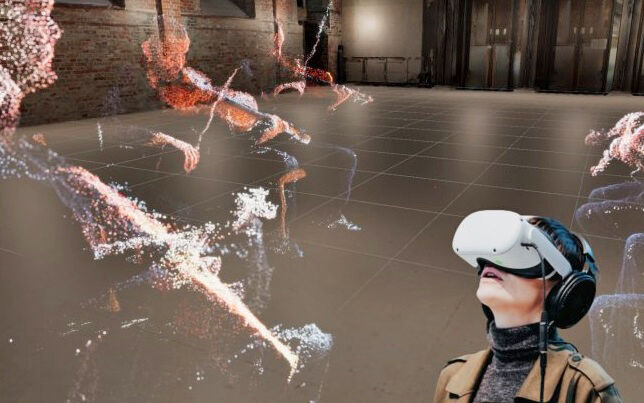
Time slots were available between 10 a.m. and 8 p.m. throughout the weekend, with tickets priced at $20 for adults and $10 for students and children 10 and older. Participants enter the first of two rooms, where they don the VR headset and earphones to watch as the performers materialize against a blue grid defining the space within the screen.
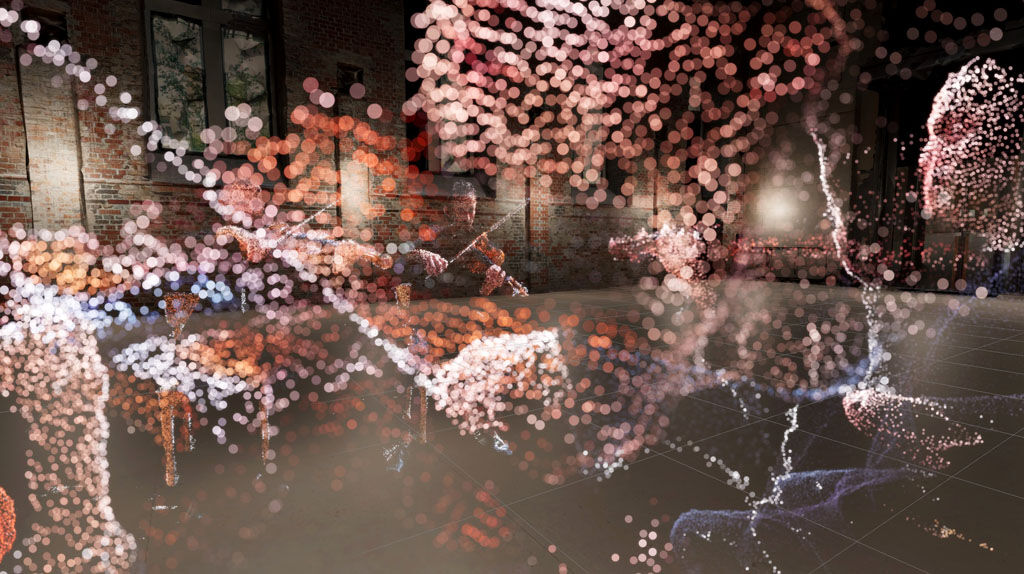
Oppermann’s favorite section, the quintet, is the most immediately striking of the three, given its introductory nature to the VR experience and remarkable closeness in simulating how awe-inspiring being surrounded by the talents of five people in their element might be.
According to Oppermann, another key aspect is that the musicians are not playing perfectly, which gives them a distinctly human quality in the artificial world. The intimacy of the performers, although intentionally bearing more of an abstract resemblance to them, feels as if they are playing right beside you — for you, even — with sound that seeps in from every angle.
The second recording, “The Unanswered Question,” takes a more unconventional approach, casting about half of the musicians onstage with significant distance from the viewer. One group flanks the right while a singular performer moves through an empty building, reminiscent of an industrial-looking warehouse, taking turns during the Ives piece.
Guests are escorted to a separate room large enough to accommodate multiple people for the grand finale with the full orchestra, while the technology provides on-screen visual warnings to alert attendees to the presence of others.
The ability to move within the orchestra while it simultaneously functions as a collective body of sound that captures every near-constant, individualized change in depth is a true marvel. Oppermann’s recommendation? Stick your head inside the upright bass for a deep, bellowing sound, or stand behind the French horns for a sensorial brass masterclass.
As a solo audience member, you know you are listening to pre-recorded performances, but each note adds an authenticity as unique as if you were just a fly on a nearby music stand. There are no boundaries, no social etiquette to worry about, and no fear of interrupting the musicians here — just a private concert in a three-dimensional virtual world that gives you permission to move about without inhibition.
The projected pieces flow through the headphones with a resonance that embraces the listener in stereo sound, traveling with them as they explore the effects of location in musical motion. Here, the audience can be as close to the performers and their instruments as possible, giving them an exclusive chance to engage in active, acoustic listening, complete with the nuances of a bow moving across strings or each musician’s measured breath.
Oppermann’s “personal pride” in the project is the use of distance modeling, which adapts to the listener’s position based on their proximity to a sound source. “Future Presence” utilizes a VR concept called “six degrees of freedom,” granting someone the ability to move rotationally and translationally in the 3D digital space.
While many would never even consider entering a performer’s personal space like that — both to avoid the social faux pas and because the stage provides an obvious degree of physical separation — this is the only chance the audience has to do so without consequence.
According to Oppermann, “a lot of people don’t want to get close because the musicians feel quite present, and sometimes they think they might be disturbing them, so they don’t want to disturb the performance, but it’s about actually getting the most [out] of it and really diving into the experience, and experience how that is to be part of an orchestra or part of a group of musicians playing together.”
Oppermann says that even the musicians who played in the recordings gain access to a different perspective with “Future Presence,” since they are able to recontextualize the piece as a listener who can hear sections other than their own.
This allows them to understand “the whole structure” of the orchestra, he adds, and gives them the opportunity to hear how each of the 50 performers plays a role in producing “the most complex body of sound that humanity has created.”
As someone who went through the surreal experience of witnessing himself play in VR, Summers says that “Future Presence” opens up “real opportunities for communication and understanding” between the MCO and audiences around the world.
“One thing that’s really nice about doing it with the whole orchestra, especially, is that you realize the extent to which everyone is listening in there, and that’s such an active thing to be able to show, where you have 50 people all listening and focusing and doing this thing that happens almost nowhere else in the world,” he says.
“We want them to be able to listen close wherever they are—inside of it or outside. I think it’s a way of representing what you might be missing if you don’t listen,” Summers adds. “We want you to be able to take away that ability and take it into every concert.”
Summers says that the most important factor for him is “making sure that we can have really warm musical meanings inside of everything we do, and to make sure that the technology and the musical meanings are pointed squarely at each other.”
“Future Presence” also offers greater accessibility for audiences, as its VR technology can transport people from their homes, hospitals, and other locations to the concert hall. Similar to PUC’s “Healing with Music” concert series, Oppermann explains, “Future Presence” uses the power of rhythm to restore the body and mind.
“If you’re going inside this experience, it really makes you forget where you are, and it brings you into the moment and being there. It’s very magical to take off the headsets of people, and they really come back,” he says.
“In this digital world where you barely shut off, it actually does that quite well, where you then just forget everything, and you’re immersed in it, and I think this is quite a gift to have those moments, and all we need is an empty flat surface,” so that people in wheelchairs or other mobility aids can enter the designated performance area, Oppermann adds.
Seeing how people react to hearing all the “complex details” that are often hidden or obscured in a typical concert hall environment, Oppermann says, makes “Future Presence” a powerful educational tool that could “augment the concert-going experience.”
The core focus of “Future Presence” is centered around “drawing people closer into concert halls” and giving them a better understanding of the music they hear, yet Oppermann continues to explore new avenues for the technology’s “endless potential.”
This could include master classes or bringing historical recordings like classical pianist Glenn Gould’s renditions of Bach to life, but his “absolute long-term goal,” he insists, would be to livestream an immersive audiovisual experience.
“These are not simple recordings or simple tasks that we set for ourselves here, and [the MCO] are very daring to go with me through that process. I’m very thankful for that, because not every orchestra would like to be exposed [like] that,” Oppermann says. “But this exposition brings a lot of magic to the people, and I think everyone [has] learned by now that there’s a lot of value in that.”
In a world that relies less and less on physical media, the flourishing of this technology does not detract from the value of a performance but adds to it, robustly preserving the artistic integrity of a work while giving it another life through a modern medium.
If virtual reality continues to beg the eternal question, the Mahler Chamber Orchestra’s “Future Presence” plays its answer in the 4/4 time signature.
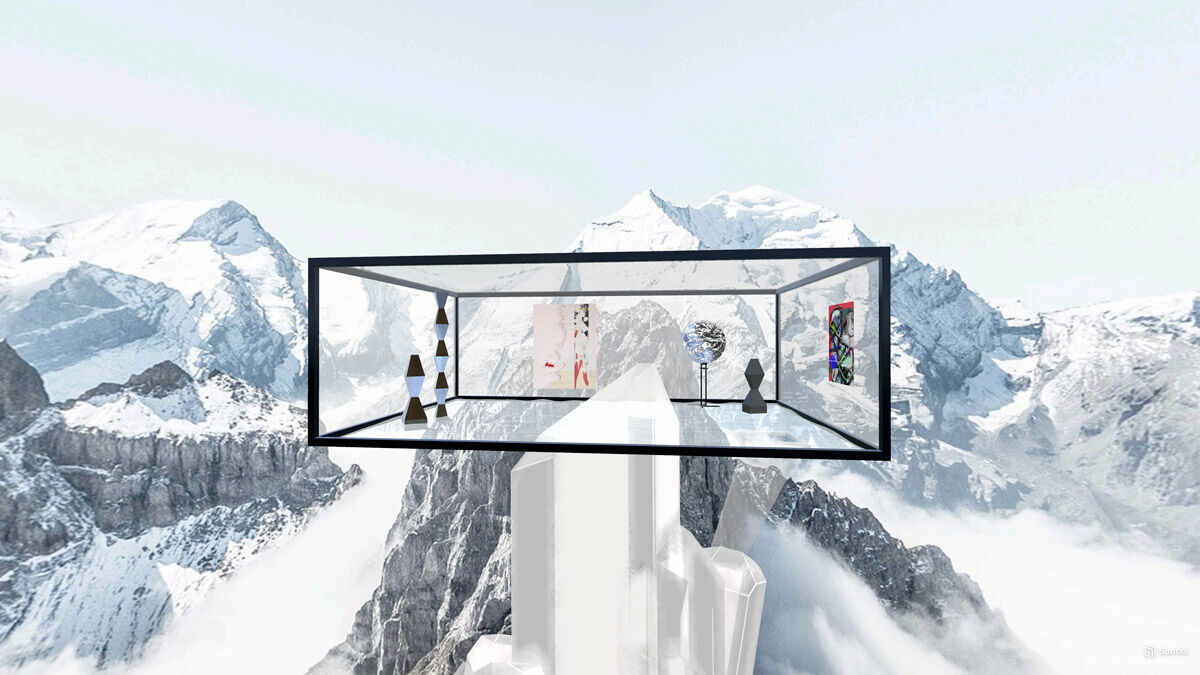
“Scenario for a Past Future” is a project by conceptual artist Josephine Meckseper that transforms one of her pieces into a navigable 3D virtual model — double projected in life-size “Night” and “Day” versions on opposing walls of the Hurley Gallery in Princeton University’s Lewis Arts Complex — to showcase her modernist, large-scale glass vitrine installations beyond the curated collections of a museum.
Presented by the Lewis Center and Princeton University’s department of art and archaeology on the mezzanine level of the Arts Tower, the free exhibit is open to the public and on display daily from 10 a.m. to 8 p.m. through Thursday, February 22.
According to a press release, Meckseper is best known for her vitrine works, referring to a display case or cabinet containing objects that “meld the aesthetic language of 20th-century modernism with her own imagery of historical undercurrents.” While she also works across the mediums of painting, sculpture, film, and photography, Meckseper notably transforms these common items from mundane origins into a meaningful analysis of cultural consciousness.
Meckseper, the former Princeton University 2022–23 Belknap Visiting Fellow in the Humanities Council and Department of Art and Archaeology, was born in Lilienthal, Germany, and is currently based in New York City. She has previously exhibited at the Museum of Modern Art and the Solomon R. Guggenheim Museum.
Based on her 2022 work of the same name, “Scenario for a Past Future” is the result of a partnership with architect Hani Rashid and digital arts agency DMINTI, an organization described on its website as reimagining “how digital art can be created and experienced using VR and AR technologies” by establishing an “art metaverse” to “build the future of digital art.”
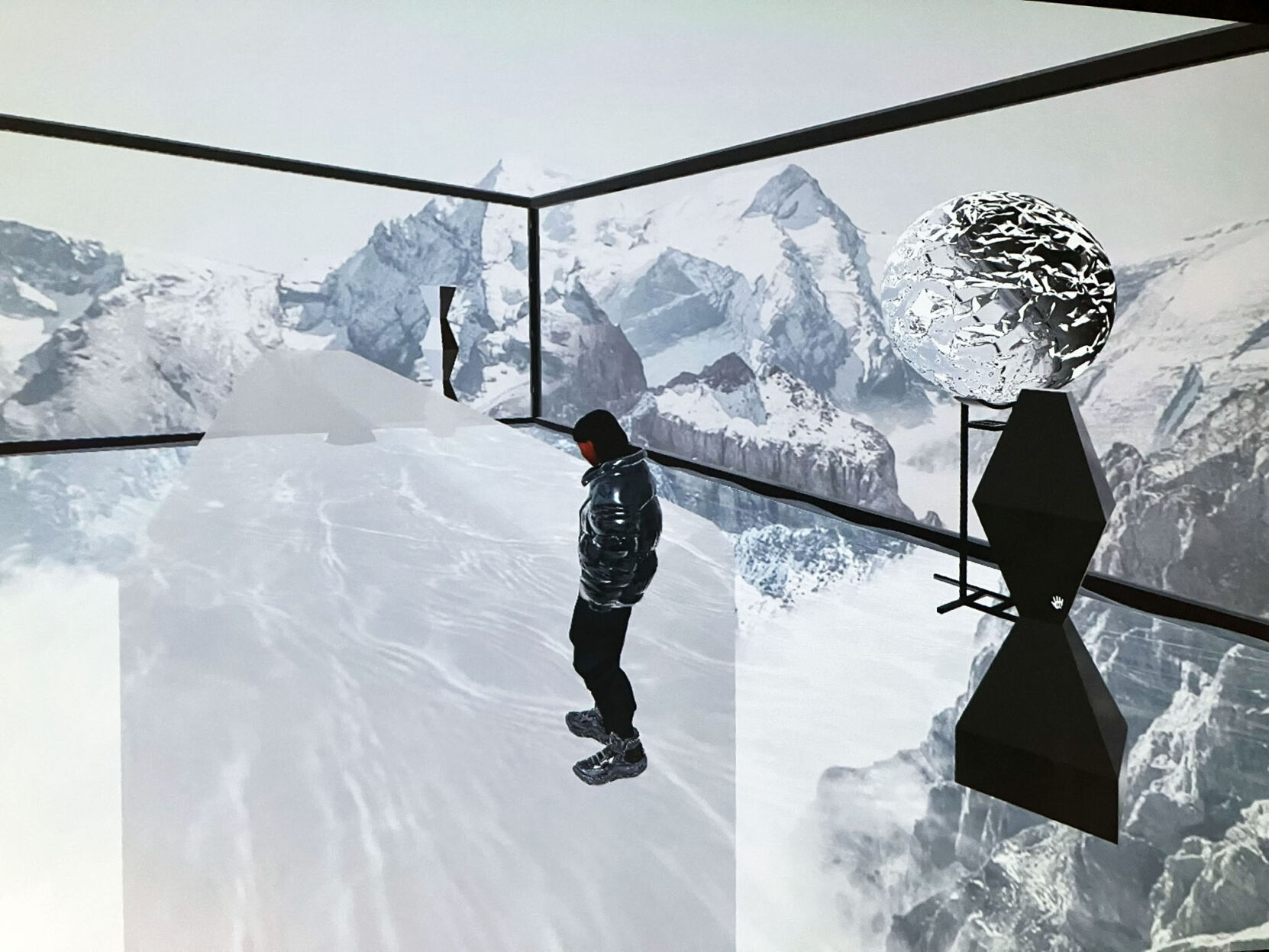
Enter the digital environment of the metaverse pavilion, set against the peaks of an Alpine mountain in a glass structure reminiscent of Meckseper’s vitrines. But this time, there is no physical separation preventing the audience from interacting with the content inside, as the user controls an avatar via keyboard to move through the alternate world in real time.
As Meckseper explains in the exhibition materials, “Scenario for a Past Future” is an atmospheric glimpse of a utopian future that, through its sincere homage to architectural designs of the past, recognizes the dystopian nature associated with advancing technologies like artificial intelligence.
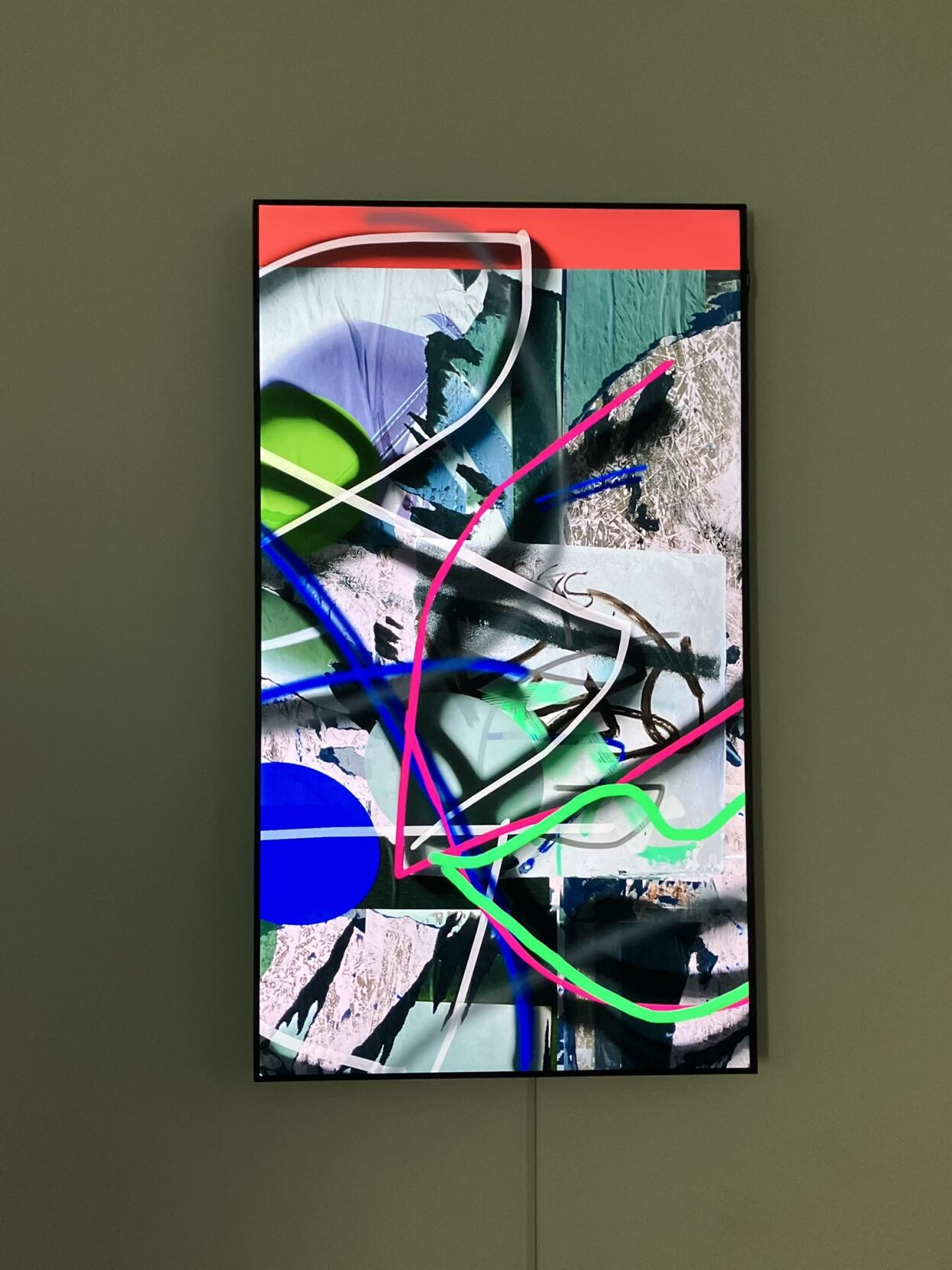
Modernist sculptor Constantin Brancusi’s “Endless Column” appears in the form of three sculptures that constantly shatter and reform within the traversable artwork. Meckseper’s animated painting, Sidewalk Cinema (2022), exists there as well as physically, where it loops on a monitor between the two main screens in the Hurley Gallery.
Like in “Future Presence,” “Scenario for a Past Future” utilizes its sonic power by incorporating an electronic soundscape inspired by German avant-garde composer Karlheinz Stockhausen, who pioneered the use of aleatory and spatial music techniques in serial compositions, or “music based on a series of tones in an ordered arrangement without regard for traditional tonality,” according to Stockhausen’s Britannica biography.
For more information, visit arts.princeton.edu/events/scenario-for-a-past-future-exhibition-by-josephine-meckseper/2024-01-31.
Meckseper was invited to the Princeton University fellowship by art historian Brigid Doherty, an associate professor with joint appointments in the departments of German, as well as art and archaeology, who also helped organize the exhibit. Together, the two co-taught “Counterworlds: Innovation and Rupture in Communities of Artistic Practice” an interdisciplinary seminar about “the dynamics of creative collaboration through case studies of utopian communities of artistic practice in 20-c. Europe and the US (Worpswede, Bauhaus, Black Mountain) and the architecture of modern cities planned and imagined” in fall 2022.
She began working on the artwork for “Scenario for a Past Future” around the same time she and Doherty were developing the syllabus for the class two years ago.
“In the context of Princeton, it was interesting to me to show this work that opens up this visual experience of illustrating layers of history. It’s like a history class in an artwork. Having the possibility to engage directly with the art objects as an avatar or vis-à-vis life-size installation creates a dialogue with the art and history that is, to some extent, maybe more approachable than something that a museum would do,” she says in an interview, noting that this format eliminates the “automatic barrier” between the viewer and the artwork on display.
Meckseper says she has been working with glass for the past two decades “as a material to create a distance between the viewer and the objects that are purposely very pedestrian — objects that are elevated by being put inside a vitrine — creating a different dynamic between the viewer and the object and the relationship between the object and its value in [relation] to a larger economy.”
“Then, [in] this work, I’m doing almost the exact opposite. I’m eradicating the barrier, and I’m letting the viewer inside the piece, and there’s no more separation between the artwork and the viewer except for the screen,” she adds.
Meckseper explains that she connected with Rashid over their shared ties to the Guggenheim Museum because Rashid, also a partner at DMINTI and the co-founder of the New York-based Asymptote Architecture firm, created the Guggenheim Virtual Museum.
Rather than looking to the present or a definitive future, Meckseper used this opportunity to re-examine the “avant-gardist and early 20th-century precedents of architects and designers.”
The virtual vitrine was specifically inspired by works such as Lilly Reich and Ludwig Mies van der Rohe’s “Barcelona Pavilion” (1929), a temporary structure designed for the 1929 Barcelona International Exhibition, and Bruno Taut’s “Alpine Architecture” (1917), which depicts “crystalline temples on Alpine peaks” drawn when the architect became a pacifist during World War I.
These influences are the result of Meckseper’s upbringing in what she describes as a “utopian” community of creatives in the northern German village of Worpswede, home to a formidable artists’ colony for more than 100 years with Taut-related architecture.
Meckseper admits that the geography in “Scenario for a Past Future” is “somewhat autobiographical,” as while most of the northern parts of her home country tend to be flat, she grew up on “the only hill in the whole region.”
Worpswede is home to a war memorial featuring Bernhard Hoetger’s expressionist sculpture “Niedersachsenstein,” a tribute to the soldiers lost in World War I that sits atop a roughly 180-foot dune and, according to Meckseper, reminds her of Brancusi’s “Endless Column” piece.
The title “Scenario for a Past Future” comes from French philosopher Gilles Deleuze’s concept of the “crystal-image,” which she defines as “the shaping of time as a constant two-way mirror” that splits “the present in two directions,” one that propels “us towards the future, and one that falls into the past.”
Yet at the same time, she adds that its name “refers to the fact that it’s a scenario” or “proposition,” rather than a “permanent space” existing in corporeal form.
Like the architecture, Meckseper adds, the style of the background track references “early avant-gardist” and “mid-century composers” such as Stockhausen, who, in collaboration with the German Pavilion for the 1970 World’s Fair in Osaka, Japan, designed a spherical auditorium that used localized sound sources to envelop the audience in a domed concert hall. Meckseper also drew on the subject of her last film, Arnold Schoenberg, another musical figure who specialized in serial composition.
Reflecting the experimental style of these two visionaries, the exhibit’s original music echoed the quiet solitude of a guided meditation track, featuring a sequence of futuristic noises that punctuated the piece with electronic tones.
Despite the nature of her current collaboration, Meckseper does not personally consider herself a VR or technological artist, instead using the project as “an experimentation with the media that conceptually relates to my work in general, which is very much focused around architecture and [the] framing of architecture as a recording device.”
Meckseper explains that she has been using 3D models for about the last two decades as a “practical tool” for both “fabrication” and “exhibition design.”
In her film work, she says that “the architecture turns into almost like a quasi-camera in terms of the way that I’m framing images,” and this is a realization of that idea in virtual reality.
Meckseper admits that her exhibit employs a “nontraditional” use of the technology, in contrast to “normally, you would experience the spatial environment through a VR headset, and in the headset, you take on the perspective of the avatar.”
Rather than become the avatar, who dons a puffy coat fit for the hypothetical weather of the world, Meckseper wants the viewer to remain “in dialogue” with them using an analog approach.
“I think it’s important that we can both take away the power of technology, or that sense of fascination, but also, at the same time,” create an avatar “who is empowered rather than instrumentalized by the viewer,” she says, adding that she wanted the piece to be life-sized so that avatar could be scaled up to human height.
“I think that all the tools or the cultural inventions that we have are always interesting for artists to explore and to experiment with in their work. I think artists have always done that, so I think this technology is just like any other technology that we have at our disposal, and I think the interesting things happen when artists are able to subvert and to really put their own stamp on technology,” Meckseper explains, “to infiltrate” while simultaneously “circumventing the corporate structure.”
“I think it’s an interesting moment for younger artists to look at this, to really subvert it, and to not buy into the building blocks that are already available in the metaverse,” she says in conclusion, emphasizing how important it is for them to establish “their own language and vocabulary,” especially one different from the “mainstream perspective.”
For Meckseper, this exhibit is simply an exercise within an experimental medium, another format in which to explore the themes that populate her work. The mountainous utopia, electronic music, and ever-changing modernist sculptures inside the virtual vitrine combine undercurrents of history with the artistic expression of what is to come. She has defined, over time, a language of commentary — on containment, capitalism, and consumerism — further communicated through her crystal-clear vision in “Scenario for a Past Future.”
Meckseper says she had no idea that a similar exhibition at the intersection of art and technology would be coming to the Princeton University campus just a week before her show opened.
While immersive, the two experiences were not without their technological obstacles. Oppermann had to be available for the entire weekend to essentially recalibrate the exhibit according to the changing light and shadows in the room throughout the day, redefining the edges and teaching the VR the boundaries of the space.
The “Day” and “Night” projections worked properly the first time at “Scenario for a Past Future,” but the sound did not return after being manually switched off for the interview. On the second try, just one of the screens worked, but the Stockhausen-inspired music succeeded in showcasing the stylistic strengths of the exhibit.
Both “Future Presence” and “Scenario for a Past Future” promised to journey into new, virtual worlds with differing arts at their apex. Audiences can interact with a digital realm where everything else fades away thanks to audiovisual experiences engineered directly by passionate musicians, artists, and sound designers. As both disciplines continue to evolve, modern technology necessitates this human touch to reap the full rewards of such creative expression.