Let’s talk about H2O, aka water. In 1746, Benjamin Franklin observed, “When the well’s dry, we know the worth of water.” Today, Franklin might consider amending that to read: When the well is dry, we know the worth of clean water.
Assuring clean water for daily use in our community means intelligently managing not only usage, but runoff of water back into the watershed. The National Oceanic and Atmospheric Administration defines a watershed as the “land area that channels rainfall and snowmelt to creeks, streams, and rivers, and eventually to outflow points such as reservoirs, bays, and the ocean.” And NJ connects to all those kinds of water resources.
One form of water runoff management is a rain garden. In essence, the rain garden, when properly planted, sends water back into the ground for natural purification and the refilling of the groundwater tables — the very groundwater which fills the wells Franklin referenced in 1746.
Up until 2004, little attention was paid to water runoff from properties when people “paved paradise and put up a parking lot,” as Jonie Mitchell crooned. Creation of impervious structures–patios, driveways, tennis courts, reduced the amount of open land to soak up water to send it back into the ground. Consequently, anything landing on these impervious surfaces–road salt, chemicals, animal waste, flowed directly into the storm systems and out into the waterways.
In 2004, new water management rules were established in Chapter 7A of New Jersey law requiring better water management systems to be connected to development. That change led to the writing of a 572-page analysis report from the Department of Environmental Protection.
The report noted that within New Jersey, “there are 7,840 miles of rivers and streams including 6,330 miles of non-tidal rivers and 1,510 miles of tidal rivers; 69,825 acres of lakes and ponds larger than 2 acres;1,069 square miles of estuarine and ocean waters; and 1,482 square miles of fresh and saline marshes and wetlands.”
In an interview, Rutgers Environmental Sciences Professor Chris Obropta; who is also an Extension Specialist in Water Resources with Rutgers Cooperative Extension, said, while everyone is concerned about new development, it is actually long-standing developments which continue to cause water run-off problems.
“The only way to fix our streams, our lakes, our bays, and to reduce localized flooding,” Obropta said, “is to retrofit our older housing developments. All those old properties have no stormwater management.”
In late January, Hamilton Township Mayor Jeff Martin unveiled the architectural drawings for the new municipal building to be located at 1750 Whitehorse Mercerville Rd.. The building is slated to open by the summer of 2026. The proposed development includes two rain gardens–one at the NW corner of the property along Kuser Rd.; the other on the southeast side near Whitehorse Mercerville Rd..
Karen Robison, an Associate Project Manager-CME Associates, a Howell-based engineering company which works with municipalities and other public entities, like school districts, worked on the design for the municipal building. Robison said the gardens will line the parking areas at the site.
She noted the goal of any new development, or redevelopment of an old site like Hamilton’s, is to make sure the quantity and quality of the water runoff is addressed before it leaves the site. In this case, the design had to take into consideration the current poor soil on the site, as well as developing a new drainage pattern. The site of the new municipal building was once a shopping center with a large swatch of impervious parking lots.
“I really like these projects where we can redevelop and improve upon the drainage from the site,” Robison said in an interview. She said the gardens will be filled with native plants.
Obropta and his colleagues have been on the forefront of advocating for rain gardens in NJ communities. In 2014, Hamilton Township funded a water management study conducted by Rutgers. The study identified numerous public locations that could host rain gardens. But private individuals are encouraged to install rain gardens on their properties too.
A rain garden essentially consists of digging a depression on a downslope of one’s property and filling it with plants. Obropta advocates for plants native to NJ. Those plants have long root systems which can help with the penetration of rain water into the groundwater tables. A homeowner can even link downspouts into the rain garden.
The rain garden concept is not a new one. The history of using rain gardens for water management began in Prince George’s County, Maryland in 1990. According to reports, developer Dick Brinker wanted to “replace the traditional stormwater management pond with residential rain gardens.” This kind of stormwater management is called bioretention. A 2022 study about the Prince George’s project, done by University of Minnesota, noted when assessed, the decision to use rain gardens in the development “resulted in a 75-80% reduction in stormwater runoff during a normal rainfall.”
Minnesota is also the site of a successful rain garden initiative. In 2002, Fred Rozumalski, a landscape architect with a minor in ecology, was approached by water management people from the City of Burnsville. They wanted to reduce stormwater runoff into Crystal Lake.
“The lake was degrading and they were looking for solutions,” Rozumalski said in an interview. The degradation of the lake was coming from the pesticides and other materials running off lawns of surrounding homes.
Rozumalski said, “usually you build a pond.But there was no place for a pond in the neighborhood.” But, he had a hypothesis. “If you soak water into the ground instead of running it to the lake, the lake would be in better condition.” The proposed solution led to the installation of rain gardens in an older development near the lake. A later study showed a significant improvement in the lake’s quality.
Rozumalski said when he encountered reluctant homeowners, he would install a rain garden with only three species of plants arranged in little islands. He said gardens are never “no maintenance” affairs. However, with his low-maintenance design, he can teach people what the three species of plants look like and instruct homeowners to pull out other plants which are likely weeds.
Rutgers professor Obropta agreed that rain gardens need not be complicated; but it is important to build them. “The systems have to be put in throughout a community,” Obropta said. The more rain gardens that are erected, the better the water management and quality of water.” Obropta and his Rutgers team just finished installing a rain garden with students in Bridgewater, NJ. He has overseen the installation of gardens at three schools in Hamilton–Hamilton High West, Steinert and Alexander.
And while rain gardens manage water runoff, they can also provide a feast for pollinators–bees, birds, and butterflies. The monarch butterfly population experienced an historic reduction in population last year. Experts with Monarch Watch noted, “to recover, monarchs will need an abundance of milkweeds and nectar sources.” A rain garden can provide monarch feasts.
The municipal building rain gardens will be the sixth and seventh ones constructed in the township on public property. In addition to the previously mentioned school gardens, there are rain gardens located at the Hamilton Township library and Veterans Park.
“We are having more and more extreme weather events,” Obropta noted. “What’s causing those events doesn’t matter; they’re happening. And, we have to prepare for these events. I know we can manage stormwater better.”
* * *
Homeowners interested in building rain gardens on their properties can access plans from the Rutgers Rain Garden Information Center: water.rutgers.edu/Rain_Gardens/RGWebsite/rginfo.html.
Or from the Native Plant Society of NJ Rain Garden Manual: npsnj.org/native-plants/rain-gardens.
* * *
The Native Plant Society of New Jersey plans to host its second annual “Annual Gathering” on March 10 with the theme of “Native Plant Show-n-Tell.”
The event is scheduled to take place from 2 to 4 p.m. at the Tulpehaking Nature Center, 157 Westscott Ave., Hamilton. The event is open to the public, but registration is required. To register, email mercer@npsnj.org.
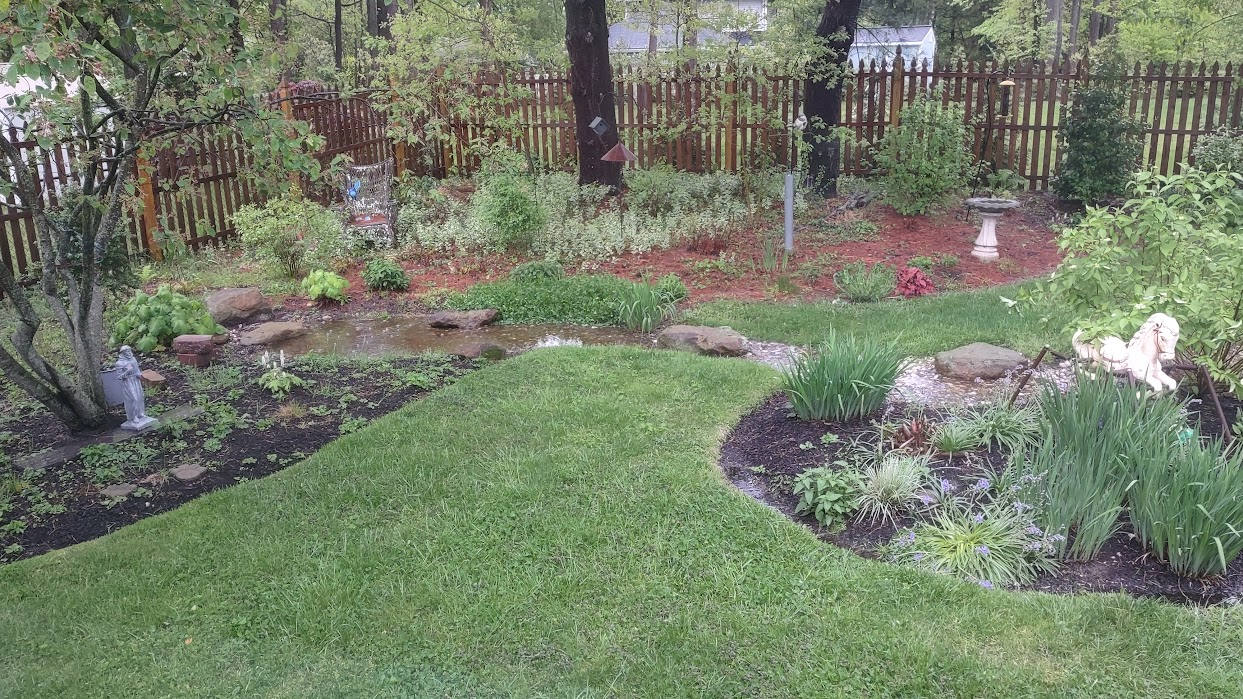
A properly built rain garden can help replenish the groundwater resources that communities rely upon. (Photo by EMH Studios.),

