Getting into someone else’s car carries with it the implicit understanding that you are entering a dictatorship, in which the person controlling the car also controls the stereo system. There’s room for flashes of democracy (i.e., requests to change the radio station or play a certain song), but for the most part you, as a mere rider, are subject to the whims and preferences of your driver.
Though it’s sometimes cause for teeth-gritting, this phenomenon does have benefits for the passenger. Aside from providing a revealing glimpse into the tastes of the driver, this can be a prescribed widening of one’s world, forced exposure to entertainment not otherwise encountered. My wife’s habit of constantly scanning radio stations while driving can be irritating—in her never-ending quest for the perfect tune, rarely do we hear an entire song, usually leaving early or arriving late as chance, or her personal tastes, would have it. But whatever limited knowledge I have of current pop songs, as well as some happy discoveries of classical and jazz pieces, I owe to her and her rapid-fire radio sampling.
Recently, this practice caused me to hear the song “the Final Countdown” by Europe for the first time in a while.
With no driving responsibilities to distract me, I focused on the lyrics, which I’d forgotten except for the “final countdown” refrain. The fact that I remembered the song so well, while only recalling those few words, is perhaps an indication that the lyrics don’t really matter. This is a song whose popularity is tied to its opening keyboard riff, and a sense of epic, operatic urgency, not a carefully considered storyline or thoughtful analysis of social issues.
Case in point: While the first lines set up an interesting sci-fi scenario:
We’re leaving together, but still, it’s farewell
And maybe we’ll come back to Earth, who can tell?
and tantalizingly hint at the reasons for this departure:
I guess there is no one to blame
We’re leaving ground
Will things ever be the same again?
The second verse’s collapse from the vague and mysterious to the specific and dumb is sudden—and precipitous:
We’re heading for Venus
And still, we stand tall
‘Cause maybe they’ve seen us
And welcome us all
Not to be a science stickler, but… Venus? Even in 1986, it was common knowledge that Venus was too hot and unforgiving to support life as we know it. Science fiction benefits from at least a semblance of scientific truth; it’s speculative, but if the speculation has already been settled, there’s really no point. Not only is Venus the preferred destination of these space travelers from Earth, it seems that there are already (alien?) inhabitants there, who may or may not welcome them.
A cynical reader might be tempted to think the choice of Venus as a destination was driven solely by its easy rhymability (Venus/seen us), but of course, that’s absurd. The scientific flaws continue in the next line:
With so many lightyears to go
And things to be found
I’m sure that we’ll all miss her
A light year is a measure of distance—the distance traveled by light in one year, around 6 trillion miles. At its farthest point, Venus is about 162 million miles away from Earth. The mistake is astronomical, in both senses of the word. Unless…
Reading (generously) between the lines, maybe Venus is not the final destination, but just a way station before starting the longer journey? After all, “I’m sure that we’ll all miss her” seems like a reference to Earth, but maybe it’s really about Venus?
No time to dwell on that—here comes the chorus! Once again, it’s the final countdown! The rest of the song doesn’t clarify much, though, more or less repeating the same lines:
It’s the final countdown
We’re leavin’ together
(The final countdown)
We’ll all miss her so
It’s the final countdown (final countdown)
(Oh)
It’s the final countdown
Yeah
I wanted—needed—to know more. Why were the travelers leaving Earth? How many were there? Were they really “leaving ground” and not “leaving now,” as I had apparently misheard for years? As usual, the information superhighway was an express pass straight to the bottom of the rabbit hole.
“The Final Countdown” was written by Rolf Magnus Joakim Larsson, aka Joey Tempest. It’s the perfect stage name for a man responsible for a perfect combination of the ridiculous and the sublime. Regarding the song’s origins, Mr. Tempest has said: “I started thinking maybe the human race is leaving Earth because it’s dying and the song is about the countdown to the last ship leaving the planet.”
Straight from the horse’s mouth. But “art is in the eye of the beholder,” a phrase that people often use to mean that everyone has a different opinion about what’s good and what’s not. I see those words as more than just a comment on the subjectivity of personal tastes: they also indicate that art, and its perception, is inseparable from the viewer (or listener) and his or her thoughts, preconceptions, and opinions. Thus, the perception of art is different for every person. It follows, then, that people have interpreted the song’s meaning in other, more expansive ways.
On the website songmeanings.com, a few people write that the song is about love, since Venus is the goddess of love in Roman mythology, and one even posited that “The Final Countdown” was the leadup to a wedding.
One person speculated that “the line ‘Maybe they’ve seen us and welcome us all’ underscores the point that maybe another species already knows of us and are waiting for humans to take the next jump.” Reinforcing the uncertainty that surrounds any intepretation of the song, he went on to admit: “Maybe I’ve just had too much beer every time I listen to this group.”
At lyrics.com, one user theorized that the song is “about Space Explorers who had a specified time to visit each planet but they were especially sad to leave Earth. Earth gave them a lasting impression.” Another said the song is about two people who take drugs: “’We’re leaving together but still it’s farewell,’ since under the influence, they won’t know what the other is doing. ‘Maybe we’ll come back to Earth’ — maybe they’ll survive the overdose.”
More than one person held to the common 1980s interpretation of travelers leaving an earth destroyed by nuclear war. In recent years, it’s become more common to see the cause of a ruined earth as global warming or some related environmental disaster. Does the line “I guess there’s no one to blame” mean we are all equally guilty of environmental catastrophe? Or that it couldn’t have been avoided? Or simply that there’s no one left alive?
It’s all very quantum physics, in which particles exist in an unresolved state until observed, at which point they each coalesce into a single, discernible meaning. Thus, maybe all of these interpretations are valid, and “The Final Countdown” can exist as both magnificent and awful—and based on the situation, mood, and predispositions of the listener, can be experienced as awfully magnificent, or as magnificently awful.
Maybe there’s a 13-year-old boy in all of us who bought The Final Countdown on cassette (or at least recorded the song from the radio) and still thinks it’s pretty cool, just as there’s also a 50-year-old in there who laughs at the over-the-top goofiness of the entire affair.
“The Final Countdown” places simultaneously on “Best of” and “Worst of” lists alike, categorized as hair metal, rock ballad, or “Dad rock,” among other classifications. It serves as end-of-workout soundtrack, high school sports rallying cry, and reminder of appointments on one’s digital calendar. The song’s been covered in virtually every style imaginable: reggae, hardcore, bardcore, folk, bluegrass, dance, house, trace, techno, ska, new age, jazz, punk, heavy metal, bagpipe metal, and a cappella, each artist enabled to interpret an iconic rock anthem while maintaining an ironic arm’s length distance (kind of like I’m doing with this column).
A classical version by the London Symphony Orchestra is both rousing and preposterously pompous, while a GEICO ad from 2015 featuring the band playing their signature song shows they’ve got a healthy sense of humor about its continuing place in the popular consciousness. And how could I fail to mention the song’s brilliant use in Gob Bluth’s magic shows on the TV show Arrested Development?
In 2017, Europe produced a track intended as a sequel of sorts to “The Final Countdown”—“Pictures” from the album Walk the Earth. It’s a very David Bowie-esque song, lacking in loud, proud keyboard riffs or any other vestiges of the 1980s. It doesn’t answer the many questions provoked by the original—but as we’ve established, maybe that’s a good thing?
It takes a special ability, and a happy accident of fate, to create an enduring song so simple, and yet so fascinating; this is, perhaps, the definitive example of “complex simplicity.”
Now, if it’s not already playing in your head, tune to the end of the song in your mind’s ear, thrust one hand in the air, and bob your head in rhythm. Then picture Joey Tempest rocking out in leather pants while you buckle down for this column’s final breakdown. Sing it with us, Hamilton: this was The Final Rundown… of “The Final Countdown.”
Peter Dabbene’s website is peterdabbene.com. His graphic novel biography “George Washington: The Father of a Nation” is now available through Amazon.com for $20 (print) or $10 (ebook).
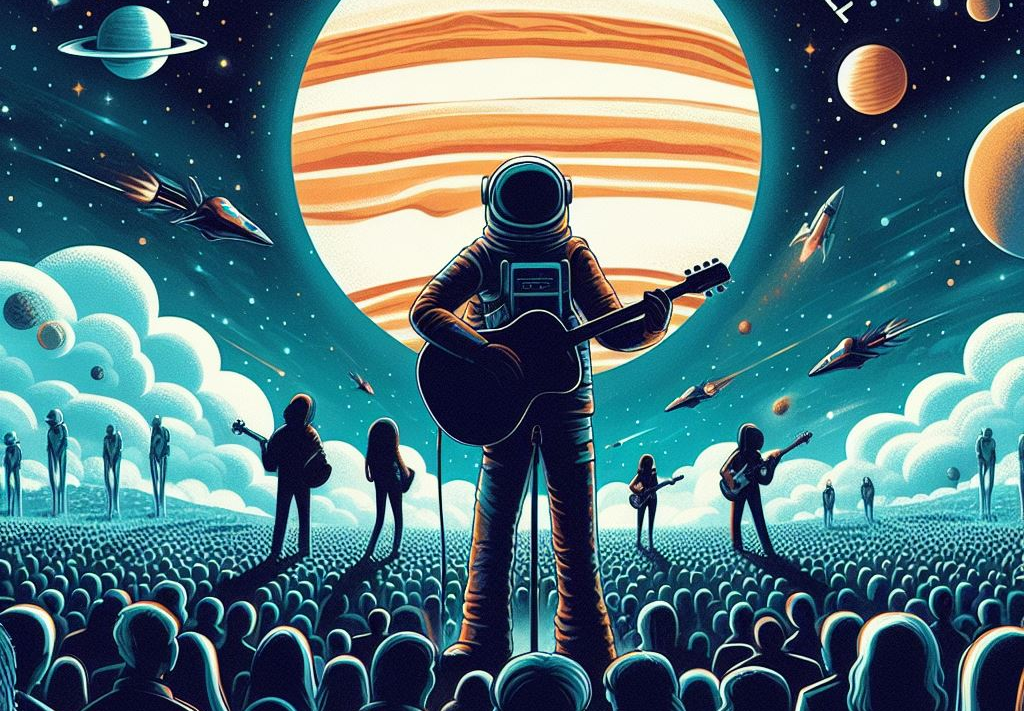
Image generated with AI.,

