The Lawrence Gazette recently say down with officials from the Lawrence Township Public Schools to talk about issues confronting the district.
The first part of the Q&A resulting from that interview ran in the April issue of the Gazette and reflected officials’ thoughts about the school budget, and a potential reconfiguration of grades currently attending the elementary schools and the Lawrence Intermediate School.
This month, Superintendent Robyn Klim and Sean Fry, the director of personnel and administrative services, talk with Lawrence Gazette editor Bill Sanservino about how the nationwide teacher shortage is impacting the district and how the LTPS is responding.
A lightly edited version of their talk appear in the Q&A below. Other topics discussed will appear in appear in subsequent issues.
* * *
Lawrence Gazette: There’s a teacher shortage, which has been ongoing for some time now. Can you talk about the situation and some of the difficulties that you and other school districts are having?
Sean Fry: School districts across the state are all facing the exact same problem, and that’s that the pipeline is drying up. I mean, that’s the reality. When we go to our job fairs, there’s typically less candidates there. We see that through the number of student teaching requests that we get annually. Practicum students, those numbers have all reduced.
So, we’re having less people coming in because those programs have gotten smaller in size. So therefore, there are fewer candidates for us to choose from. There are fewer aspiring teachers coming through our buildings. We try to house as many of them as we can, because it’s a great recruitment tool. You get eyes on teachers and get to see them and kind of mold them. But it’s, it’s definitely a huge challenge.
We also face the fact that some of the programs that offer certain education preparation programs are eliminating certain areas. So, there’s only a couple programs that will offer, for example, family consumer science. There might be like one program. There are not many programs that offer certain core areas, which makes it increasingly difficult to recruit those areas.
So that’s a major challenge that as people retire, or as they relocate—leave the profession, what have you—it’s difficult to replace some positions because of the nature of how some of the colleges are eliminating some of those programs, and some of that they’re doing for their own financial reasons. Low enrollment numbers, for example. But there’s a problem when the state requires us to meet certain standards and certain core areas that we must teach as graduation requirements, and the output of educators doesn’t match the increasing demands they put on schools to provide all these areas.
LG: Are there less people going into the teaching profession overall?
SF: I’ve looked at trend numbers going back the last 12 years or so, and you can see a pretty big drop off starting around 2008, 2009, 2010. Back then is when you started to see a decline in the number of educators going into the teaching profession. That’s nationally, and New Jersey mirrors that. That has been an impact that people are not going into the profession. I think in New Jersey, part of that has been some of the changes that occurred around that time period, and that impacted perceptions and things like that.
People need to understand that education is a very rewarding career, and it’s also a very challenging career. The people that are going into education are their heroes, and I don’t think we hear enough about that. I don’t think we see enough public campaigns about how amazing teachers are. I think that we need to do a better job of demonstrating their importance and do a better job to make it a profession that people collectively want to go into.
LG: To your point, I know a number of people who have told me over the years about a teacher or teachers that they had growing up who made a major impact on their life.
SF: Yeah. It’s critical.
LG: So how do you attract teachers, especially if there’s a shortage all over? How do you say, “Come to the Lawrence School District. It’s great here?”
SF: I think we do a good job of marketing our goals and the things that we value. Letting them know our commitment to all of our students and the fact that all of them are being cared for and that they matter. Let them know about our work around making sure that all of our students have a sense of belonging. So, when we interview candidates, those are things that we hear. They hear that, “Wow, I’ve heard from my colleagues. I know someone working in Lawrence, and I hear really wonderful things about how it is to work here.
We have expanded our mentoring program. Our assistant superintendent, Pimmi Goomer, has introduced a mentoring program that goes above and beyond what’s required by the state so that all of our new educators that we hire have mentoring opportunities. That’s a great way to build a professional staff, and also it helps with retention when people feel supported in the place that they work.
I think it’s also really important that you have a strong collaborative relationship with your union leadership. We have three unions here. We collaborate with each of the leaders of those units, and that’s really important because that helps set a tone so that your employees feel like their voices can be heard, and that you establish a cooperative work environment.
I think a lot of people stay in Lawrence because of the culture, and that’s primarily set from our building administrators and our curriculum supervisors who are supporting those teachers day in and day out, working extremely diligently to support them. They really set a tone of culture and care. I think our staff feel like they’re cared for and feel like they have a voice and feel like they matter. So, I owe that to our principals and supervisors who are working with them on a daily basis and setting that tone and building that positive culture.
LG: A few years ago, our office manager was going for her master’s in teaching, and she left to became a student teacher here in Lawrence. How important are programs like that? Things like outreach to the local colleges and creating programs where you can kind of capture them and show them why they should come and work in Lawrence before they’re even out of college.
SF: We try to open our doors at any opportunity that we can when the requests are reasonable and when we can match them. Obviously, we have to have people willing to host students in a variety of things, but if there’s any type of opportunity where we can bring in college students, we try to do that. When the edTPA (a teacher certification test that was eliminated as a requirement of a teaching certificate in 2022) was still around, we were one of the few local districts that was offering opportunities for people to come in and take their test here, even if they weren’t doing their student teaching here.
We were coming up with some sort of collaborative arrangement for them to be able to complete their test here. Just because we want to get eyes on, and we want to show, “Hey, Lawrence is an amazing place. And a lot of people, when they have that opportunity, apply here. We hire a lot of our long-term substitutes because they see that this is a great place to be. They see the awesome students we have, and they see the awesome dedicated staff we have. They want to be a part of that.
You want to work to work in an environment where you’re surrounded by excellence. If we already have a bunch of great teachers in the building who want to be a part of that grade level, then they’re going to elevate you, and you’re going to be better at what you do. I think that’s really important when you have a really, really strong professional staff and you have people who are good at what they do, which we have throughout Lawrence, people want to be a part of that because they want to be a part of that excellence, because they know it’s going to help them elevate and grow.
Robyn Klim: We also have partnerships with colleges like Mercer County College, and we’re talking with Rider University and The College of New Jersey. We’re offering college level courses. I have just sat in a senior class today, and it was English 102—a college level course. The students are getting college level credits. I think it starts from the student perspective. They know that we’re investing in them.
They know that when they start college, they’re already kind of ahead of the game with a few credits under their belt. Then when they go to college and they’re interacting with other students who maybe didn’t have that opportunity, or their district didn’t have these partnerships, I think they realize the investment that this district has put into them. And a lot of them, like Mr. Fry said, come back and teach for us, because of the experience they were given, which is pretty cool.
LG: Do you think there are instances where a high school student is looking for a career or considering being a teacher, and they see another young person come in as a student teacher, and identify with them more than an older person who’s a teacher?
RK: We are actually even building out our education academy at the high school. So, there is kind of like a three-year plan. We’re working with the high school administration to really build out opportunities for students who already know in freshman year that they’re interested in the field of education. We can kind of foster those relationships. The principal of the high school has this vision that they would be given a mentor that would follow them, and they would be kind of in a cohort.
So, they would be in their interest level sort of cohort, which is pretty cool. And the guidance team would be working with them on this trajectory to possibly go in that route of education and expose them to different things and electives. That way when they start freshman year at a college level, maybe they’re ahead with a few extra credits here and there. Maybe there’s more enrollment in our early childhood growth and development class as a result of that.
We’re looking at expanded, electives and how we can kind of entice our students. We survey our students. We know what they want. We gather their interests. It’s very important to us. We get teacher feedback before we open up a new elective or do anything different with the course of study. We also get numerous amounts of input from parents, students and staff. It’s not something that we do in a bubble. It’s really serving our constituents.
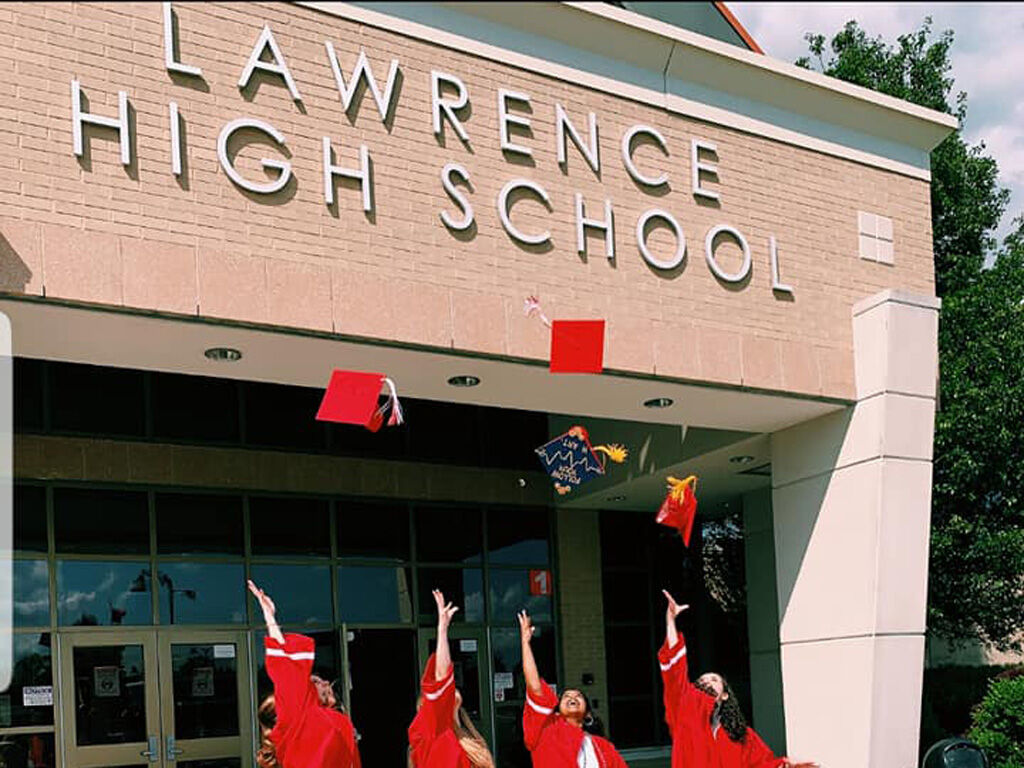
Lawrence High School,

