Glenn Michibata, whose humility knows no bounds, was nervous about speaking in front of the area’s tennis elites at the Mercer County Tennis Hall of Fame Dinner.
One would never know it, however, as by the time his speech ended, event co-chair Marc Vecchiolla still hadn’t heard enough.
“I could have listened to his stories for another two hours,” Vecchiolla said. “You’re talking about someone who was on the tour, just living that lifestyle. You want to soak that in.”
Indeed, the long-time West Windsor resident was enlightening and humorous, but his 11-year-career on the ATP Tour —which included two weeks as part of the world’s No. 1 doubles team—is not what earned him induction into the Mercer HOF.
That background obviously helped, but Michibata’s donation to county tennis is as a teacher. He served as Princeton University’s head coach from 2000-12. For the past 12 years he has been an instructor at West Windsor’s renowned Princeton Tennis Program while also serving as an assistant at The College of New Jersey since 2018.
When giving his induction speech June 14 at the Mercer Boathouse, Michibata stressed that he was being honored for just enjoying his role in this world. Afterward, he said “I feel like I haven’t worked a day in my life and I’m getting rewarded for it. I know a lot of people who really have to work hard and often don’t get what they deserve. It doesn’t seem right. I love teaching for the sake of watching someone learn and get better. That’s enough of a payoff.”
“On the other hand,” he added, “I did put in a lot of hard work, so I am thankful and honored that my achievements got recognized.”
Especially from a group that continually promotes tennis in Mercer.
“These are people who try to make the game better,” Michibata said. “They donate a lot of their time, it’s almost like a thankless job in some ways. They make a lot of sacrifices.”
They also made the right decision in honoring Michibata, who is also in the Canadian Tennis Hall of Fame and Rogers Cup Hall of Fame.
“Everybody’s had the opportunity to get to know the type of person he is,” said Vecchiolla, who runs the award-winning Mercer Tennis Center and coaches Mercer County Community College. “Not only does he do high quality things, he’s just a high quality human being.
“What strikes me is Glenn’s level of expertise. He’s a world class coach. There’s probably not too many people who have come in and out of Mercer County that have had his level of experience over the years. I hold his teaching in the highest regard.”
In looking at the criteria for induction, part of it says the inductee’s impact on Mercer tennis, “must be balanced by a reputation that can be admired and respected.”
Michibata’s reputation has been impeccable from the start.
Growing up in Toronto at a time when tennis wasn’t popular in Canada, Glenn would hit against a backboard while his brother took lessons. When he began competing, Michibata was Canada’s No. 1 at U-12, U-14 and U-16. He was the country’s top-ranked U-18 player at age 15, which qualified him for Junior Tournaments at the sites of all four major events.
His biggest thrill – and fear – was in England.
“I’d been reading about Wimbledon all my life as a kid, and I got there, of course it’s awesome,” he recalled. “The practice courts are not on site so I’m fine and then my match gets called. I’m still doing OK. And then you get to the court and honestly, as I stepped from the concrete onto the grass I was playing on, my knees buckled.
“All of a sudden a wave hit me. I could see the outside facade of center court and the background of the clock and the scoreboard, and I thought ‘Oh my God, I’m actually here.’ I don’t remember one point. Somehow I ended up winning. I just remember being so shaky – literally my knees were rattling – and having to force myself to stop shaking during certain points of the match. The place is really special. It’s the mecca of tennis.”
After an outstanding junior career Michibata was a three-time All-American at Pepperdine University from 1981-83. It was in college where he met his wife, Angie, who runs a racket stringing service out of PTP.
In 1982 Glenn won the Canadian National Tennis Championships before embarking on a professional career. In singles he reached the second round of all four Grand Slam tournaments and earned his highest ranking at No. 48 in April, 1986.
It was doubles where Glenn made his mark. Teaming with fellow Canadian Grant Connell, the duo won four ATP titles and in 1990 reached the Australian Open finals. In 1991 Michibata had his highest doubles ranking as an individual (based on playing with different partners) at No. 5, and heading into the 1991 U.S. Open, he and Connell were No. 1 in the world in team point standings.
“When Jannick Sinner got to number one (in men’s singles), Andre Agassi said to him ‘If the universe had a tennis tournament right now, earth would pick you, Jannick,’” Vecchiolla said. “So I’m gonna tell Glenn if the universe had a tennis tournament during those two weeks in 1991, earth would have chosen him (and Connell) as their player. It takes a lot to rise to the top of your field in the entire world.”
Michibata and Connell hooked up after being ranked as the top two doubles players in Canada. They did so for Davis Cup purposes and went 7-8 in those events, and also played in the 1988 Seoul Olympics.
Prior to specializing in doubles, Michibata had the dubious distinction of playing the powerhouse team of John McEnroe-Peter Fleming in his Wimbledon doubles debut.
“I was basically a singles player, somehow I got into the doubles qualifying at Wimbledon and we made it to the main draw,” Michibata said. “Who do we draw but McEnroe and Fleming, the dominant doubles team of their era. That was nerve wracking enough, then we see the schedule and we’re on (the famed) Center Court! How’s that for an introduction to Wimbledon.”
Connell and Michibata had the necessary chemistry to play doubles, as Glenn provided steady consistency and Grant was a big hitter. Off the court it was a bit different. As a bachelor, Connell would roam the cities the tour afforded them, while Michibata was more of a homebody; or in this case a hotel-body.
“It wasn’t my personality,” he said of the night life. “The enjoyment I got from the tour was getting better and being able to compete against the best players; trying to to get better against them. If you’re waiting for some story about me rubbing elbows with Elton John, I don’t have one.
“I didn’t take full advantage of the social opportunities. It was my job, I worked really hard. I was either in the hotel, at the practice courts, or playing my match. Everything was geared to the next day. It’s not like I was a hermit, but I was definitely on the less adventurous side.”
Michibata got a big laugh during his acceptance speech when he recalled being in Paris with his wife. Angie begged him to see the City of Lights but he was focused on training. So as a solution, he took her to the top of the Eiffel Tower and they walked around it.
“I said ‘There you go Ang, we just saw the entire city,” Glenn said with a laugh.
When injuries slowed his career, Michibata retired and had a brief stint as director of tennis in Whistler, British Columbia. At the urging of Angie, he decided to finish his schooling and get a college degree.
Thus, Glenn took classes at the University of Southern California and was hired by a former Pepperdine teammate as assistant coach of the women’s team. After three years, Michibata knew he wanted a coaching career and applied at Princeton with no thought of getting the job. He just figured going through the interview process at an Ivy League school would be good training for future interviews.
Michibata shocked himself by getting the job and replacing the legendary David Benjamin, who was also Executive Director and CEO of Intercollegiate Tennis Association (ITA) at the time. Glenn, Angie and daughter Cori pulled up stakes and moved cross country.
With Benjamin graciously helping him make the transition, Michibata coached Princeton for 12 years. His teams went 145–121 and had seven winning Ivy League seasons along with producing three Ivy Players of the Year.
In 2012 his son Matthew began taking an earnest interest in tennis. Michibata approached PTP Director Gwen Guidice about starting a high performance junior program in order to work with Matthew and other talented youngsters. Glenn began to train and develop some of the top juniors in the area and his success stories are impressive.
Matthew set The College of New Jersey record for most combined wins in singles and doubles and reached the NCAA Division III Tournament. James Hopper was ranked the No. 1 singles and doubles player in Division III and led Case Western to the NCAA team title. Andrew Lutschaunig was part of the Division I national doubles championship team at Ohio State.
All three wore the Michibata badge.
“That was pretty gratifying to have some part in helping them get to where they are,” he said. “That was typical of the type of kid we were getting. Being in California, I figured California, Florida and Texas were the hotbeds of tennis, but I found there were a lot of good players here.”
Michibata no longer organizes high performance groups at PTP but still gives private lessons to high performance juniors and also provides adult lessons to players from beginner to B level.
No matter how raw or polished they are, students get Michibata’s best effort.
“I’ve had a passion for tennis right from a young age so I was always motivated to work hard at improving and learning about the game,” he said. “This passion carried on when I became a coach and I am doing my best to pass on whatever I have learned to my students.”
Michibata also developed a passion for West Windsor. The move from California was made easier by their welcoming nextdoor neighbors, Craig and Jody Nestel, who got props during his acceptance speech. Glenn praises the West Windsor school system and calls it “a great place to raise a family.”
At age 62 he is unsure how much longer he will coach, and is now being helped by Matthew. The desire is still there but, despite being in great shape “my body is nicked up with aches and pains, I’m not sure how much longer I can go.”
He loves coaching with Matthew as their bond is tight. Michibata notes that despite a pro career his greatest thrill in tennis was winning the National Indoor Father & Son Doubles championship with his boy.
When Glenn finally retires, Vecchiolla feels it will be a huge loss to Mercer tennis. If only for the fact he represents the sport with such class.
“There’s a lot of experienced teachers and with that experience you have to have confidence,” Vecchiolla said. “When you have confidence it can bubble over into having ego. There is absolutely none of that with Glenn. You’d have to pry his accomplishments out of him. Glenn is just a selfless, selfless guy.”
As witnessed by an acceptance speech that left them wanting more.
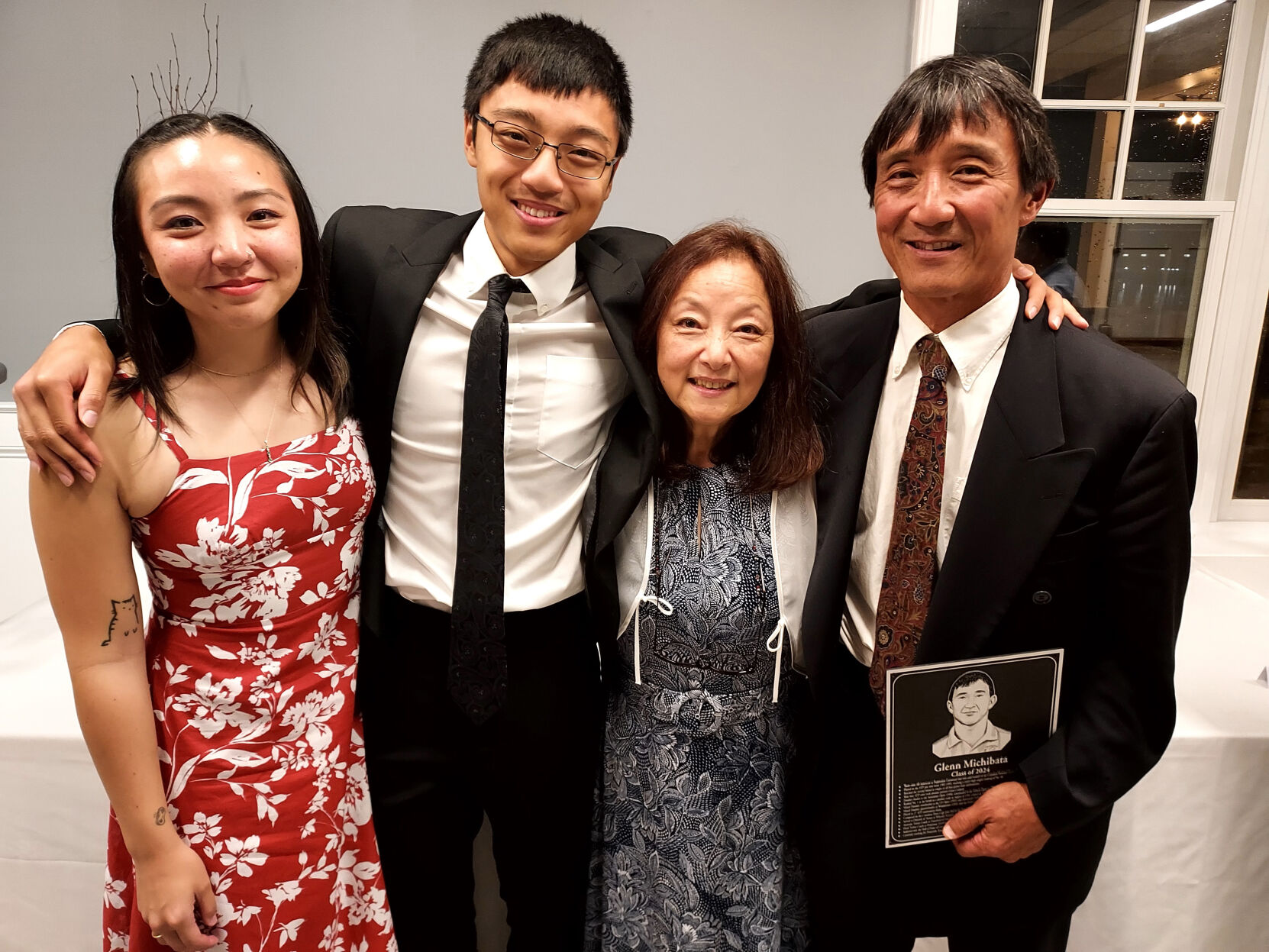
Glenn Michibata (right) displays his plaque for being inducted into the Mercer County Hall of Fame as he is joined by daughter Cori (left), son Matthew and wife Angie.,

