I was biking in the Sergeantsville area when I saw some large, hairy cow-like creatures. “Are they buffalo or beefalo?” I asked a passerby.
“They are yaks,” she said.
“Yaks! Like in Nepal?” I asked.
“Huh?” she said.
It turns out, I had pedaled past Silver Cuff Farm, a “boutique” yak farm. Susan Mandatta and her husband raise eight yaks for their fiber or down, which gets turned into exquisite fabric. The down lies under the long hair, close to the skin. With intense labor, they comb it out three times a week for six weeks. Only four to five mills in the U.S. are equipped to spin yak down.
Mandatta describes yaks as “beautiful, social and resilient,” herd animals that turn sad without other yaks around them.Some yak offspring are sold to folks who use them as pack animals, a function they served for eons in Tibet. If you need one, you can buy your own yak for $2,000 to $3,000.
Remarkably, there is a second yak farm in the area. However, Brent Walker, the owner of WoodsEdge Farm near Stockton, is getting out of the yak meat business. The cost of butchering yaks has become prohibitive. Yak meat is very healthy, with the fat on the outside acting as insulation essential in their native Himalayas.
The Walker family was the first in New Jersey to raise llamas and alpacas imported from Peru and Chile. They now have a hundred head. Both animals have long gestations: 350 days for llamas, 335 days for alpacas.
The herd gets sheared around April 1 to spare these Andean natives the summer heat. The wool is distributed to 32 knitters and weavers nationwide. Alpaca fiber gets turned into socks, gloves and sweaters. Llama fiber gets turned into rugs.
Another local boutique farm is Hidden Spring Lavender and Alpaca Farm in Skillman where Marie Voorhees has been raising alpacas for six years. She said the chief challenge is keeping them healthy, particularly in face of meningeal worm disease, a fatal neurological infection caused by parasites living in deer feces.
In addition to monthly antibiotic shots, alpacas also need to have their teeth ground down — dental work performed with a Dremel drill while the animals are strapped into a cattle chute.
Normally shy, her alpacas are trained at a young age to tolerate a halter and be comfortable around people. This allows visitors to take the alpacas for a walk, and it facilitates their being shown at competitions, where they are judged on the quality of their coats and bodily conformation (stance, level back, straight legs).
Looking for more Andean beasts, I biked to Triple S Farm, where the Sourlands are alive with the sound of coyotes. Juan, who tends the herds, said llamas keep coyotes away from alpacas. Each alpaca produces from 5-6 pounds of fiber in a single shearing.
In addition to threats from the deadly worm disease, Juan said that llamas and alpacas have sensitive skin, so the stable area is kept fastidiously fly–free. Constant removal of manure provides compost for the farm’s organic produce.
For 30 years, the Readington River Buffalo Farm near Flemington has been the only commercial purveyor of bison meat in New Jersey. Owner Gerry Doyle originally acquired stock from breeders in South Dakota, Nebraska, and Indiana. Their 60 enormous bison remain truly wild and, consequently, are difficult to move from one place to another. The most rambunctious ones are quickly transformed into healthy, low-fat steaks.
What A View Farm in Hillsborough keeps three Vietnamese potbellied pigs. Farm worker Jonah described the pigs as too heavy to be lifted by a grown man. They are the farm’s smartest animals, known to lift a gate off its hinges and let out other animals while they stay behind, grunting with piggie glee.
For years, my biking highlight was visiting a pair of emus on John Von Oehsen’s Foxbrook Farm in Hopewell. In 1995, he bought two baby emus, a male and female named Romeo and Juliet.
The emus thrived as beloved pets, protecting the sheep and chickens from coyotes. Since they are from Australia, they laid eggs in winter. The male sits on the large green eggs that look much like avocados. Eggs actually hatched during two mild winters.
Three years ago, Romeo died. Two years later, Juliet was missing great swaths of feathers. The goats had been eating her feathers. They got rid of the goats.
Juliet continued in her dominant farmyard role until last Christmas, when the family heard a tremendous commotion with lots of barking. When they ran out, they found their sheep cowering in a corner and the emu dead, killed by a neighbor’s two huskies. The emu did not go down without a fight.
Yet another Romeo and Juliet tragedy. Yet another reason to dislike dogs.
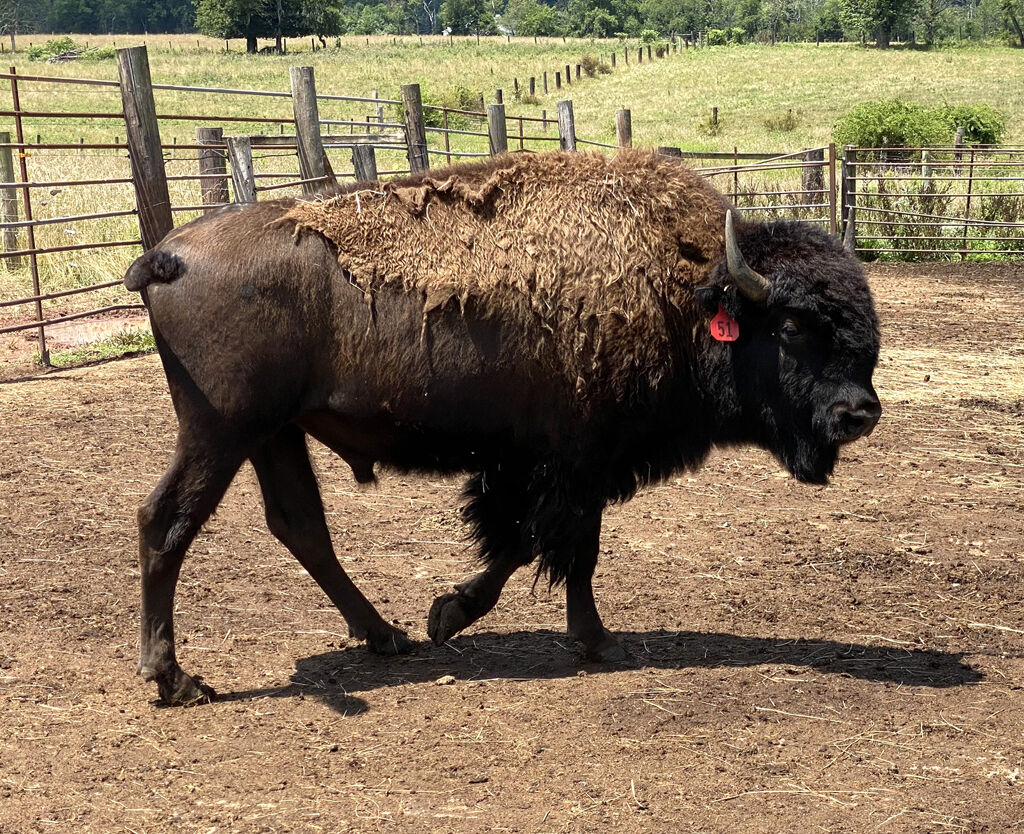
A buffalo at Readington Farm. (Photo by Robin Schore.),

