It’s undeniable that display technology is one of the most revolutionary developments of the modern era. Not only in the way it has dominated every major industry—from healthcare to aerospace—but how it has become woven seamlessly into everyday life. A thin piece of durable glass, the screen is also a looking glass into knowledge, entertainment and function.
As visual technology continues to advance, it’s easy to take for granted how far displays have come since the days of clunky TVs in the ’80s and ’90s.
Throughout almost a century, the science behind the screen has undergone significant evolution: from the Cathode Ray Tube that sparked black-and-white films to the LCD (Liquid Crystal Display) that illuminate flat screen televisions.
Somewhere in between, a revolution within itself emerged, the OLED (Organic Light-Emitting Diode).
With its superior color quality, elegant design and sustainability, OLED has held its spot at the top of the billion-dollar industry and is moving closer to becoming the ultimate display form.
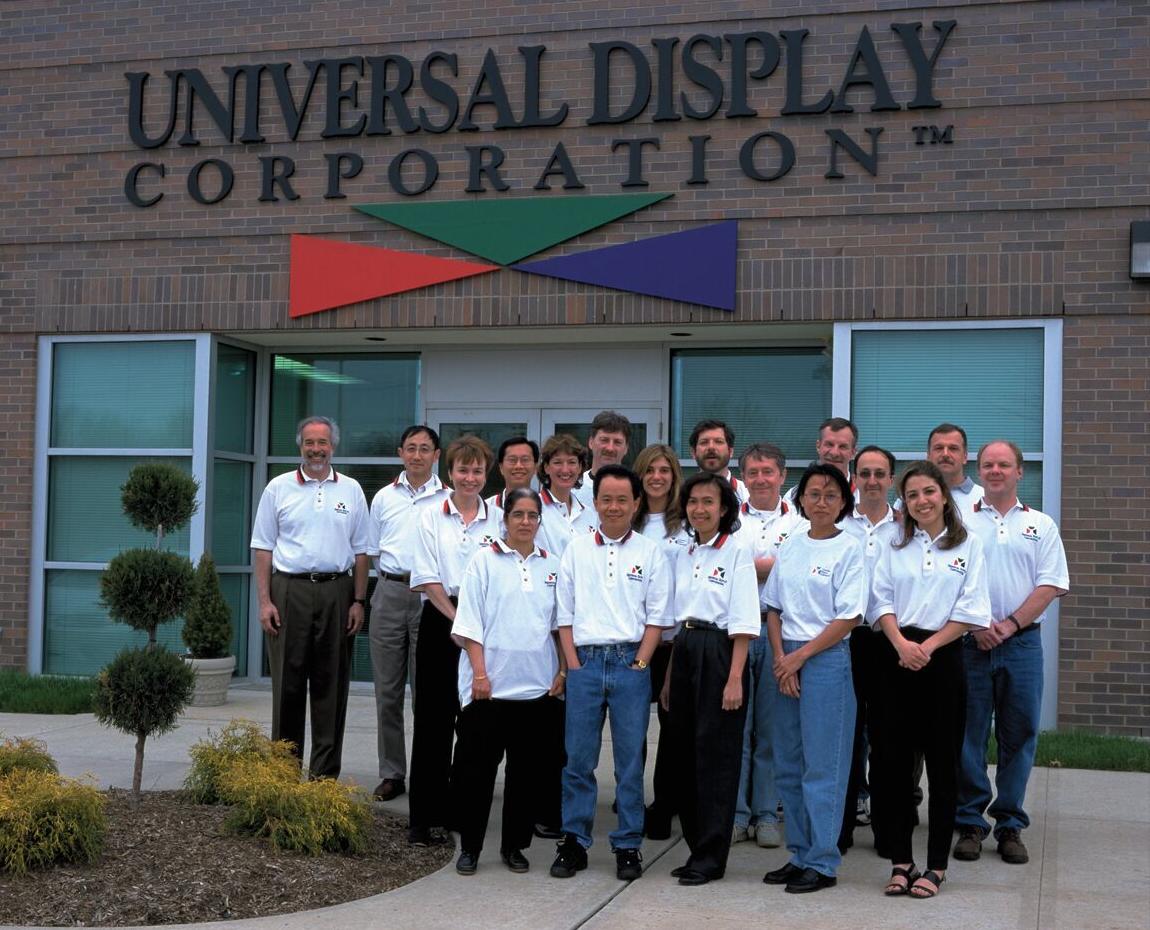
Universal Display Corporation, based in Ewing, began as a small startup of less than five people in the late 1990s. This year they are celebrating 30 years in the industry as a world leader in the invention, research, development and commercialization of OLED materials.
Janice Mahon, senior vice president of Technology Commercialization and General Manager of Commercial Sales Business, was one of the very first employees at UDC. She has watched the company grow from the ground up, contributing to the growth and innovation of the corporation in all facets.
“When I joined the company, we had no revenues and no profits. We had a handful of patents and a great dream,” she said. “What we’ve done over 30 years is taken that vision, innovated and made it reality.”
Mahon, a long-time resident of several Mercer County towns, was a part of the early phases of research and development behind OLED displays. Today, she is responsible for the manufacture, quality assurance and distribution of PHOLED products sold to top OLED display and lighting manufacturers. Just a couple of weeks ago, UDC rang the closing bell at the Nasdaq stock exchange, commemorating its global success.
OLEDs are a series of thin organic films sandwiched between two conductors: an anode and a cathode. When electricity is applied to an OLED, charge carriers (holes and electrons) travel from the electrodes into the organic thin films until they form excitons. Once formed, electricity is converted into light output (electroluminescence), illuminating the display. The individual light pixels are 1/1,00th the thickness of a human hair, resulting in a simple and sophisticated end product.
UDC is responsible for inventing and developing phosphorescent OLEDs. While Fluorescent OLEDs can only convert 25% of electrical energy into light, losing 75% as heat, PHOLEDs can convert up to 100% of the energy into light. This results in better performing, more efficient OLED displays that require less energy.
Before UDC’s technology emerged, display manufacturers were initially unimpressed with OLEDs due to their link to inefficient fluorescent technology. By introducing PHOLEDs, significantly reducing power consumption, OLEDs became more attractive to manufacturers and consumers.
Originally from the Boston area, Mahon studied chemical engineering at the Rensselaer Polytechnic Institute in Troy, New York. She received her MBA from Harvard Business school with an interest in energy saving technology.
She was a vice president and general manager for Chronar Corporation, a developer and manufacturer of amorphous silicon photovoltaic panels based in Princeton. She moved from there to a start-up at Rutgers University that was developing an energy-saving, thin-film technology. The company eventually moved to Minnesota and Mahon decided to stay in New Jersey, where she met the president of UDC, Steve Abramson.
Abramson was just starting to build the company based on Sherwin Seligsohn’s 1994 vision of a new display technology. Looking for a new challenge, Mahon met with Abramson and was introduced to OLED technology, invented by Steven Van Slyke and Ching Wan Tang of Eastman Kodak in 1987.
Aiming to further develop this technology, the UDC research team worked to develop PHOLED at Princeton University and University of Southern California. She joined Abramson, who’s still the CEO today, in January 1997.
Mahon was first stationed at the labs at Princeton University, helping engineer early prototypes for OLED displays. Some of the most pivotal projects include replacing the display of a landline telephone and replacing it with an OLED display. Princeton believed UDC’s ideas were becoming too commercialized for a university, urging them to find a new home.
“We’ve grown from what was 15 employees to now about 450 with about 200 people on the campus here in Ewing,” Mahon said. “Now, we have three buildings there, one on one side of Phillips Boulevard and two other facilities. So, we continue to grow from what was just a handful of folks to over 200 in Ewing. It’s been a really remarkable 30 years.”
When compared to other incumbent technologies like the LCD, OLED offers better performance, a higher quality viewing image and a better response time. It has become increasingly common for videos and gaming to reduce lag.
OLED displays require less material without a backlit unit, as OLEDs emit their own visible light. This results in an incredibly thin display that can be made with flexible, foldable and/or near-transparent materials. Because these pixels can be individually controlled, OLEDs have an almost instant response time, saving power, creating contrast and intensely dark blacks.
Over the years, Mahon wore a dozen different hats, helping the corporation evolve across sectors: from sweeping the floor, to product education to research and development. She joined the company before flat panel displays reached the mainstream, explaining that CRTs were all people were familiar with. The biggest change she has witnessed is UDC’s gradual transformation to a key provider for OLED materials for myriad applications. What hasn’t changed is the tightly knit community and nurturing work culture that has existed from the beginning.
“When I joined the company our founder Sherwin Seligsohn, our leader Steve Abramson and former Executive VP Sidney Rosenblatt, had marvelous value systems, morals, ethics, and I thought when the company got to be 25 employees it would change. It didn’t. When it got to 100 employees I thought, companies get to a certain size and then they change, and at 100 we didn’t,” Mahon said.
Today with about 450 employees, UDC prides itself on having the same culture. For Mahon, it is important to enjoy working with a team that truly believes in the technology they develop, while fostering good moral and ethical values.
“Every day I still wake up and look forward to going to the company that I work for. Having made Universal Display such a special place to work in, with a technology that has always had promise and still continues to have tremendous promise,” Mahon said.
Her most pivotal memory at the company occurred early in her career, when she sought out companies that might be interested in using UDC’s technology. She visited a former colleague from her time at PPG in Pittsburgh, hoping they would integrate OLEDS into architectural windows and car windshields.
Despite initial feedback suggesting the technology wasn’t yet ready for such applications, PPG proposed a partnership to advance UDC’s technology instead. This unexpected turn led to one of the strongest, longest partnerships between UDC and PPG since the year 2000, in what Mahon considers ‘serendipity.’
Mahon says she is proud of contributing to the very OLED products consumers use in their everyday lives.
Some of her staples include her Samsung Galaxy phone, iPad, TV and at home lighting. She highlighted the Apple Watch, with OLED displays that have become a strong medical device. She says she finds it fulfilling and rewarding to have helped develop such revolutionary technology.
“It’s an amazing feeling—a few of us have had the rare pleasure of going to New York City to ring the closing bell at Nasdaq a couple of weeks ago, and it was the day to think about how far we’ve come and yet how many opportunities still abound for the company,” Mahon said.
Looking ahead for OLED technology, UDC has already introduced their red and green OLED technology and materials to the market. Their next major advancement aims to incorporate blue PHOLED materials into screens by 2025, promising significant increase in energy efficiency and reduced power consumption for smartphones, TVs, and other devices.
Currently, OLEDs are expanding into new applications such as augmented reality and virtual reality products, including micro-OLEDs seen in devices like the Apple Vision Pro, providing an incredibly realistic user experience.
Samsung has initiated the development of tandem OLEDs—panels featuring a two-stack tandem structure—expected to increase panel brightness while consuming less battery power. This advancement has already been highlighted in the product description of the new iPad.
Mahon expresses most excitement for the potential of OLEDs in more unconventional materials. Its flexibility, such as being built on plastic or fabrics, opens numerous possibilities. Applications range from wrapping OLEDs around structural columns to laminating them onto automotive windshields or integrating them into pens, like UDC’s founder once envisioned. Transparency capabilities allow for unique applications that can be useful in retail, automotive, and entertainment sectors.
With a long history of trial, error, and great success, the Ewing-based company still strives to bring innovation to reality, eager for what lies ahead.
“Opposed to being a young scrappy company we’re now starting to focus really on process, systems, documentation, so that we build a company that’s sustainable for decades into the future,” Mahon said. “So, where I sit today, I marvel at what we’ve accomplished, and yet I’m also exhilarated by all the opportunities that still exist for the company and the people who are helping it grow.”

Janice Mahon, senior vice president of Technology Commercialization and General Manager of Commercial Sales Business for Universal Display Corp., was one of the company's earlies employees.,