More than all of the speeches by Abraham Lincoln, Frederick Douglass, or William Henry Garrison, the vehicle that influenced most average Americans to disdain slavery was a work of fiction, Harriet Beecher Stowe’s “Uncle Tom’s Cabin.”
Stowe focused on individuals, members of a family fleeing a tyrannical owner, one that touched on a concept and institution rather than being primarily about it. Writers like Athol Fugard and Arthur Miller and even a soap opera producer like Agnes Nixon created more awareness than activists by dramatizing how a given situation affected specific people.
The strongest parts of Benjamin Benne’s play, “Alma,” at Trenton’s Passage Theatre through October 20 depict the title character, an illegal resident of the United States for 17 years, striving to make a life for her and her daughter despite not meeting requirements for the green card that would legitimize her place in the U.S. and free her from a constant fear or deportation and separation from her child.
Alma induces our sympathy. She is the woman next door, a hard and steady worker raising a daughter and paying her own way. She is a burden on no system. She is no threat to anyone. She lives decently, minds her own business, has ambitions for her child, and wants nothing but relief from having everything she is denied and everything she has had taken away because she entered the U.S. from Mexico without asking “May I?”
Alma’s is a case to consider among the myriad combinations and permutations that make America’s immigration picture so complex. Benne and the excellent acting of Jessy Gruver argue eloquently for Alma to remain, unthreatened, in the United States because she has proved her ability to be a good, productive citizen who maintains both a job and a house and is a good mother to Angel, her daughter.
Few, if any, in the Passage audience would quibble if Alma was granted a green card, or even citizenship for her 17 years of worthy residency. They would agree to waive a waiting period and other legal obstacles to allow her to continue her average, peaceful live in her California town, La Puente, which symbolically means “the bridge” between the life she left in Mexico for the tough but firmly middle class existence she has in the U.S.
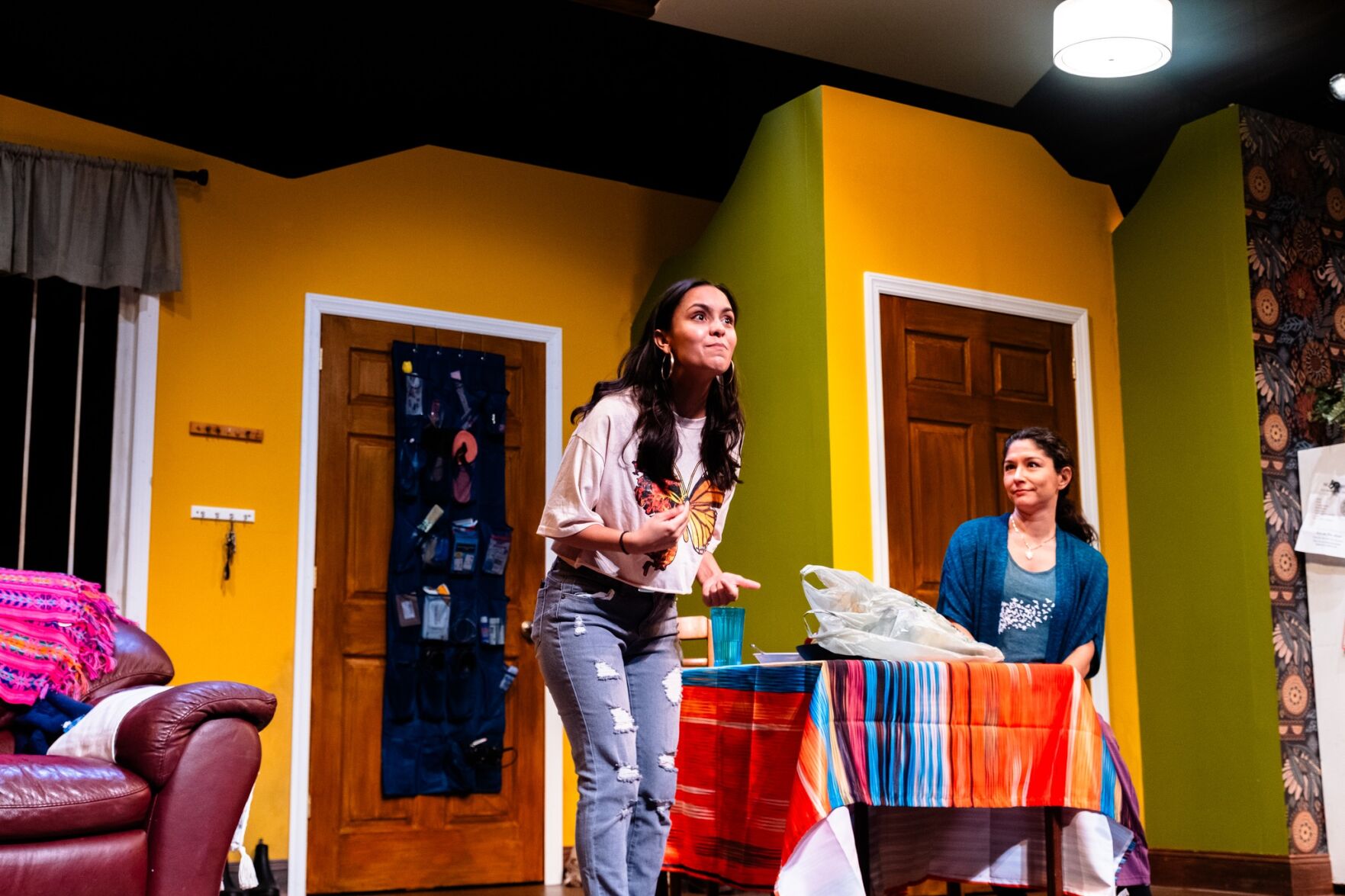
“Alma” remains a domestic drama with occasional comic lines and diversions. It is set in the small house Alma and Angel share and depicts episodes between them. We hear of Alma’s dilemma, we learn her frustrations and worries, but we never see her confronting or being confronted by authority. The closest intrusion to a wide-ranging dialogue between Alma and Angel involves a neighbor who comes to find out if Alma is all right after some news she receives makes her scream.
We mostly learn about Alma’s struggle to become legal as she relates to Angel what a lawyer told her about the process and how she must negotiate it.
Hearing her necessary steps adds to our sympathy towards Alma.
Although that sympathy never abates, and it’s clear Alma should be welcome in any community, there comes a point in Benne’s play in which a bigger picture is wanted, even required.
“Alma” spells out one family’s plight well, but it isn’t expansive enough to go beyond the situation Alma and Angel face.
Sure, they are not the only ones in their situation, but Benne makes no attempt to show universality or scope. Alma’s case is made, but it doesn’t address the whole subject of immigration or illegal entry into the United States.
It speaks to people who have come here, settled, and made a life only to have the sword of Damocles poised to end their progress at the whim of ICE or some other enforcement organization. It differentiates Alma from people who may not want to assimilate so neatly or adhere to laws and traditions beyond the one they broke to secure something more important, freedom.
It would be difficult for any play to encompass all that is involved with immigration today. “Alma” eventually becomes claustrophobic because it stays in one place with one character. As compelling as that character is in showing how it would be a larger crime to deport her than to ease her way past red tape, “Alma” doesn’t speak to an entire subject. It settles on an easy situation to grasp, admittedly one that can be found in any town or city and that puts good people who have become good workers and neighbors in peril, but it stops there. Immigration is not addressed as much as how applying laws with too wide a brush can hurt a lot of people, like Alma, who deserve to stay within our borders.
“Alma” does illustrate the American dream. Alma has one set of index cards with questions from the U.S. naturalization exam on one side and the answers on the other. Angel has a similar set that pertains to questions asked on the SAT. Mother and daughter take turns quizzing each other about the information on the cards. Benne has both criticize the type of information the respective tests look for, but those criticisms sound more like personal gripes than anything that has weight.
A test has to have a standard. Disdain for those standards doesn’t make the test less fair or less necessary. It was more difficult to empathize with Alma or Angel when they were cynical about the questions they might face. One reason is Benne wrote those complaints more as declarative statements with which he imagines an audience might agree instead of just opinions casually mentioned by Alma or Angel in their own voice.
“Alma” becomes flawed when one of the characters, most often Angel, a high school senior who might be susceptible to the political passions and arguments of a time, leaves the conversational mode to make what sound like a pronouncement or manifesto.
Director AZ Espinoza may have been wiser to make such assertions the dopey maunderings of a young woman of her time rather than have Angel (Diana Maldonado) turn to face the audience when she tells her mother that drinking milk is part of the American oligarchy’s plan to weaken the general populace or to mention an oligarchy at all.
Angel likes to spout politics, but her statements tend to come from current fashion, seeming to be what Benne thinks his audience might want to hear and nod at but which are really controversial ideas or just plain rhetoric.
Since it does lack scope, “Alma” works better when mother and daughter center on their domestic life or immigration law as it specifically affects them.
It is the way the law hampers and hamstrings Alma that affects us, not Angel’s broad partisan screeds.
“Alma” does have sequences that amount to magic. It is set in December 2016, just as the results confirming Donald Trump’s election as president are being announced. A television, featuring stories about or remarks from Mr. Trump, goes on automatically, without Alma or Angel being able to turn it off. The sequences involving the renegade television does resonate as news that might again be heard in December 2024. Because of that, its presentation might benefit from more subtlety, letting the audience react as it randomly might, rather than seeing Alma and Angel have conniptions over what they hear.
At Passage, “Alma’s” virtues, the way it depicts Alma and Angel, outweigh it flaws, Benne’s penchant to write broad political statements, and AZ Espinoza’s bent to emphasize them. The performances by Jessy Gruver and Diana Maldonado pave the way for the best aspects of Benne’s script, and Espinoza’s direction is usually clean and straightforward enough to stay out of their way when they are portraying an everyday mother and daughter with a nagging, potentially destructive dilemma.
Jessy Gruver deftly shows the many sides of Alma. She can be warm and maternal one minute and angry or vindictive in another. Gruver builds a character as complex as Alma is. She lets you see her aspirations and her concerns about Angel’s education and social life while letting you see her worries. Alma is competent and pragmatic, but she can also be superstitious and frustrated. Gruver keeps the portrait complete, making you like Alma and root for her, including in her campaign to convince Angel to go to college and excel in a profession.
Diana Maldonado, even when she turns Angel into a political spokesperson, is wonderful at displaying Angel’s intelligence and wit. This is young woman who is versed in practical knowledge as well as political cant. Maldonado expresses the range of a young woman who makes you believe she will succeed no matter the route she chooses.
Gruver and Maldonado are superb as a team, point meeting counterpoint throughout their various mother-daughter conflicts and debates.
AZ Espinoza, as noted, for the most part aims for the straightforward. It’s a good choice. Alma and Angel’s humanity and overriding reality zoom into focus that way. For most of “Alma,” you feel as if you’re watching a slice of life.
Grisele Gonzalez’s set exudes a comfortable, lived-in look that fits Alma and Angel being together so much. Anna Sorrentino’s costumes move neatly from what Alma and Angel wear outside the house to the loose clothes they favor when relaxing at home. Calvin Anderson’s lighting makes the phantom television spookier while also being almost poetic in depiction of stars.
Alma, Passage Theatre, Mill Hill Playhouse, 205 East Front Street, Trenton. Through Sunday, October 20. Showtimes are 7:30 p.m. Thursday and Friday, 2 and 8 p.m. Saturday, and 3 p.m. Sunday. (Thursday, Oct. 10, the performance is at 6:30 p.m.). $33. www.passagetheatre.org or 609-392-0766.