The brawl begins in the right center aisle of Princeton’s McCarter Theatre, where men clad in shades of red start talking about being insulted and start pushing each other and shouting taunts to blue-garbed loudmouths congregated in the left center aisle.
Soon the fracas has reached the McCarter stage, where surly knaves from both sides convene to “bite their thumbs” at each other while denying it to stay on the right side of the law, “thumb biting” being akin to flipping a middle finger and the laws of Verona, where this scene is laid, prohibiting such action.
All this quarreling, thumb biting, and caution about it tell us clearly we are in the world of Shakespeare’s “Romeo and Juliet” and witnessing a robust, if prolonged, enactment of an early scene in which feuding Capulets, here in red, and Montagues, here in blue, tease and bait one another to illustrate how fierce and disruptive the enmity between those two houses, both alike in dignity, is.
It is one of the sequences in which “Romeo and Juliet” provides the framework for an evening of balance-defying feats that amaze and amuse as Shakespeare generally moves to the side to get out of the way of a magnificent troupe of circus performers who twist, twirl, juggle, climb, fly on the trapeze, demonstrate incredible dexterity and strength, and dazzle in a way that makes one marvel at the human body and the discipline through which it can manage extraordinary examples of poise, concentration, and just plain fun.
Alas, the troupe that astounded so entertainingly, Montreal’s 7 Fingers, only visited McCarter for a week. Their show, “Duel Reality,” is gone, but the adroitness of its performers, whether they were showing off fine motor skills or achieving acrobatic wonders, is worth remembering and catching up with should an opportunity present itself.
Members of 7 Fingers proved to be deft singers and dancers as well as superb circus performers. They did a lot to impress, most of it involving eye-hand coordination, pure strength, and body control that rendered most of our daily movements modest and perfunctory at best.
You see “Romeo and Juliet” is already forgotten in admiration of the performing ensemble’s nimble miracles.
The rudiments of Shakespeare’s tragedy are visible. During the opening mayhem, a red-clad lad is pushed forward in a way that leaves him standing in the way of blue-robed maiden. They display immediate attraction for each other, provoking others in blue and red to pummel each other more.
Eventually, this physical battling gives way to a different kind of competition, one that goads a participant in red to improve upon the feats of an attention-getter in blue, the object being to take the fight from the battlefield and make it a competition of wit and derring-doo.
Again, events related to “Romeo and Juliet” are clear, usually presaged by one among the cast reciting some lines from Shakespeare. Mercutio and Tybalt’s famous duel turns deadly by Romeo’s interference. The famous star-crossed couple marry and consummate.
These episodes are more representative than they are important. While one might be moved, in one of several directions, by Tybalt’s death — more on that later — what we want to see and what earns 7 Fingers its rousing welcome is not its ability to incorporate a classic work into a circus performance — that part of “Duel Reality” is minimal and inconsequential, just some suggestions to give some context — but to demonstrate physical skills that make our jaws drop.
The “Duel Reality” program does not delineate which performer played which role or thrilled with a specific circus specialty, but the troupe was unanimously gifted.
“Duel Reality” begins, as mentioned, with the brawl. The audience is invited to get involved as cheering sections; I sitting house left was given a blue wrist band and coached to cheer for the blue teams while folks sitting on the other side of the house were given red bands and prompted to encourage the Montagues.
The fight is remarkable for how intense it gets, but it remained only a fight, it would overstay its welcome as theater. Attention is paid when you see combatants climb poles, metal rods that look too slick to allow the casual footsteps 7 Fingers uses, reach a spot, then with two hands on the pole reach out gracefully with their legs to land a kicking blow on a rival’s head. Or keep one hand and one foot against the pole and lash out at a foe from that position.
These movements were remarkable to watch, but “Duel Reality” became most engaging when individual performers broke out to demonstrate their individual expertise.
These spotlight moments were allegedly a competition, but performers in blue often received more help than resistance from an “enemy” in red.
It was the feat that counted, and it was exhilarating to watch as one man roamed the stage keeping track of what looked at one time to be at least a dozen balls he caught and juggled, keeping them constantly in mid-air.
OK, occasionally one fell, but it never seemed to be a defeat, only odds claiming their due.
I watched this juggler closely, concentrating on his concentration. I could feel his eyes studying the pattern of the balls as they rotated in mid-air and marveled when he added a ball to the pack or caught and disposed of them so nonchalantly.
The ease, naturalness, and comme il faut attitude of the performers as they accomplished the astonishing added to the joy of their acts. Nothing fazed them. They were catching balls, manipulating hoops, leaping choreographically on seesaws, catching each other in mid-air, and doing what had to be difficult with no sign of effort. To them, walking on the edge of a thin surface, negotiating at least 10 hoops, and being able to control separate joints and muscles so arms, waists, and legs can be working at different tasks at the same time, looked as effortless as the average Princetonian walking from the dinky to the Amtrak train at Princeton Junction on any given morning.
The woman twirling a hoop on each limb, one leg extended while the other remained — what else? — rooted to the ground, one arm up above her head, the other pointing straight out from her shoulder, a hoop gyrating around her chest, her midriff, her waist, her hips, her thighs, her knees, and her ankles all at once, was a joy and wonder to behold. Think of having such physical control of so many joints at once and the concentration to be aware of what each needed to remain in synchronous motion.
It was a special moment when the performer playing Romeo, sitting on a trapeze, was able to lift and manipulate Juliet, catching her his just arms, holding her with his feet, and bringing her to sit with him on the trapeze.
7 Digits didn’t quite pull off all of the emotions and plot details of “Romeo and Juliet.”
It didn’t matter. “Duel Reality” was full of moments that thrilled and astounded. On those terms, it succeeded mightily.
The cast McCarter hosted in “Duel Reality” were Daniela Corradi, Adam Fullick, Gerardo Gutiérrez, Michelle Hernandez, Marco Ingaramo, Miliève Modin-Brisebois, Per Einar Kling Odencrantz, Anton Eric Perrson, Ashleigh Roper, Santiago Rivera, and Arata Urawa.
Singers were Sophie Beaudet, Katee Julien, Ricardo Isaias Collier, Alexandre Désilets, and Mykalle Bielinski.
Music was by Colin Gagné, who wrote lyrics with Ricardi Isaias Collier. Most of the music was original. Some lyrics came directly from “Romeo and Juliet.”
“Duel Reality” was directed by Shanna Carroll, who kept things lively.
More from McCarter Theatre: www.mccarter.org or 609-258-2787.
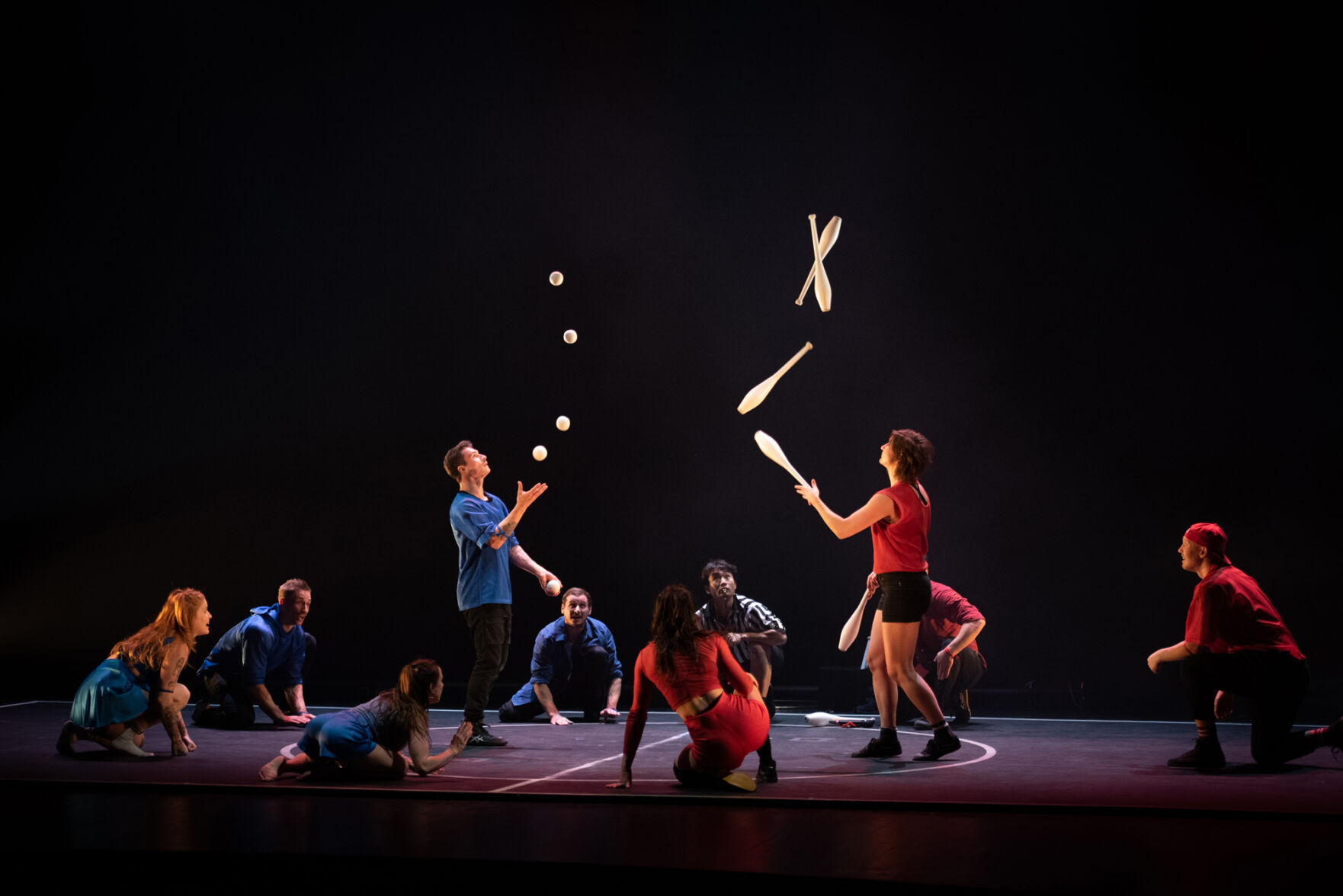
The blue-clad Montagues and red-clad Capulets have a juggling face-off in ‘Duel Reality.’ Photo by David Bonnet.,

