You never know when and where a story idea will turn up, or where it will lead you. My spouse and I were enjoying a quiet dinner at a favorite restaurant some weeks ago when we happened to overhear a snatch of conversation at the next table about an upcoming talk on — of all things — quilting!
Quilting? Our only connection with quilting is a treasured vintage “Lone Star” design quilt, a gift from my late grandmother that she received as a wedding gift more years ago than I care to think about. That memory, and the enthusiastic tone of the overheard conversation, piqued my interest.
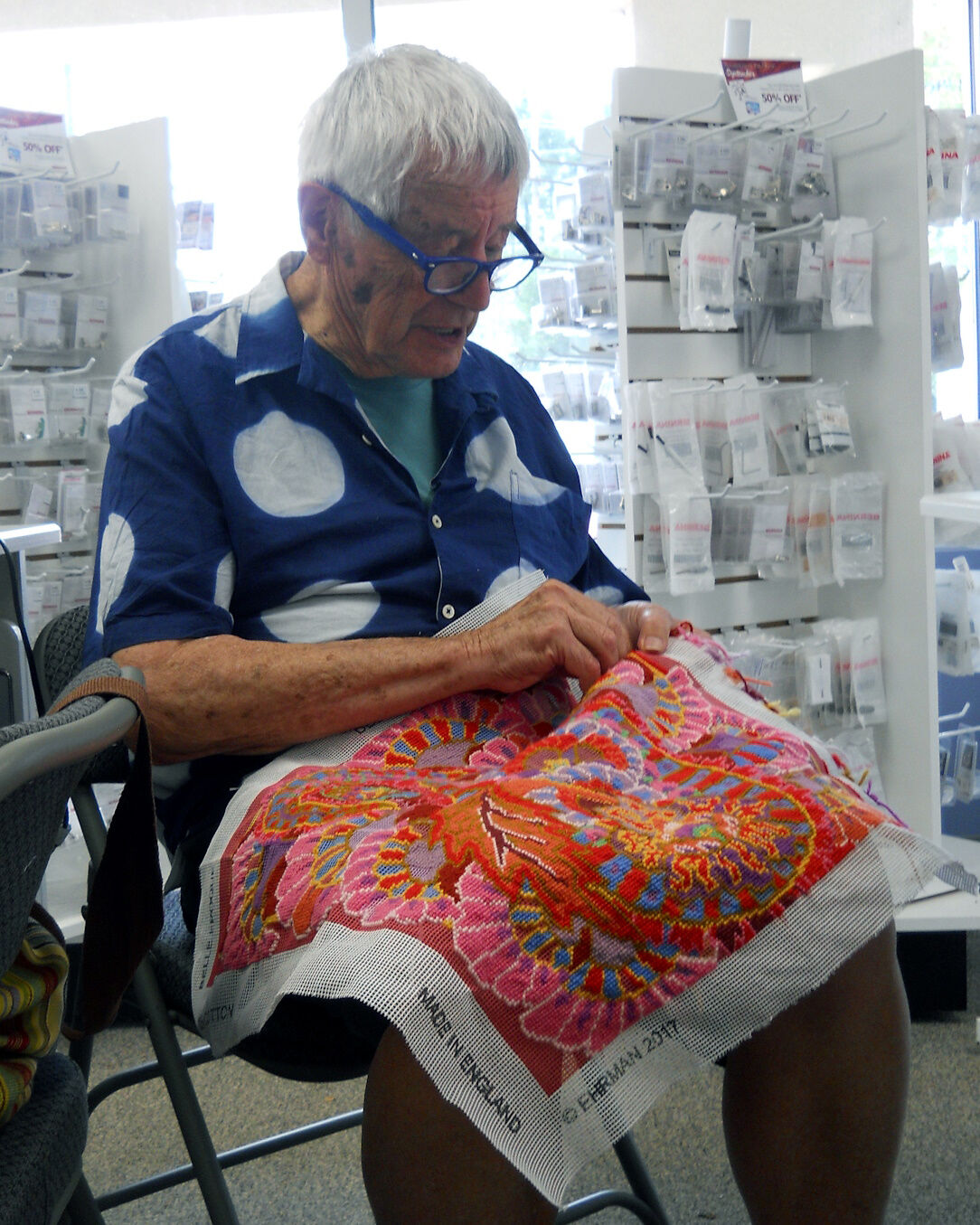
We pieced together enough details to pay an online visit to the Pennington Quilt Works, the sponsor of the talk, and a link to purchase tickets to the event, featuring superstar fabric designer (who knew?) Kaffe Fassett at the College of New Jersey (TCNJ), a stop on his East Coast tour (Mr. Fassett, born in America, now resides in England). The $90 admission price seemed a bit steep, until we learned that it also included a copy of “Quilts on an English Farm,” Fassett’s latest in a series of books on the subject, as well as a Q&A and book signing following the talk.
I learned that he would also be conducting workshops at the Pennington Quilt works on the two days following his talk. Each of the sold-out workshops was limited to 20 participants.
I also had enough time to do a bit of research on the subject of quilting prior to Fassett’s talk, and the results were eye-opening if not downright mind-boggling. According to “The Size of the Quilting Market: Quilting Trends Survey Results 2024,” an annual survey put out by the Craft Industry Alliance (craftindustryalliance.org), a trade association serving the craft industry, the quilt market is expected to be a $5 billion business by 2027.
According to the study, the craft of quilting has 9 to 11 million active participants, a number that’s remained constant for a decade. The average quilter identifies as female (98 percent), is retired (70 percent), and in her 60s with a household income of at least $70,000, began quilting at age 39, and on average owns four different types of sewing machines.
And my “who knew” question was answered in short order when we arrived at TCNJ. Apparently lots of people know who Kaffe Fassett is, crowding into the reception area to check in for the talk and receive their copy of his book, a colorful compendium of colorful designs he created and inspired by “the bounty of nature on a Kent farm deep in the English countryside.”
Lushly photographed in various Kentish tableaus, the quilts bear bucolic names such as Barn Doors, Gingham Lattice, and Country Snowballs. Not just a book of pretty pictures intended for your coffee table, each quilt is accompanied by a list of materials, a full set of step-by-step instructions, and detailed diagrams that promise to make it “easy to copy his designs to the last detail.”
While waiting for the Mildred & Ernest E. Mayo Concert Hall to open, many of the early attendees were also milling about the tables piled with all manner of merchandise; fabrics, quilting sundries, books, quilting kits, thread, scissors, tote bags, fabric weights, magnifying glasses. Still others sat in small groups around the periphery of the reception area, sharing quilting projects in various stages of completion and exchanging sewing tips and techniques.
Arriving early also gave me the opportunity to have a word with Jan Crane, the owner of Pennington Quilt Works, who, despite the approaching zero hour of Kaffe Fassett’s talk, generously spent some time patiently answering the naive queries of this non-quilter.
“Kaffe Fassett is a knitter and fabric designer who’s been at this for a long time,” Crane explained, “and he’s doing a whole East Coast tour. . . . His books are very inspirational. Kaffe asked if we would host it, as we did on a tour Kaffe did eight years ago. We jumped at the chance. He’s an extremely nice man, very talented. Very helpful.
“Tomorrow and Monday we have classes with Kaffe at the store,” she continued. “Each class will have 20 attendees. We have design spaces marked out on the walls, and each participant will be working with a particular pattern. They’ll cut the fabric and arrange it on the wall, and then Kaffe will make suggestions on how to improve their designs. He’s so good at suggesting.”
I shared with Crane my discovery of the extent of the popularity of quilting, and that it’s still growing. “It is,” she agrees. “Ten years ago we were concerned about introducing young people to quilting. There are a lot of younger people who are quilting now, as well as a crop of upcoming designers, authors, teachers. It definitely has a bright future.
How long has her store been in operation? “We will have our 28th anniversary in October,” she says. “We were in another location for 10 years before moving here.”
How has she seen quilting evolve over that 28 years? “There have definitely been significant changes,” she says. The main thing that drives the industry is the fabric. The fabric is just so gorgeous, and that’s what brought the craft to life. And today most do their work using sewing machines. There are hand quilters as well, but you can get so much more done on a machine.”
In addition to the increased use of sewing machines, another (to me) seemingly minor innovation has facilitated the rise in the popularity of quilting; the rotary cutter, a simple but hugely labor-saving device consisting of a sharp cutting wheel mounted at the end of a grippy handle.
“Rotary cutters have helped keep the industry going,” She elaborates. “When I started quilting in the ’70s, I made cardboard templates of all the shapes I wanted to cut, put them on fabric and traced around them, cut them with scissors, and sewed them by hand. With a rotary cutter, you can cut fabrics so much more easily and quickly. We use an acrylic ruler to guide the cutter and a cutting mat to accurately measure out the cuts.”
Another labor-saving innovation is the increased use of long-arm quilting machines, expensive, sophisticated often software-driven contraptions that enable a skilled operator to complete the tedious task of sewing the quilt top, batting and backing together expertly and efficiently, allowing quilt makers to focus on the fun part of the craft, piecing the quilt top together.
“That was a major change to the industry,” Crane notes. “People love ‘piecing’ (putting the top of their quilt together) but putting the top, batting, and backing together isn’t so much fun, and commercial enterprises have sprung up to do that tedious part of quilting for consumers.”
Speaking of the fun part of quilting, I pointed out to Crane that I couldn’t help but notice that quilt designs have evolved from simple patchwork and that Lone Star pattern of my grandmother’s quilt to complex, wildly colorful and in some cases pictorial, almost painterly designs.
“Yes, definitely,” she agrees. “There are collage designs that are pictorial, ‘pixelated’ watercolor designs and more. That’s part of the reason that the industry has lasted and that people have stayed in for a long time, because there are so many ways you can approach it.”
I also pointed out my observation that, while we were waiting for the auditorium to open, groups of people were sitting around the edges of the reception area, projects in hand, exchanging ideas and helping each other. “There’s definitely a sense of belonging to a community, and that’s nice, too,” she says. “A lot of these people met in my quilting classes and started socializing. I love it when people make those connections in the store.”
Is there someone or something that inspired Crane to become a quilter? “There was a small store that I started going to,” she says, “and there was also a large consumer quilt show in Lancaster (Pennsylvania) that I attended for a couple of days very early on, a gift from my husband. It was just so mesmerizing to see all of the quilts!”
By then, the doors to the hall were opening, and Jan Crane took her leave, promising to continue our conversation at her shop. And Kaffe Fassett’s talk? I won’t keep you in suspense; even to this non-quilter, his talk was fascinating and enlivening; in short, a look at the gardens, landscapes, and other wonders of nature that have inspired his fabric designs and color choices over the decades. The hour flew by, and the prolonged standing ovation from the audience felt genuine and well-deserved.
A few days later, I reconnected with Jan Crane at Pennington Quilt Works. With cooler weather fast approaching, I asked whether there was a quilting “season.”
“Not, really,” she says. “People quilt all year ’round. We find that we have a lot of effect on how much quilting people are doing, based on what we’re offering here in the store. When we have a new program or line of fabrics that we’re offering it’s a big draw for us.
“Our biggest program is our Saturday Sampler. We run it during one week a month, 13 different sessions. People can attend any of the sessions. It’s a quilting demo. For example, we just started a new one in September. It runs for a year. People make a block every month and end up with a finished quilt. (Note: The registration fee is $54.95 and includes a starter kit containing the first quilt block and a book containing block layout options and complete directions.) They make the block and bring it to the next session and get the fabric for the next block for free, and so on. As the sessions progress, we start talking about finishing kits — borders additional blocks, etc. — needed to create a completed quilt.
“That’s a big one for us,” she continues. “When we get started we have over 500 people participating. Most of them attend in person, although we do have people who participate by mail and purchase their block each month. It’s a very important program for us. People love it, and it brings more people into the store.
How would you advise someone who wants to start quilting? “We hold classes for beginners over five weeks that we call ‘From Start to Finish,’” she says. “Most people who participate already know how to sew but might not know much about making a quilt. We start with how to cut and put sections together, then how to assemble them and create a finished quilt. We also offer private lessons. People not familiar with their sewing machine will often take a private class before the ‘Start to Finish’ class.”
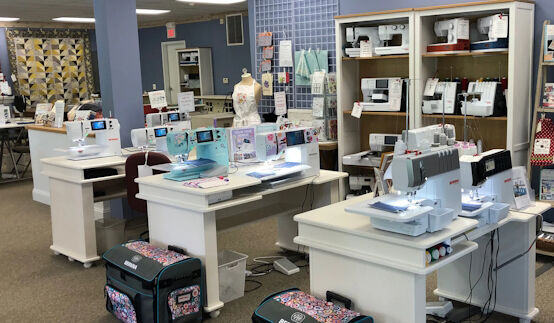
You’ve mentioned sewing machines; your store seems to feature Bernina brand machines at a wide range of price points. What do you recommend for someone just starting out?
“People often start off with a rather simple machine,” she responds. “Our Bernina entry-level machines start at about $1,500. We encourage people to start with a Bernina machine if they can. It will take you pretty far, because there are a lot of accessories can you can add as you keep exploring. If not, we also offer entry level machines from a Bernette, a sister company, that start at around $300.”
She notes that a lot of her customers buy Bernette machines for their kids for the Pennington Quilt Works Kids Camp sewing classes, a three-day in person summer class where third graders on up learn how to sew patchwork and make their own small patchwork projects.
She also pointed out purchasers of machines from her shop receive complimentary instructions in their use. “When you purchase a machine from us you always get free lessons with it,” she says. “The first lesson is an orientation lesson when you pick the machine up. We’ll spend time with you going through the basics so you can go home and use it out of the box. Then, depending on which machine you have, we run a minimum of three additional small-group classes. If you’re doing embroidery there are additional classes for that.”
Are your staff all quilters themselves? “Yes,” she says. “Some are deeper into other types of sewing, but everyone in the store quilts and is happy to answer questions from our customers.”
At this point in our conversation I was beginning to get a real sense of the shop as a center for social interaction, when, as if on queue, Debbie Greaney entered the room. Jan explained that Debbie runs the local chapter of the Quilts for Kids program, which happened to be holding their monthly meeting at the shop that day.
According to the organization’s website (quiltsforkids.org) “Quilts for Kids is a 501(c)3 nonprofit organization dedicated to transforming fabrics into patchwork quilts to comfort children facing serious illness, trauma, abuse or natural disasters.” The organization has chapters across the U.S. and in Canada. Pennington Quilt Works holds quilting workshops and acts as a drop-off point for Quilts for Kids quilts.
Debbie proudly shared that she received 90 quilts this month. “We get between 70 to 90 quilts a month,” she says. “We’re received close to 6,000 since the program began.” Dedicated volunteers make the quilts from donated and purchased fabric from a variety of sources.
She added that her group is also currently working on Christmas quilts for the Shop With A Cop program, a nationwide program that focuses on underprivileged children and families. Police officers spend time with children at the holiday season and shop with them in a local store with a gift certificate furnished by the program. The officer serves as a companion throughout the day, allowing children to become familiar with police and feel comfortable in their presence and experience them as individuals who have families of their own and are here to help.
It’s another facet of the social aspect of quilting that I discovered in my chat with Jan Crane. “We’ve been instrumental in bringing people into the craft,” she says. “Our customers bring in their friends, who then become quilters. There are so many different ways you can approach it, small projects, big projects, simple projects, complicated projects, charitable projects. That’s what keeps it interesting to people, they can grow into it as their skill level and interest grows.
“There are lots more sources of inspiration now as well,” she continues. “When I started the quilting world was a world of books and magazines. Now there’s so much online; websites, Pinterest, Instagram, Facebook, YouTube. I can’t believe that I’ve been dealing in fabric all these years, yet when I receive a new line of fabric from these amazing designers, I can still say ‘Oh! Isn’t that ‘beautiful!’ That’s just one reason I still enjoy coming to work every day.”
Pennington Quilt Works, 7 Tree Farm Road, Pennington. Open Monday through Saturday, 10 a.m. to 5 p.m. 609-737-4321 or penningtonquilts.com.
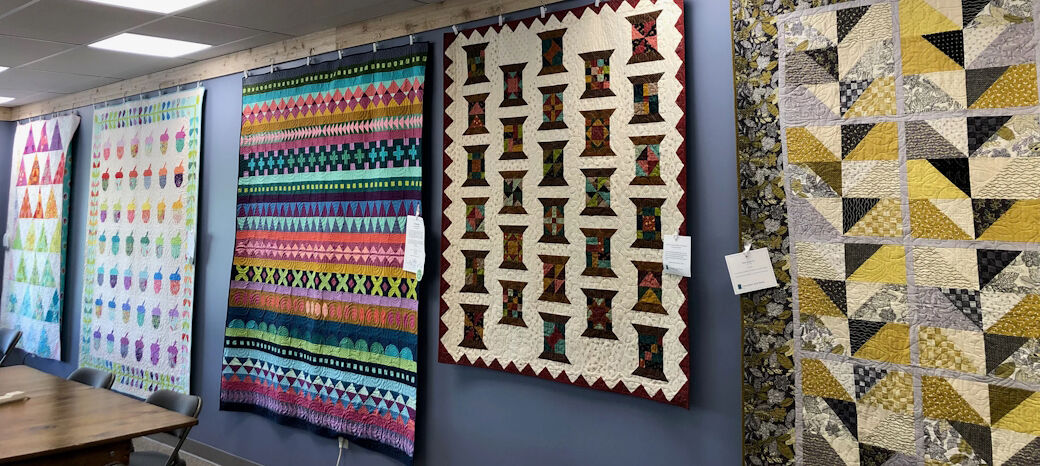
A display of finished quilts at Pennington Quilt Works.,