Last month, I promised to take a deep dive into the Board of Education’s role in the failed HVRSD referendum along with steps to assure the next offering hits the mark.
My reason for writing this column was an event that occurred weeks before the referendum vote. I was introduced to a school board member at a local restaurant. They told me, “My job is to make sure referendum information is out there and let voters decide for themselves. If they vote it down, then hard decisions will need to be made.”
At the time, I thought that was an odd exchange. Then weeks later, at a HVRSD town hall meeting, the board chair of finance and facilities said: “The world will not end if the referendum does not pass, but” — eerily similar to his colleague’s foreshadowing — “we will need to make some difficult decisions.”
This reinforced my suspicion that board members may not fully understand their job. They seemed to be parroting a suggested narrative instead of explaining their due diligence in crafting and vetting a responsible referendum and its importance to voters.
In years past, there was usually a mix of new and experienced board members. In the last 5 years, however, high board turnover has led to majority of sitting members serving in their first term. This year the most senior member, the board president, began a second term.
A dearth of critical experience and leadership is taking a toll on the community, our students, and the entire district. The two most frequently voiced public concerns about the referendum were:
Did HVRSD present a Christmas list of all their wants, needs, and dreams?
Why didn’t the BOE better engage the community regarding the referendum?
Part I in this series last month considered how the administration could have better addressed the first question and suggested that providing correct, consistent, complete, and forward-looking information would have helped defend their choices.
Part II reflects on the board of education’s role as community liaisons to address the latter question.
Please note also that blaming the public for not attending BOE meetings or researching the HVRSD website, is not a productive solution for community members with no children in district. Information must be shared in ways that reach all segments of our community.
What should a BOE member do?
Let’s start with the basics. Board members are officials elected to advocate for the needs of all students and incorporate the input of their constituents. Under all circumstances they will need to make and justify hard decisions. Standing by while a referendum fails does not achieve a board member’s top priority of “ensuring educational welfare of children.”
Instead, by engaging the community in a proactive and inclusive way, board members can anticipate concerns, adjust plans accordingly, and advocate to successfully meet student needs through referendum, administrative oversight, or policy making.
Recommendation: Board members should review HVRSD bylaw 142 to better understand the priorities of the job, and attend NJSBA training.
What should a board liaison and a board president always do?
The HVRSD board’s third bylaw reads: “The purpose of a board liaison is to create a connection between our district and local organizations. The role of the board liaison is to provide accessibility by representing the school district in a meaningful dialog with local organizations.”
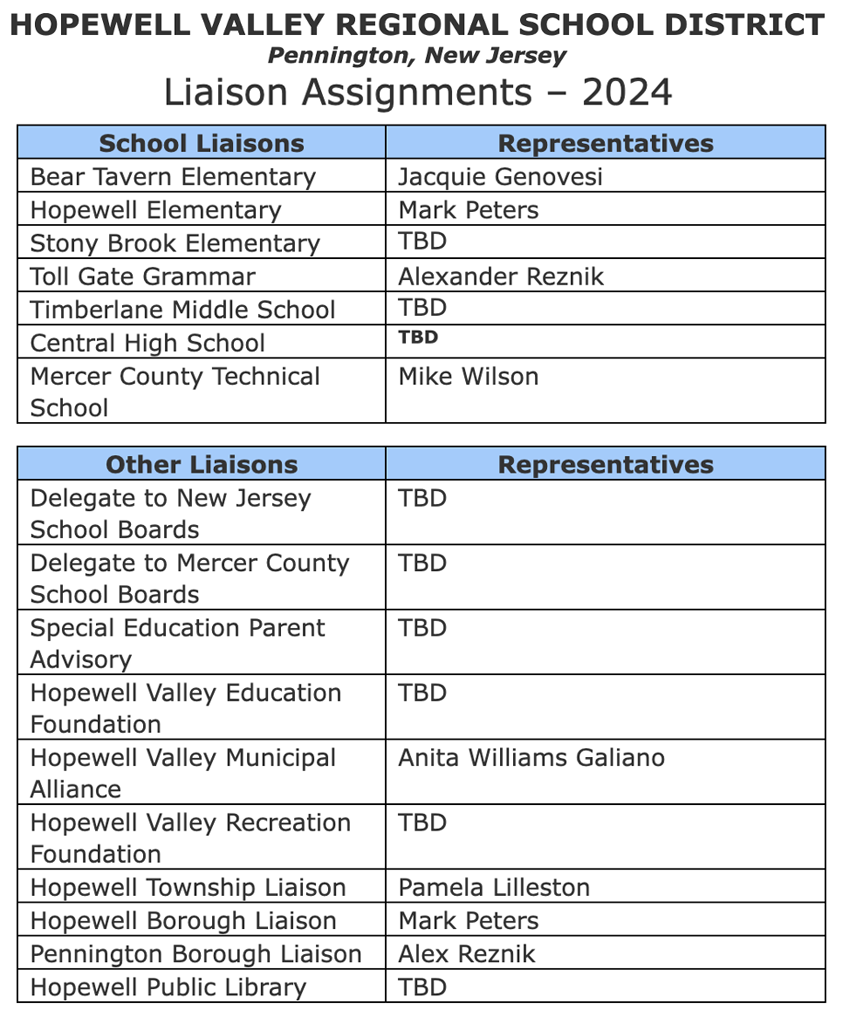
Every January, the board reorganizes and elects a president. The elected president’s initial duties include determining committee and liaison assignments. According to the board website, the majority of board liaison roles were not assigned as of last month and are listed as TBD. (See table on page 17)
Recommendation: Board presidents should assign liaison roles in January. Members should actively follow liaison responsibilities as outlined in HVRSD bylaws and engage the community.
Why was there deafening silence from parent groups?
Unlike the recent referendum, the 2016 referendum passed by the largest margin in HVRSD history. That effort began by engaging local organizations shown on the liaison assignment page and spread from there.
Hopewell Valley Education Foundation exists to support the school district. In 2016, HVEF’s endorsement letter and referendum campaign was helpful. HVEF reports that no one from the district reached out about the referendum, and in general, they rarely engage.
Did anyone actually want additional turf fields? Administrators devoted considerable energy lobbying to spend $6 million for extra turf fields. Their justification included busing costs and athlete safety. Yet there was little advocacy in advance of the vote from sports teams, boosters or even sports parents. This lack of support may have contributed to the overwhelming challenge to the turfs’ inclusion.
It’s a hard sell either way, but with no board members actually assigned to liaise with middle or high school PTOs, groups, or sports parents, there is little evidence the board gauged demand for the expenditure.
Contrast that communication with the CHS turf. The Rec Foundation raised $1 million. Hopewell Township contributed $650,000 in PILOT funds to relocate a new baseball field. Sports boosters and community organizations came out in force to buy turf medallions and support the efforts in other ways.
Additionally, an arts and wellness space at CHS, funded by the 2016 referendum, added external bathroom access from the turf field, a gym and the first ever dedicated space for performing arts. Sports and music theater parent groups came out in force to support the plan. Today, the state continues to provide annual aid for the performing arts magnet that utilizes the space.
Recommendation: board liaisons to HVEF, CHS, TMS and elementary schools should engage parent groups to take an active role in providing input and foster their support.
Why didn’t the BOE confer with municipal leaders to ensure clarity about the referendum?
There is persistent confusion around school and municipal funding and taxes. Municipal PILOT activities were conflated with the school district referendum culminating with a letter from the Pennington mayor and answered by a letter from township mayor. The board should have anticipated this confusion and facilitated municipal dialogues to find common agreement for supporting our students prior to any referendum campaigning.
Conversely, prior to the 2016 referendum, the board president met with all three Valley mayors to discuss the proposed BOE referendum. Subsequently, the mayors settled their differences and came together to help launch the district referendum. That action was regarded as state-wide model and, in October 2017, the HVRSD board president, superintendent, and the township mayor were invited to the New Jersey School Board Association annual convention to present a workshop entitled, “Working closely with your municipal leaders.”
Where was support from the school board members? Finally, the most obvious supporters should be HVRSD board members. After all, they voted yes to approve everything in the referendum! While the school district and administration may not lobby voters, board members may certainly share their voices as individuals.
Indeed, as NJSBA’s chief membership engagement officer recently confirmed to me: “Yes, many successful districts often have board members proactively write letters that share why they voted YES and encourage others to join them. Letters should include a sentence saying that they are not speaking for the entire board but only for themselves.”
Recommendations: School board members should generate support, anticipate challenges, and model the behavior desired. Provide complete and correct information. Engage and respect community opinions and remove items for which there is no public support.
Where do we go from here?
Several people asked me, was such a spectacular failure on the referendum a vote of no confidence in the board and/or administration?
Let’s not jump to that conclusion. Board members volunteer to carry out a difficult job, so let’s assume their intentions are good. Through making rookie mistakes, they gained battle scars and experience from which to learn.
Recommendation: Remember that board inexperience led to this unfortunate waste of time and money. The public must also learn from the process. Re-elect current board members with the expectation that a little extra seasoning, training and experience may result in better outcomes.
Keep in mind that our community values strong schools that provide an outstanding education and students need a secure and productive learning environment. I’m optimistic that, presented with a future referendum that is thoughtful, well vetted, and better communicated, voters will choose to support and improve our schools as they have in the past.
,

,

