If you’re like me, you might spend your free time reading through old documents such as deeds, pension applications and damage claims from the Revolution.
You’re absolutely right: sounds like a lot of fun! After all, it was Indiana Jones who famously quipped the best archaeology is done in a library.
In doing this type of research, you occasionally stumble upon information that opens new doors of discovery; perhaps, you might even pry open existing doors that stubbornly refused to budge more than a crack.
The analogy here applies to a recent finding of a damage claim filed by a Burlington County resident after the Revolutionary War. Mount Holly resident Joseph Bennet lost several items of property to the British and Hessian troops in December 1776, but the first missing item he chose to list was a human being.
Unfortunately for our purposes, this person’s name is not recorded. Mr. Bennet’s claimant simply writes: “One Negro Boy, 18 years old, taken Col. Block, £75.” All we get is the individual’s skin color, his age, what happened to him, and his estimated value.
Obviously, this person was an enslaved individual belonging as property to Mr. Bennet. It would appear he found his freedom among the Hessian army, or did he?
Believe it or not, Black Americans did serve in the Hessian Army during the Revolution. While few saw roles in infantry units, the majority served as waiters and drummers. Employing enslaved African men in these roles had been established practice within the Prussian states that made up modern-day Germany.
Records indicate many enjoyed freedom, albeit in a military sense, compared with the chattel slavery they had endured before joining the army. But what might be seen as abolitionism should not be confused with opportunism on behalf of both parties. For the enslaved, the opportunity to escape and serve in the army was a ticket elsewhere from their present conditions.
For the Hessian regiment, it was a way of freeing up noncombatant positions so white soldiers could plug holes in infantry regiments. Still, others had no choice and were kidnapped regardless of their personal feelings. After all, no regiment was ever at full strength, and the Hessians actively recruited white Americans in New Jersey too. According to the Hessian muster rolls, several Burlington County residents joined up in December 1776.
From the scant recording of Mr. Bennet, it’s hard to discern what condition or choice this individual was in. Was he taken against his will, or is that Mr. Bennet’s version of events?
Lt. Col. Justus Heinrich von Block commanded the battalion named after him. It consisted of grenadiers plucked from the Regiments Donop, Prinz Carl, Trümbach, and Wutginau. Divided between four companies, Col. Block had about 800 soldiers under his command at full strength.
The grenadiers were among the crack squads of the Hessian regiments that landed in 1776, and had fought gallantly at Brooklyn, Harlem Heights and White Plains. Despite their name, none carried explosive grenades into New Jersey. What they did carry was a strict discipline and imposing stature of the Prussian-state war machine of the eighteenth century.
When Count Donop attacked Mount Holly on Dec. 23, 1776 in what is known as the Battle of Iron Works Hill, the Block Battalion was present. At the onset, when Donop decided he’d had enough of the small resistance taking shots at him from atop the mount, he ordered the Block and Linsing Grenadier Battalions, along with two regiments of the 42nd Royal Highland Regiment, to envelop Mount Holly.
The American skirmishers were outnumbered, and broke from their position. The ensuing artillery bombardment into town and onto Iron Works Hill saw the last of the American militia fleeing town after nightfall.
Unlike the bulk of Count Donop’s brigade (whose members returned to their previous posts), the Block Battalion stayed in Mount Holly, along with the Hessian Jägers under Capt. Ewald and Col. Donop himself. There they lay for three critical days. When news arrived on Dec. 26 of Washington’s attack on Trenton, Donop ordered his forces to assemble and make way for Black Horse and then Crosswicks.
Despite the past few days laxness, he was wise enough to know he might be cut off if American troops got between him and Princeton. Most of the brigade hurried forward while Ewald lingered in the rear to secure the baggage and contraband: dozens of wagons full of booty.
The Hessians had plundered Mount Holly and taken with them untold amounts of stolen property. It appears Mr. Bennet’s enslaved individual was among them, claimed by Lt. Col. Block.
This means this person was present during the ensuing Forage War of 1777 and the Battle of Short Hills on June 26.
Colonel Block fell ill in the summer of 1777, and command of his battalion fell to another officer; it was renamed the Lengerke Grenadier Battalion and saw action at the Battle of Red Bank on Oct. 22, 1777. Ironically, Col. Donop himself employed a young Black individual. After being mortally wounded at Red Bank, a Hessian officer wrote that it was Donop’s Black servant who flagged him down to inform him the count’s leg had been blown apart.
Zachariah Rossell, known in Mount Holly as ‘Old Zack,’ was a tavern keeper and Patriot supporter. Evidently, the British were aware of this in June 1778 when they marched into town. Mr. Rossell adds an extra layer to our story by including the following in Mr. Bennet’s claim:
“Zachariah Rossell, being affirmed declares that he was taken a prisoner by the British Army and taken to New York, and while there saw the aforementioned Negro boy, whom this affirming knew in Mount Holly previous to his being a prisoner, and upon asking the said boy concerning his being there, the boy replied he was there a waiter to Col. Block, and this affirmant further says that he has good reason to believe that the said owner has not since got him again.”
After this, it’s impossible to know what became of this young man. He very clearly had no intention of returning to Burlington County. Lt. Col. Block, was in fact, no longer in New York. He was no longer in America, having sailed home in July 1777 with Hessian General Leopold von Heister.
Did he accompany the officer back to Germany, or did he remain in New York as a waiter to another officer? If this man survived the war’s many obstacles (smallpox being chief among them), it’s likely he left with the British army in November 1783. when they evacuated New York City. One can then speculate he settled as a freeman in Nova Scotia or parts elsewhere.
What should be clear to the reader from this little snippet is that the Revolutionary War has stories of diversity that offers modern audiences plenty of opportunities for research, learning and understanding of our history.
Adam Zielinski is president of the Rev War Alliance of Burlington County.
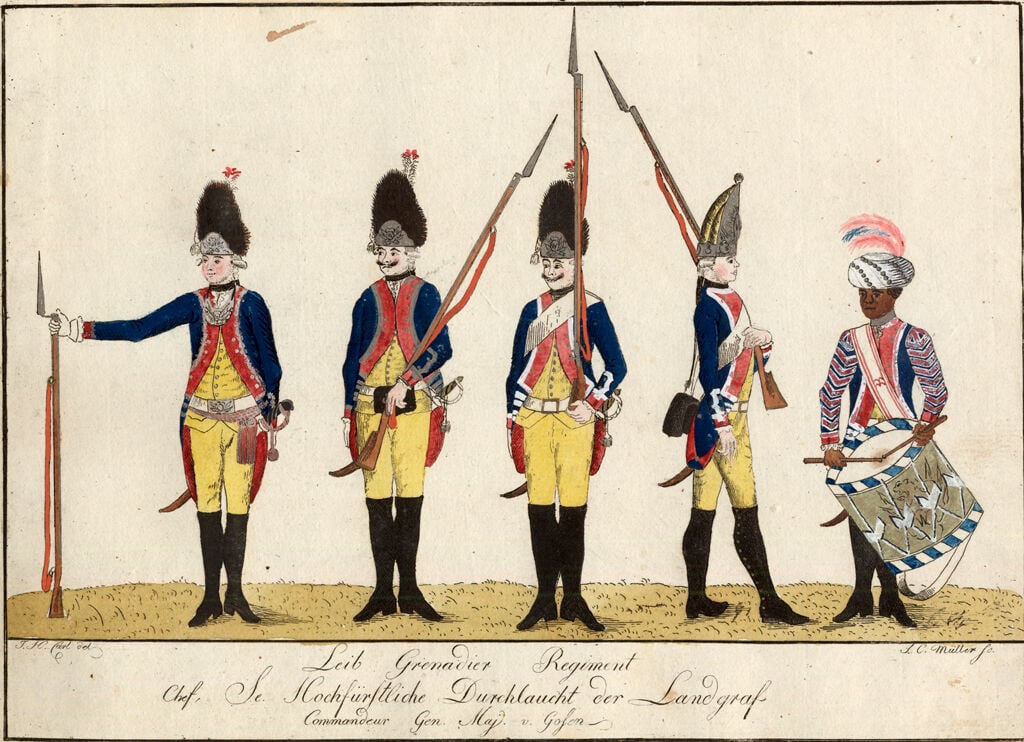
J.H. Carl, “Leib Grenadier Regiment” (1784). Prints, Drawings and Watercolors from the Anne S.K. Brown Military Collection, Brown Digital Repository, Brown University Library.,

