A year-long investigation of the Trenton Police Department by the Civil Rights Division of the United States Department of Justice and the United States Attorney’s Office, District of New Jersey, has resulted in a 45-page report that is deeply critical of the department and its “pattern or practice of constitutional violations.”
The investigation, launched in October, 2023, was prompted by an incident the previous year in which a Black man was shot four times and paralyzed from the waist down after he drove away from officers who were refusing to tell him why they had approached his vehicle.
Investigators interviewed police officials as well as more than 100 community members; reviewed department records, body camera footage, newspaper reports, and court filings; and conducted site visits and ride-alongs.
While the department disbanded two specialized enforcement units that had been involved in egregious constitutional violations as soon as the investigation began, officials concluded that those changes alone were not sufficient to address the department’s systemic issues.
“We have reasonable cause to believe that TPD and the City engage in a pattern or practice of conduct that violates the Constitution,” the report states. “First, TPD uses excessive force, often escalating encounters when facing little resistance or threat. TPD’s excessive force includes both physical force and pepper spray. Second, TPD conducts pedestrian and traffic stops and searches without legal justification, unlawfully prolongs traffic stops, and makes unlawful arrests. These violations were especially prevalent in the Street Crimes Unit and the Violent Crimes Unit, but constitutional violations extended across the department.”
The report cites numerous incidents to support these claims:
• “Officers from the Violent Crimes Unit chased a sixteen-year-old boy because he matched the description of a suspect reported to have a gun and ran when police pulled up next to him. One officer grabbed the teen by his neck and slammed him into the hood of a car as he cried in pain. The boy was unarmed.”
• “An officer beat a woman in the head with a police radio over a dozen times at a soup kitchen. The officer had told the woman she was not allowed at the building and had to leave. The officer claimed that the woman hit first and that the officer ‘inadvertently’ hit back in self-defense.”
• “In one incident, officers in the Violent Crimes Unit followed a young Black man after seeing him outside the back of a store in black clothing at 10 AM. The officers followed the man, grabbed him, and placed him under arrest. After the arrest, one of the officers said to the other, ‘I don’t know what he had.’ The officer added, ‘Maybe he didn’t have anything. I don’t know what he was doing.’ Without any objectively reasonable basis to suspect the young man committed a crime, the officers should not even have stopped him, much less arrested him. Officers also arrested five more Black men for filming the young man’s arrest from across the street, even though the men did not interfere with officers during the arrest.”
The report also noted a pattern of officers using pepper spray on people not breaking any laws who criticize or insult the police — a form of free speech generally protected by the First Amendment. For example, it cites an incident in which “a man yelled at an officer that he would call a lawyer after witnessing how the officer responded to a car accident. The officer responded by pepper-spraying the man, causing him to fall to the ground in pain.”
Investigators list a host of systemic issues as contributing factors to the department’s issues. The department was found to actively ignore or insufficiently investigate instances of excessive force; to discourage complaints and disrespect those who made them; to undermine accountability through poor or inaccurate record-keeping; to provide inadequate training and supervision; and to lack the systems to assess its own work.
A list of 26 recommended remedial measures was provided in the areas of use of force; stops, searches, and arrests; accountability; policies; training; and supervision.
In a statement following the report’s release, Trenton Mayor Reed Gusciora said: “We gave this extraordinary access because we believe that the safety of our residents and the protection of their constitutional rights is paramount, as is supporting those members of law enforcement who do their best every day. These are not mutually exclusive ideas. All residents of the City of Trenton, and the thousands of people who come here to work and visit on a daily basis, want and deserve a police department which keeps them safe while upholding the rights afforded by the U.S. Constitution. Trust within the community is absolutely critical to the mission of the TPD, and the members of the TPD must work at building and rebuilding that trust every day.”
He continued: “The City will continue to work cooperatively with the USDOJ, our state partners at the Department of Law and Public Safety and the Department of Community Affairs, local community organizations, and residents to implement the recommendations highlighted in the Report as quickly as possible.”
The full report can be viewed at www.justice.gov/d9/2024-11/findings_report_-_investigation_of_the_city_of_trenton_and_trenton_police_department.pdf.
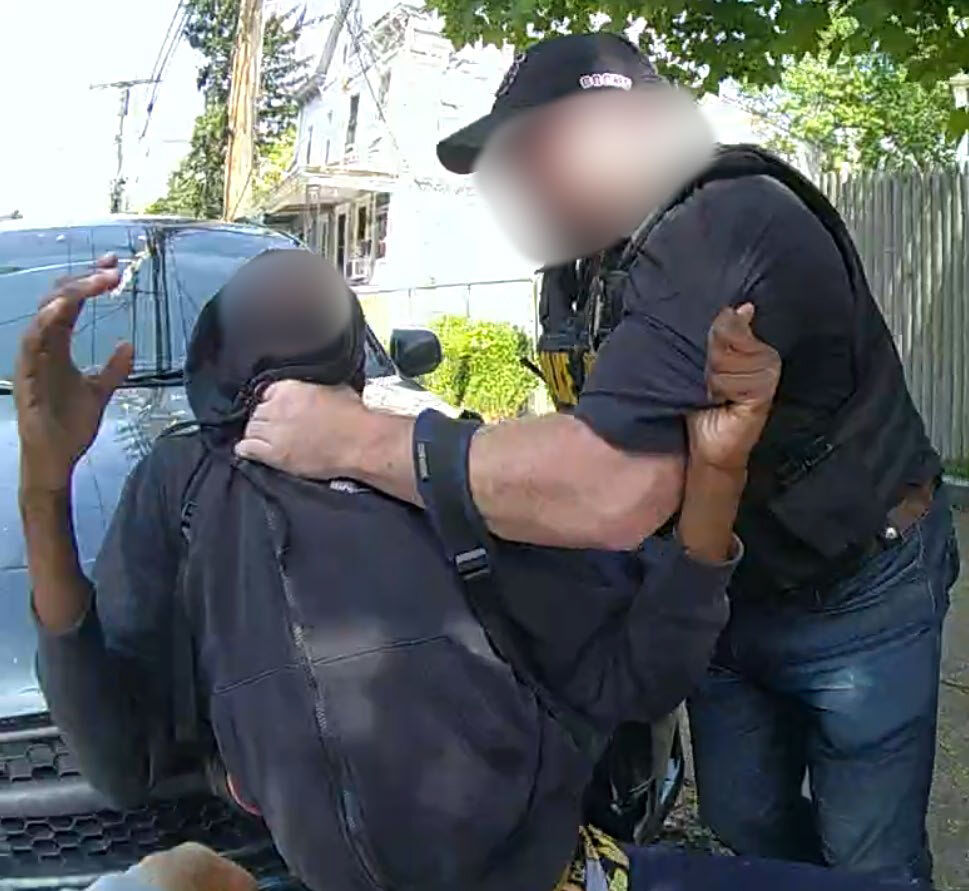
A police image shared in the report shows an unarmed 16-year-old being slammed into the hood of a car.,

