Typically a two-person art show starts with a curator’s concept that is realized by bringing together artists whose work meshes both conceptually and aesthetically. But the germ of the upcoming show, “When the Land Calls,” which opens Sunday, December 15, at the D&R Greenway galleries at 1 Preservation Place in Princeton, is a little different. The show’s curator, David Scott Lawson, writes that “the unifying context was not the art itself, but in the origin story of how these artists came together to serve a greater purpose.”
That origin story grew out of Yvonne De Carolis’s holistic vision for her land along the Millstone River in Plainsboro, which brought together two artists, Mike Benevenia and Ellen Rebarber.
De Carolis’ vision for the large, wooded property where she lives today is that it does not belong to her, but is a place of beauty that she hopes will ultimately belong to the public. Sensitive to the land’s history as well as its future possibilities, she is always adding her own artistic touches to the property. One unexpected chance to add beauty happened in 2023, when she was able to save from demolition three large sculptures created by Ellen Rebarber of Highland Park and give them a new life on her property — a story told in the January 3, 2024, U.S. 1 article “Construction Gives Way to Connection & Creativity.”
Two of the sculptures required restoration. Although De Carolis repainted the badly rusted red sculpture herself, she needed help fixing one that had been seriously damaged in a car accident. She invited welder-sculptor Mike Benevenia of Philadelphia to help her, and then invited Rebarber to consult. Their interaction was magical. As De Carolis says in the U.S. 1 article: “We worked in such unison with each other. When we knew we couldn’t totally get it to where it was, we were able to brainstorm together so quickly and fluidly that I could see the process of creativity.”
That experience created a relationship between De Carolis and these artists and inspired the idea of a shared exhibit displaying their work at the D&R Greenway galleries. Linda Mead, president and chief executive officer of D&R Greenway Land Trust, loved De Carolis’s story about the land calling to her, and also felt that Benevenia’s and Rebarber’s work reflected D&R’s mission to preserve and care for the land and inspire a conservation ethic.
“They have a lot of color, and I think at this time people like cheery color, and the earthy elements in them speak to the land,” Mead says.
Mead also sees links between their work and the Joseph Shannon legacy estate sale that will be going on in the downstairs gallery. The late Lambertville-based artist donated his house and wooded property (now listed for sale), as well as his diverse artwork and his glass and pottery collection to support D&R Greenway’s land preservation work.
When Lawson was brought in to curate the show, he chose its title “not only as a reference to the story of Yvonne De Carolis and these artists, but because I believed it would resonate with D&R Greenway’s community and a connection to the land that so many people identify with,” he writes in his curator’s statement.
“With this show, I’m not attempting to create a direct relationship between the works of these two artists, but rather, present them as individual voices that might not otherwise be shown together. Although each of these artists has a distinct approach and vocabulary, they do both work in the realm of abstraction, and both explore and employ a wide range of materials and mediums. As such, there is a conversation happening between their respective works.”
Rebarber’s connection to nature dates back to her childhood, when her father would identify trees and tell stories about them during their walks in the woods. “That jumped me into being observant of my environment and my surroundings,” Rebarber recalls.
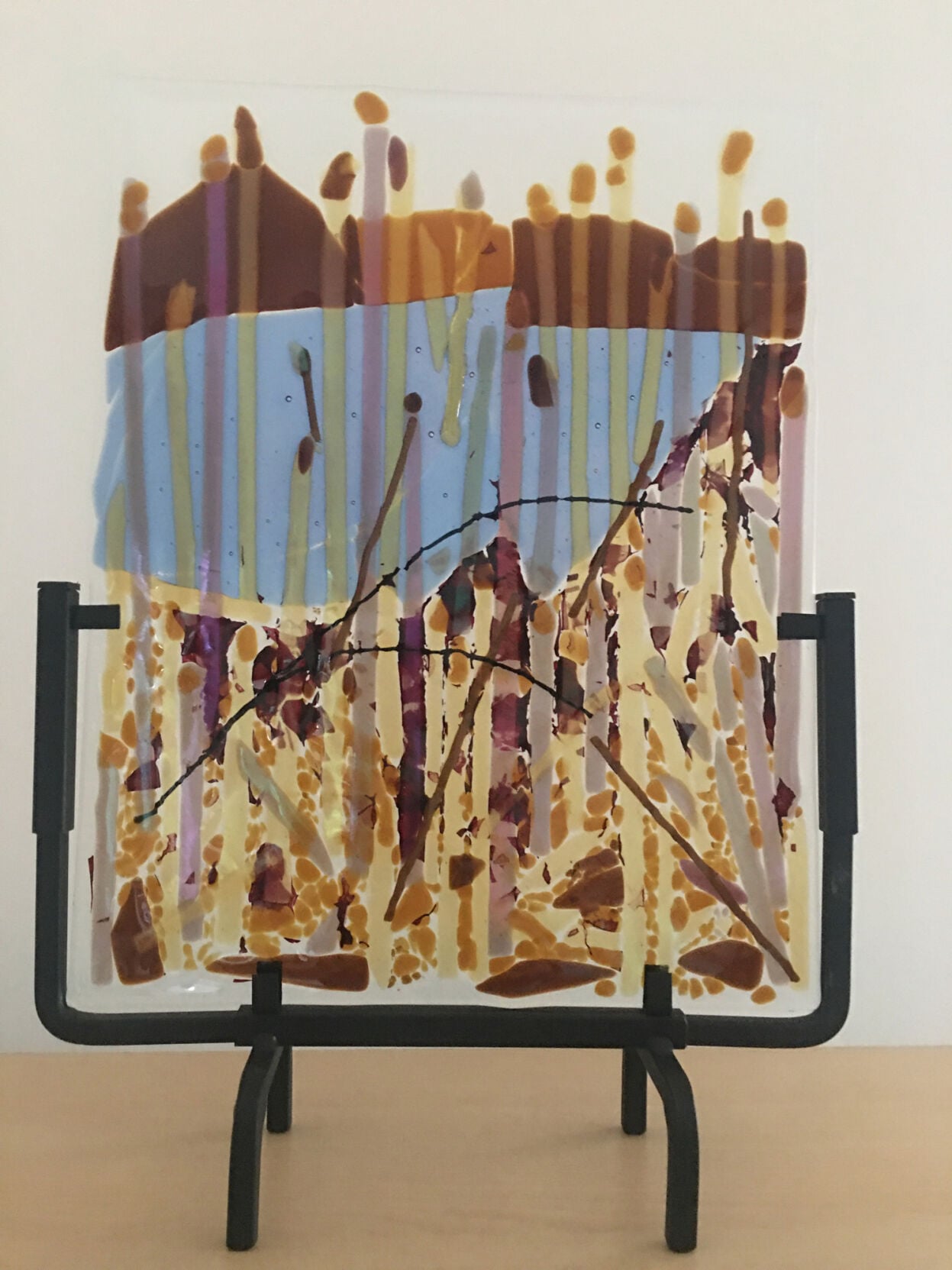
One of her pieces, “Pond Transformation,” reflects her own walks in Donaldson Park, on the Raritan River near her home, where she appreciates how seasonal and daily changes in weather and light transform the vegetation. In this fused-glass piece, Rebarber’s material choices capture her fall experience at the park with layers of transparent, iridescent glass: blue for the pond, purple for the cattails nearby, and yellow to capture the plants dying as cold weather comes.
Rebarber’s “Circle of life” captures the sense of a larger world community, connected to the land we call “Earth.” A multicolored circle of glass fragments is supported by a wooden base and vines. In this work Rebarber says she “wanted to show that we are all many races, many religions, many colors, many backgrounds and … how we’re all on this earth together. Everybody has a life and we share it with each other, and the wood pulls everything together.” The base and vines, she explains, are “the environment trying to hold us together to make a complete work of art.”
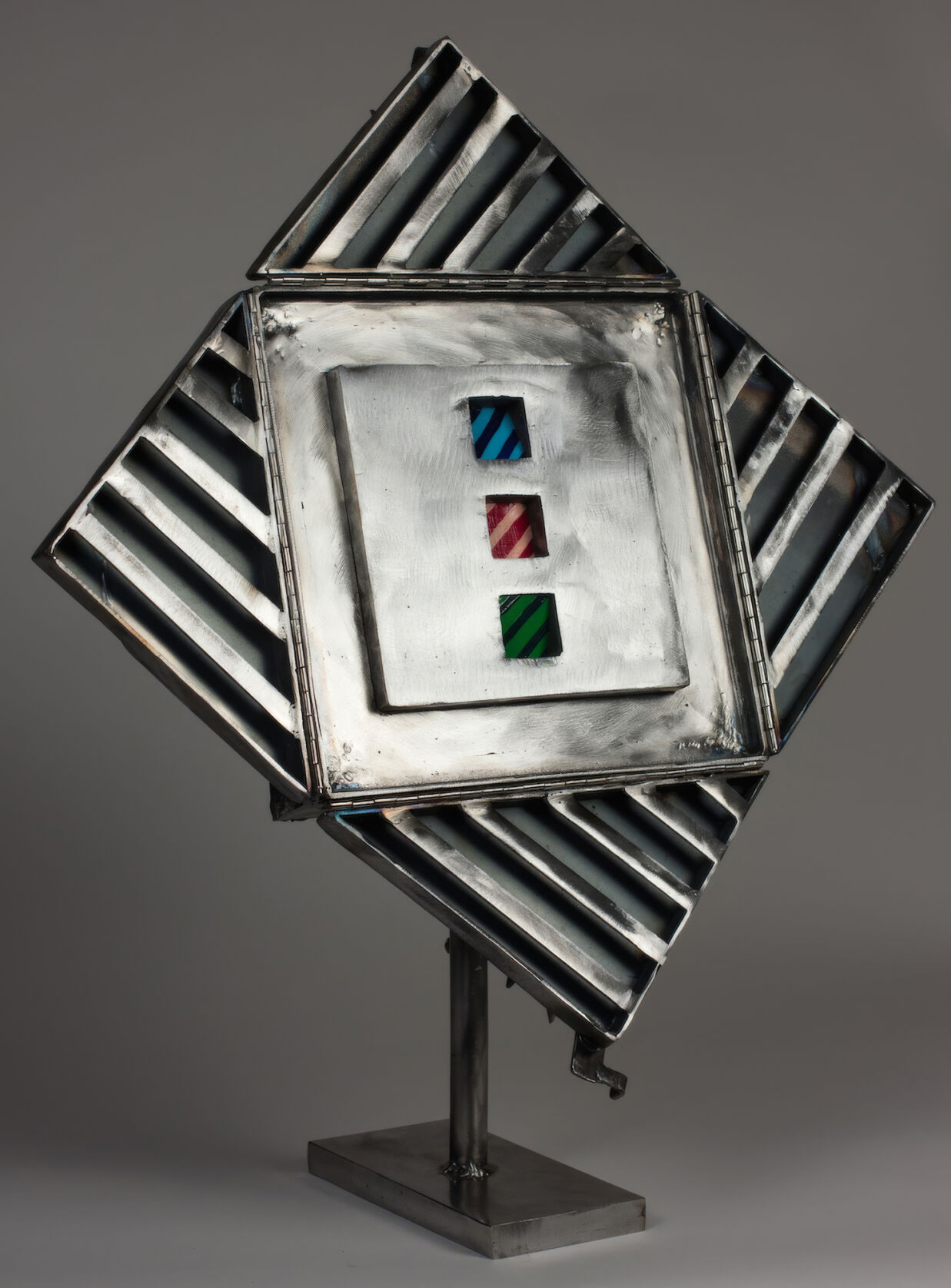
Benevenia’s Canto VIII (phototropic) responds to the phenomenon that plants grow in the direction of light. When the sculpture’s doors are open, there is an interplay of both squares and stripes, with three tiny striped paintings that reference the primary colors of light, blue, red, and green. When the doors are closed, the sculpted backs of the triangular doors take on an orchid-like shape. “The plant is reacting to the light, and the angles of the paintings are referencing the changing plant orientation,” Benevenia says, adding that in this work “I try to emulate the different gestures that I’m making in paint and in metal and go back and forth between them.”
Rebarber grew up on a New Jersey chicken farm, but her parents were New Yorkers. Her mother worked in the garment district, and her father and his brothers owned a mattress and furniture business that went bust during the Depression. At about the same time, her father became ill and was advised to move to the country for fresh air.
Her parents ended up sinking their entire savings, $7,000, into a house (without electricity or running water), garage, and chicken coop on 11 acres in Piscataway, where they moved in 1931, when Rebarber was an infant.
In a poor family like hers, art was sometimes necessary to create toys. She and her father would sometimes dig up clay on the shores of the nearby Raritan River to bring home. “I remember making little bowls of clay and sitting on the chicken coop step and letting them dry in the sun,” Rebarber says. She used the bowls for her doll — they could afford only one — and for her cat to drink milk from.
Although she took a jewelry class with her mother at age 12 (where she learned to solder nickel and copper), Rebarber got her first real introduction to art at Newark State Teachers College, now Kean University — in an art history class whose textbook she still refers to.
Three days after her 1953 graduation — the only time her husband could get off from the army — Rebarber got married. She spent three years teaching elementary school in Highland Park, raised her kids, and then taught for another 32 years.
A big turning point for her was a cold, snowy February day when she was home with her runny-nosed children. “I was at my wits end,” she recalls. “The doorbell rang, my mom comes in, and I burst out crying.” Her mother insisted that Rebarber sign up for a class, offering to babysit for her grandchildren.
For a decade Rebarber studied at the Y in Highland Park with American painter and sculptor George Segal, who she says taught her “to see.” One day in class Rebarber recalls feeling stuck and not knowing what to paint. Segal told her to look at a corner of the room, “see what you see,” and then paint it.
“I remember painting the corner, but I used color, and it became an abstract painting, and that was very exciting for me,” Rebarber says. “Just observe and look at your surroundings and you’ll always come up with an idea, and that’s always been true for me throughout my career.”
When she retired, Rebarber decided to pursue three-dimensional art, in particular large sculptures. At Middlesex County College, she learned how to use all the tools in the wood, metal, and ceramic rooms. Two years later she moved on to the Mason Gross School of the Arts at Rutgers, where she studied with Rudolph Serra, among others. “Rudy Serra pushed us so tremendously and was so inspirational,” she recalls. They would first create a small maquette (model) and then use it to create a large sculpture.
One of her first sculptures was a seven-foot-high woman made out of copper, for which Rebarber cut out all the pieces on her dining table. “‘I Am Woman’ displays the female body, which is absolutely beautiful,” she says. She also created the three sculptures now on De Carolis’s property under Serra’s tutelage.
Benevenia owes his earliest exposure to art to his father, an orthopedic surgeon who fell in love with the art of modernist American sculptor David Smith and then taught himself to weld in his basement. Benevenia learned to weld from his dad, and his first work was similar to the modernist totem forms his father had created. He also did some photography as well as painting and drawing —but, he says, “I never thought of myself as an artist; I wanted to be a geologist.”
But a campus tour at Rutgers University with his father moved art to the forefront. When their tour reached the art school, his father said to him. “If I were going to school today, I probably would go for art, not medicine.” Benevenia decided he would apply to art school.
When his interviewer at the University of Rochester flipped through Benevenia’s photographs (which constituted most of his portfolio, although he had “thrown in” a couple of steel sculptures), he was apparently unimpressed and asked Benevenia: “If somebody paid you to do photographs or sculptures, which would you pick?” Benevenia answered “sculpture” and that was it. He registered at Rutgers as a sculpture major.
Benevenia’s years at Rutgers were split between two mentors who were polar opposites. Michael Rees “was very all over the place, over the top, and wanted you to do everything,” while Gary Kuehn was interested in material, process, form, aesthetics, and “making things that didn’t necessarily have a narrative.”
For Rees Benevenia created a 15-foot-tall costume of a bull, with puppet arms. But Kuehn “really hated” that type of work. “Because of me he made a rule that no one could make any figurative work the whole semester,” Benevenia recalls.
He took Kuehn’s dictum as a challenge and created a figurative piece for his thesis — a 14-foot-tall rendering of “a funerary monument to the end of my college career,” based on Michelangelo’s “Medici Chapel.” Kuehn did manage to give him faint praise for it: “It’s not my cup of tea but you did a really good job.”
In the fall of 2010, after graduation, Benevenia went to welding school “to get a trade to make a living” and in March, 2011, he started working at the Johnson Atelier, where he learned to use cranes and to work with metal. After being promoted, he tore a ligament in his foot while moving around one of Seward Johnson’s big sculptures.
This accident gave him an opportunity to experiment and change direction. In his bedroom he started to make very small paintings “using lines to make almost a woven-looking surface,” with “lots of layers.” When his foot recovered, he went to Italy with his Roman Catholic family and became enthralled with altar pieces, which on the inside included multiple panels with different paintings, some of which, he says, “can get really sculptural.”
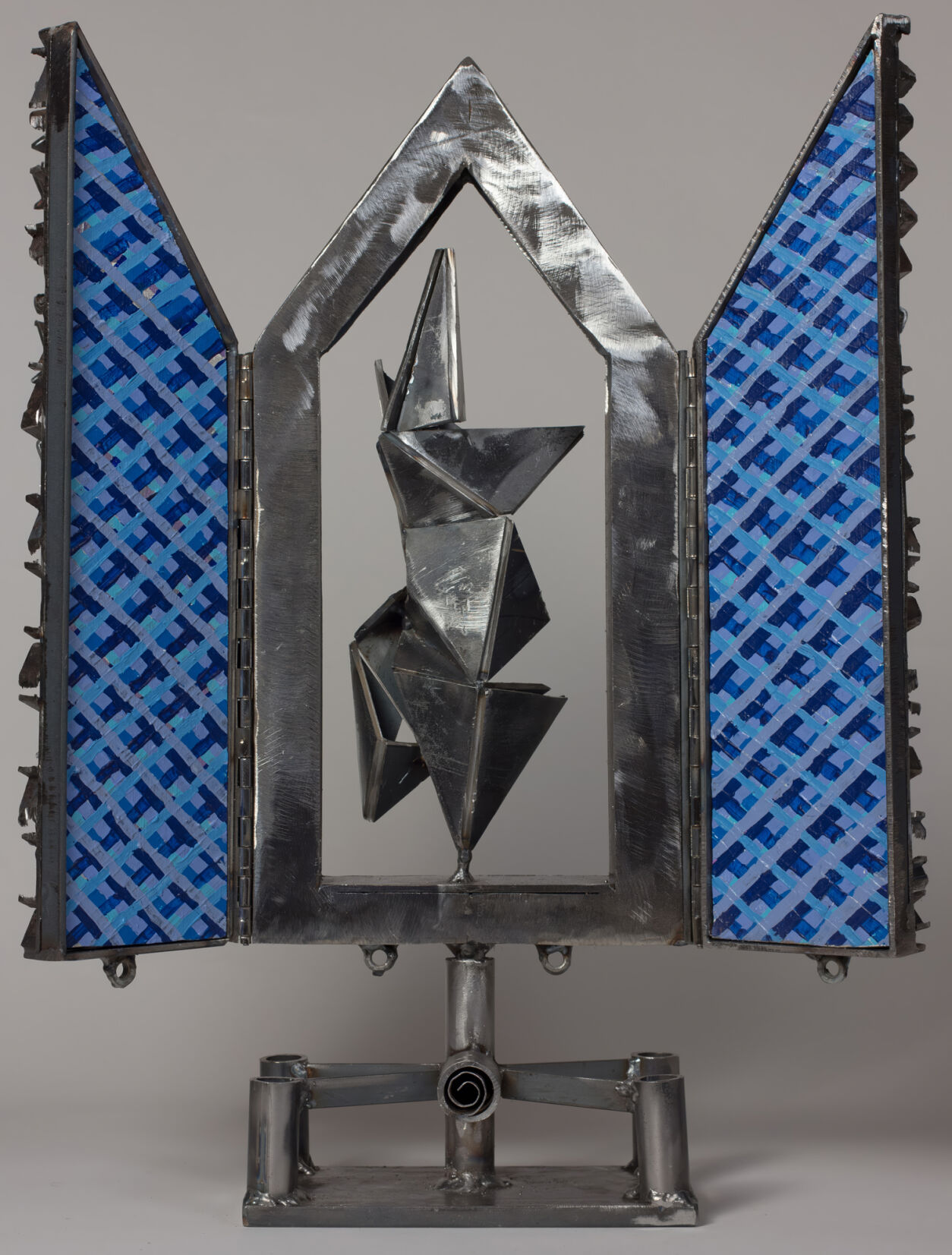
When he got home, he took time off to create an application portfolio for graduate school. The pieces he created, including the “cantos” in the D&R show, integrate metal sculpture and painting, using a contemporary approach to create sculptures that reference altar pieces.
In Canto IV (In bocca al lupo), for example, four “doors” are painted with a woven design, two in front and two in back of the sculpture. They can be closed or opened. He also cut slivers of square steel tubing that he welded to the sides of each door, to mimic the checkered blue paintings. An inner, more figural sculpture, created from triangles cut from metal, can be viewed either with no background or against a painted background.
At the Maryland Institute College of Art, in the graduate MFA program, Benevenia worked under Maren Hassinger, who wasn’t like either of his previous teachers. At two-hour meetings she would serve as “an amazing sounding board and help you work through what you are trying to do.”
Since graduate school, many influences have pushed Benevenia’s art in new directions. During a visit to the National Museum of Civil War Medicine in Frederick, Maryland, the prosthetic arms and legs moved him, and he responded by bringing them into his art.
During a visit to the Gettysburg National Military Park, he noticed the stark contrast between “people who seemed so proud” and “a horrific place where horrible things happened” and “where I felt we failed so much as a country.” The fences that were everywhere on the site got him thinking about the people who had been building and repairing them for 150 years, and fences crept into his sculpture.
In 2019 a Fulbright scholarship sent him to India to learn more about traditional Indian medicine, called “unani.” He also got interested in “jugaad,” a way of thinking and problem-solving that involves using limited resources to create innovative solutions. He was drawn to “the immediacy of solving a problem with what you have at hand. I’m trying to take that into my art by working with things that are broken. If a material has a break in it, I’m trying to draw attention to the imperfection.”
Benevenia left the Johnson Atelier this summer to become studio technician in the art department at Rowan University, where he had been teaching part time for a couple of years. His latest art project is to create abstract, nonrepresentational stations of the cross.
Although the work of these two artists is very different, Benevenia notes an important connection between him and Rebarber. “I feel a kinship with her trying all these different materials. She doesn’t leave a single stone unturned in the way that she approaches aesthetics. She tries everything.”
When the Land Calls, D&R Greenway Land Trust, Marie L. Matthews Gallery, Johnson Education Center, 1 Preservation Place, Princeton. Opening reception Sunday, December 15, 1 to 5 p.m. Featured artists Ellen Rebarber and Mike Benevenia speak at 2 p.m. The festive holiday opening offers music and refreshments and includes a Legacy Estate Sale of colored glass, crystal, pottery and landscape art of Lambertville artist Joseph Shannon. All art is for sale. Register. The gallery is open weekdays from 10 a.m. to 4 p.m. www.drgreenway.org or 609-924-4646.
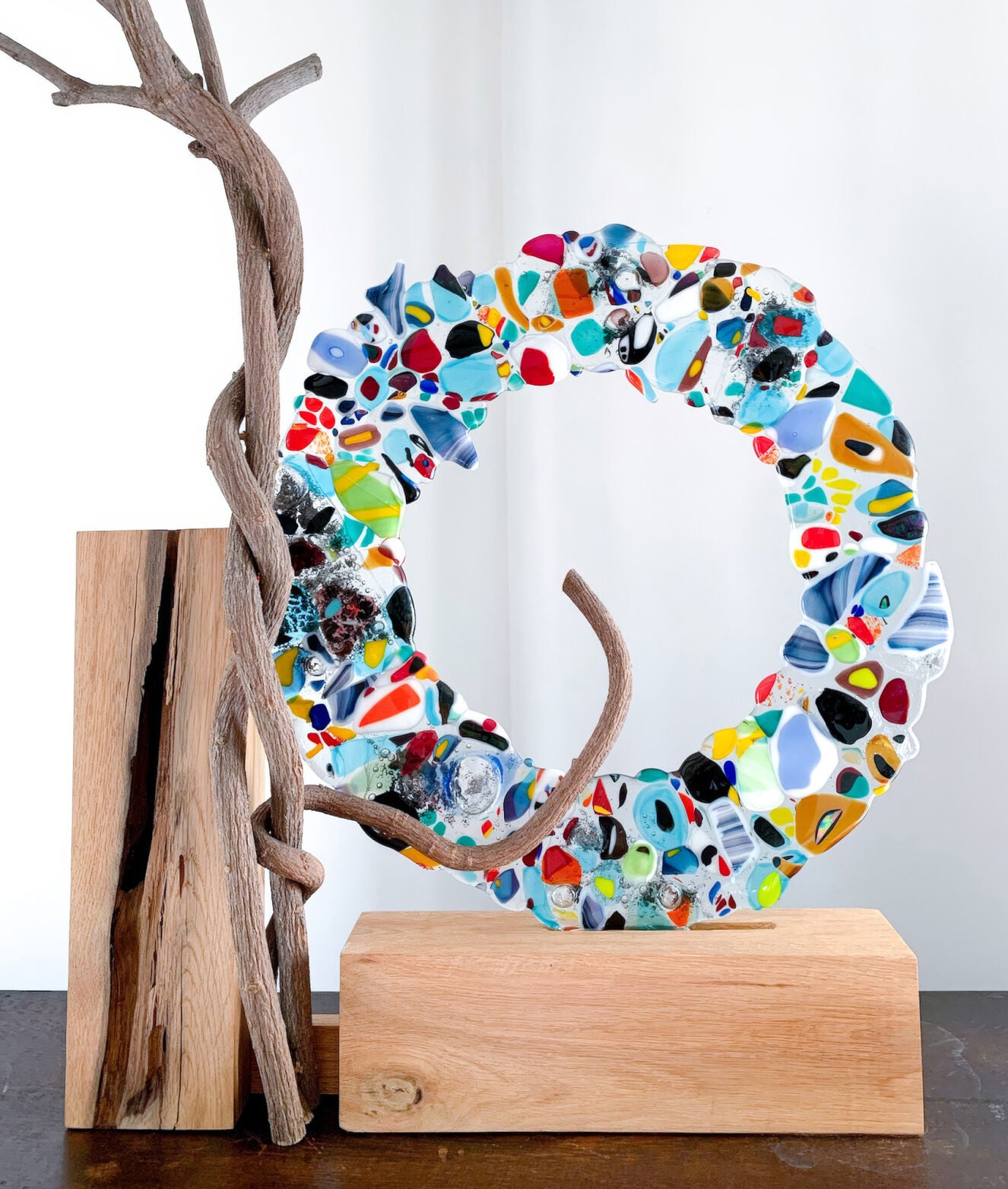
'Circle of Life' by Ellen Rebarber.,
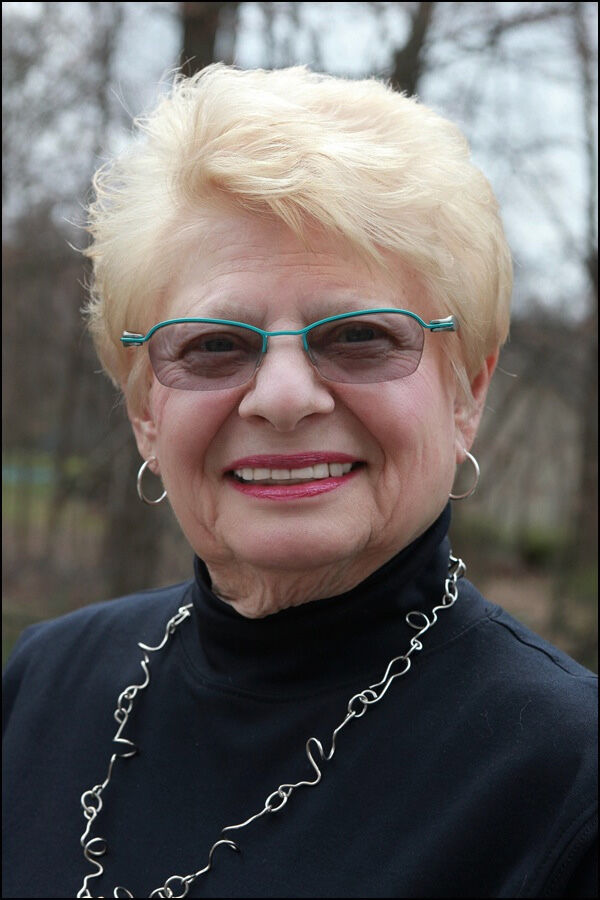
Highland Park-based artist Ellen Rebarber.,