When Gustavo Rangel Almirall heard the reggae-inspired melody of his favorite song played by the chimes of bells, it was love at first sound.
The rising senior at High School South happened to be in Princeton on the day that “Walking on the Moon” by The Police was performed on the university’s carillon — a little-known instrument that’s actually been around for hundreds of years.
What he heard that day has led him on a journey not only to learn more about the instrument, but to also create an effort that he calls “Project Carillon” to help spread the word about the instrument.
Fascinated by what he heard that day in Princeton, Almirall did a little bit of research and then emailed Princeton University’s carillonneur, Lisa J. Lonie, to learn more about the instrument.
“Next thing I knew, without ever being inside a carillon, I was up in the playing room, playing with her a simple song for all of Princeton to hear,” Almirall says. “Now encapsulated in the instrument, I learned how much culture it has, and how it adds to the soundscape of Princeton.”
The Guild of Carillonneurs in North America website describes the carillon as, “a musical instrument composed of at least 23 carillon bells that are arranged in chromatic sequence, so tuned as to produce concordant harmony when many bells are sounded together. It is played from a keyboard that allows expression through variation of touch. The keys are struck with the half-closed hand. In addition, the larger bells are connected to foot pedals.”
Almirall, 17, says that the carillon is commonly regarded as the largest musical instrument in the world and is often situated inside churches and ornate towers. Indeed, Princeton’s own carillon is located inside Cleveland Tower, the tallest structure in town. It is one of only four in New Jersey and 170 in the United States.
According to the university’s website, the Princeton’s carillon is the fifth largest in the country and one of the 10 largest in the world. It has 35 concert-pitch bells, which range in weight from 14 to 12,880 pounds.
The carillon was given to the University by the Class of 1892 and installed in Cleveland Tower in 1927. The first 35 bells were cast and installed by Gillet & Johnston, a clockmaker and bell foundry that was located in England. Subsequent additions to the instrument occurred in 1943, 1966, 1968 and 1993 with bells from the Paccard Foundry in France and the Petit & Fristen Foundry in the Netherlands. The carillon has been renovated twice since its installation.
Almirall, a resident of Plainsboro, says that he attended several carillon Sunday concerts and noticed that there was only one other person in attendance—and it was the same person at both. “I sat there and thought about how much heritage and culture is being lost, because the carillon is going every day more unknown,” he says.
With that in mind, Almirall decided to start “Project Carillon” to help further the instrument’s legacy and educate local communities about the carillon. “I am on a mission to spread the carillon, to grow back this part of Princeton that is being lost.”
“The instrument’s history and its cultural heritage enchanted me from the beginning,” Almirall says, adding that he has an interest in music and its impact on mental health. “Combining both words and transforming them in a project was exciting.”
“I strongly believe that music has a magical power over people’s well-being and mental health,” he said, “the carillon brings me joy and peace.”
He says that he has been able to introduce the carillon to more than 200 people at local events throughout Central New Jersey. He has set up booths at the Plainsboro Preserve, Thomas Grover Middle School in West Windsor and the health and wellness fair in Cranbury.
In his booths, Almirall divides his presentation with a timeline of the instrument’s history on one side and an assortment of “fun facts” on the other. Even before the carillon’s origins in 17th century Belgium and the Netherlands, “bells were already used to play music and for religious purposes,” he said.
Almirall is no stranger to music. He plays piano and percussion in the High School South orchestra and band, and guitar and piano for the jazz band. He also became a teacher assistant for the wind ensemble and served as the drum major for the 2022-2023 marching band season.
Project Carillon is not Almirall’s first experience with community involvement. While he was in middle school, he was one of two recipients in his school year to win the PTSA Award, which honors outstanding students who demonstrate leadership, academic excellence and service to the school and community.
While he intends to go on to study psychology in college, Almirall says that his experience as a lifelong musician is able to exist in harmony with his academic pursuits.
Almirall says he does not plan to stop here. “I want to continue implementing the project as much as possible in schools, clubs and events. But I also want to continue learning how to play it.”
He has come a long way with the instrument since signing up for his first lesson with the Princeton University carillonneur in Cleveland Tower, where he hopes to perform a full concert one day. His aspirations to play the carillon do not stop there, however—one day he hopes to play the largest in the world in Halle, Germany.
Finally, he is working on adapting a song from Brazil—where he spent the majority of his childhood—for the carillon. Bringing the melody of “Terezinha de Jesus” to the bells of the carillon is just one of many ways in which Almirall has made the colossal instrument part of his story.
Almirall is asking people who are interested in working with him on Project Carillon to follow him on lnstagram at project_carillon and Facebook at Project Carillon, or to contact him directly at carillongra@gmail.com.
For anyone who would like to hear the Princeton Carillon, “Music That Surrounds the Silence” is the title of the 30th annual celebration of summer concerts performed every Sunday from July 2 through Sept. 3. at 1 p.m., rain or shine.
The following is the planned schedule featuring national and international performers: July 2, Laura Ellis, Gainesville, Florida; July 9, The DeWaardt Family of Carillonneurs, The Netherlands; July 16, Annie Gao, Irvine, California; July 23, Simone Browne, New York, New York; July 30, Dennis Curry, Bloomfield Hills, Michigan.
Aug. 6, Lynnli Wang, New York, New York; Aug. 13, Princeton University carillonneur Lisa Lonie, Blue Bell, Pennsylvania; Aug. 20, Princeton Carillon Studio Members; Aug. 27, New Colleague Recital, Noah Kravitz, Princeton; and September 3, Robin Austin, Chester Springs, Pennsylvania.
The concerts are held at Cleveland Tower on Princeton University’s Graduate College on College Road West. Admission and parking are free. For more information, call 609-258-7989 or go to gradschool.princeton.edu/about/our-history/carillon.
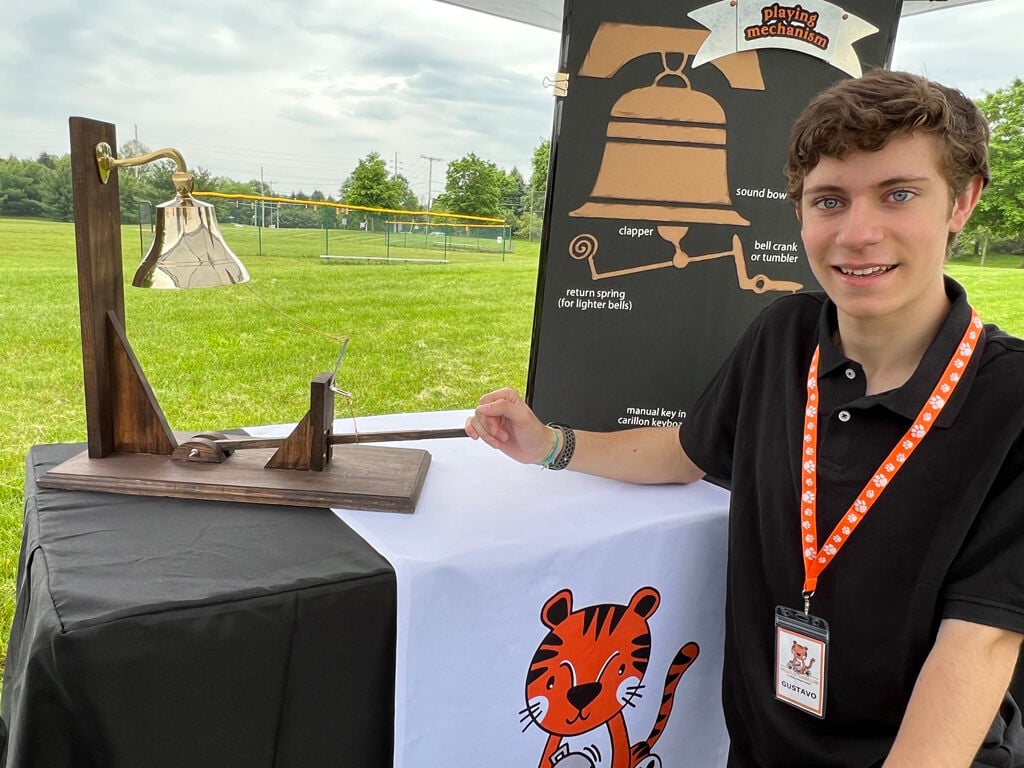
Plainsboro resident Gustavo Rangel Almirall teaches people about the carillon at booths he sets up at area events.,

