The history of Community Supported Agriculture took root in New Jersey in the 1980s, when farmers faced a serious economic crisis. A perfect fiscal storm saw interest rates soar. The Soviet Union had invaded Afghanistan, leading President Jimmy Carter to embargo grain sales from the U.S. to Russia. Farmers also weathered two droughts: one in 1983, the other in 1988.
These events led to the idea that communities could support their local farmers through farm memberships. Customers purchased a share to a farm and collected the resulting bounty across a growing season.
The model worked until about 2016; after that, members started to fall away due to the availability of lower-cost organic produce options. The Covid-19 pandemic saw consumers returning to CSA programs; but that bounce didn’t last. F
ast-forward to 2023, and now CSA operations are facing an economic moment causing farmers to rethink—or abandon—the structure of the traditional CSA model.
Yet James Klett, who owns Fairgrown Farms in Hopewell with his brother Alex, sees these changes as an opportunity for growth and development.
In January, the Klett brothers signed a lease with the Watershed Institute to restart the farm on the Watershed property—a beloved plot of land which, for 30 years, hosted the renowned Honey Brook Organic Farm.
“We’ve known for a while that we needed more land,” James said in an interview. He and Alex currently operate Fairgrown Farm on an 8-acre plot of land on Aunt Molly Road in Hopewell. That plot is secluded and surrounded by trees.
“Our current farm is not conducive to having people come and pick up produce,” Klett said . Renting 12 acres on the Watershed property allows the Kletts to spread out their crop plantings and welcome customers onto the land.
“The Watershed farm property is accessible, it’s pretty, (and) it has a CSA history that we would like to revitalize,” Klett said. While the Klett brothers will start farming 12 acres at the Watershed, by 2025, the lease would allow them to farm a total of 27 acres at the property.
Honey Brook Organic Farm was the second farm of its type to open in New Jersey; and eventually, the largest CSA farm in the state. It was run by farmer Jim Kinsel and his wife Sherry Dudas, who ceased operations at the Watershed in 2021.
Kinsel and Dudas now run a farm in Chesterfield. Kinsel has switched his growing interests from a variety of produce to fruits, including unusual fruits like pawpaws, several varieties of figs, and Asian pears.
In an interview, Kinsel credited the success of Honey Brook Farm to the fact that when he started the operation, people couldn’t find organic produce. At the time, most of the organic farms were in California.
By 2016, Kinsel said Honey Brook boasted 4,000 memberships. In order to satisfy the appetites of those members, Kinsel was farming 140 acres of property on four different farms, including the Watershed.
But membership dwindled after 2016, Kinsel said, because organic produce became available in many grocery stores. And, that organic produce came from all parts of the U.S. and overseas. Consumers didn’t need CSA memberships to get what they wanted.
Klett echoed that observation.
“Jim Kinsel brought two new concepts to the market: community-supported agriculture and organic produce,” Klett said. “Now, Costco is the number one provider of organic produce for consumers.”
But this reality doesn’t deter Klett. He noted the history of farming in New Jersey is about change. “In 1950,” Klett observed, “everyone grew tomatoes for Campbell’s Soup.”
Klett acknowledged the current competitive nature of produce markets. Delivery services like Blue Apron and Hello Fresh, for example, provide produce and recipes delivered to a customer’s front door.
But that produce doesn’t come from local farmers; it comes from larger operations. The produce is not necessarily an in-season crop. That’s where Klett sees his opening.
“Just because the market is competitive doesn’t mean I can’t compete,” Klett said. “We’re not selling convenience. We’re selling in-season produce.”
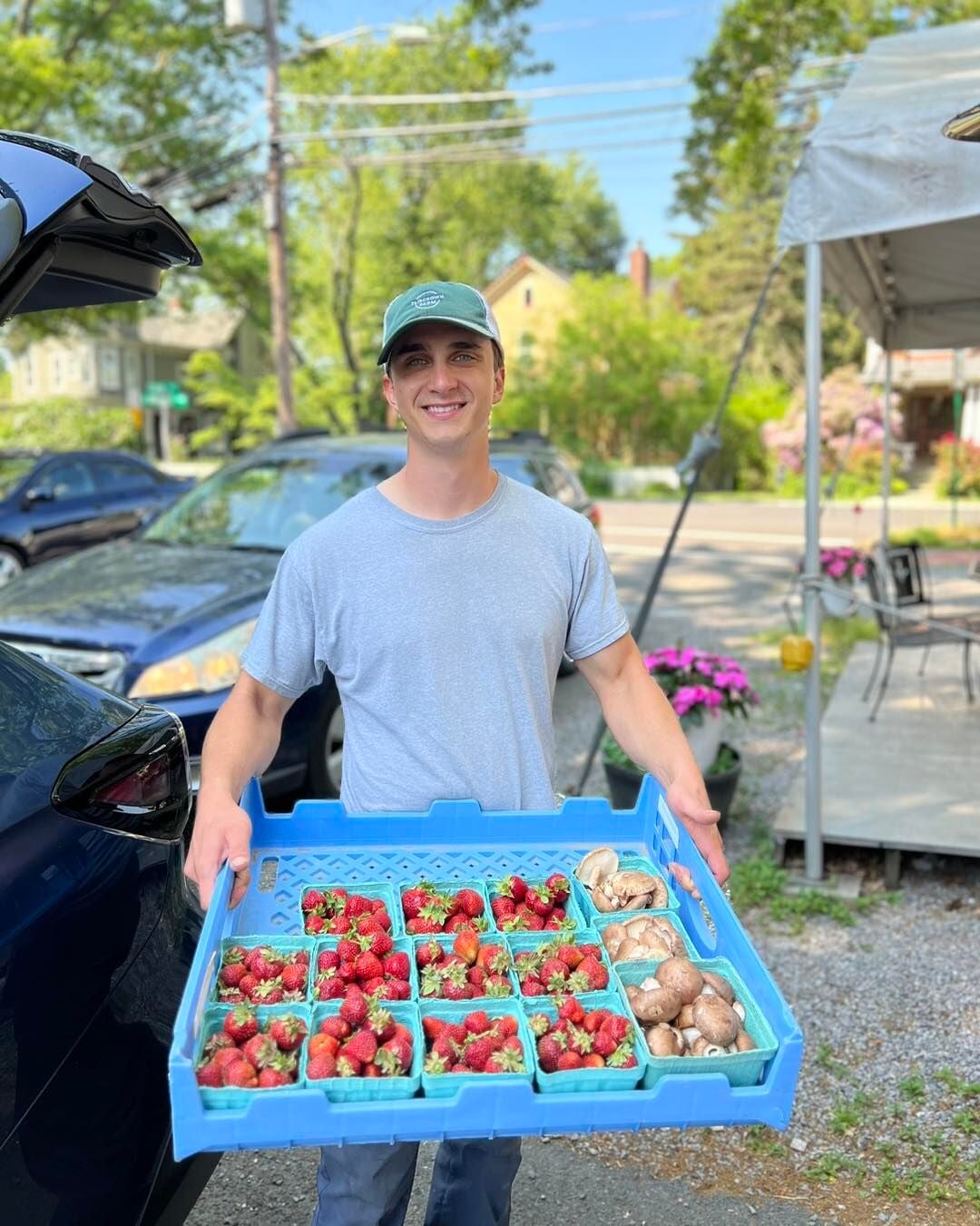
To that end, 30 farms, including Fairgrown, have formed a collaborative CSA, providing customers with vegetables and other items that are fresh and available from New Jersey farm fields. Some farm partners provide eggs; others provide fruit or vegetables. For example, the strawberries Fairgrown Farm CSA members enjoyed this summer came from Kinsel’s Chesterfield farm.
Kinsel likes the collaborative CSA model. “It allows farmers to focus on fewer crops and allows them to focus on the impact of climate change on those crops,” Kinsel said. “Collaboratives,” he noted, “can also lead to greater efficiency with production.”
For Klett, the collaborative model addresses consumer demands. “Customers expect higher quality food options,” Klett said, “and we can provide that with in-season produce.”
Klett and I met at the Hopewell Farmers Market, a weekly, Sunday morning event which runs from 9 a.m. to 1 p.m. in the parking lot at 62 E. Broad St. Klett started the market in 2019 in order to have a location for farm share distributions.
During our interview, Julie Brenner and Mark Itzler of Princeton approached Klett. Former Honey Brook CSA members, the couple joined Fairgrown Farm three years ago at the recommendation of friends.
Brenner told Klett the variety and quality of produce was great last year, and even better this year. “We love to cook,” Brenner said. “Given the variety of produce, we have tried more recipes.”
Brenner also gushed about the English peas that were in a recent share. She said she first thought extracting peas from the shells would be a chore. But it wasn’t. “I felt like I was in an Austen novel while shelling peas. It was meditative,” she told Klett.
Finding the Fairlawn Farm CSA brought the couple relief. “We belonged to Honey Brook,” Brenner said. “After it closed, we cried.”
The couple came to the Hopewell Farmers Market to collect their weekly share of vegetables; they also purchased some cucumbers. On Sundays at the market, non-share members can purchase produce from Fairgrown Farm with cash.
Klett says he sees opportunities in farming, and he’s excited to carry on the legacy Kinsel and Dudas left behind at the Watershed, while charting new territory.
With the rental of the Watershed property, Klett says he will move most of his crops from Aunt Molly Road to the Watershed. The combined operations will both exist under the Fairgrown Farm name. The Aunt Molly Road property will become the headquarters for the entire operation.
The first task, Klett said, was to get the Watershed farm recertified as organic. The fields have been fallow for two years. Starting this month, Fairgrown Farm will offer members a limited Pick-Your-Own option at the Watershed property.
“If members want the experience of picking, they will find cherry tomatoes, herbs, flowers and peppers to pick,” Klett said. Children, with adult supervision, wil be allowed into the field.
“Getting the crop in the ground and taking care of it is the easy part of farming,” Klett said. Behind the scenes, there is much to do on a farm. Klett’s brother Alex is charged with keeping the machinery running and the infrastructure—barns and other buildings—in good repair. A farm infrastructure also includes irrigation systems and wells. There needs to be space for packing boxes for delivery to people’s homes. The farm owns vans for produce deliveries. All of those operations will happen at the Aunt Molly Road site.
Eventually, Klett would also like to revitalize the pick-your-own strawberry fields at the Watershed. First, he said, he needs to learn how to grow those berries.
Klett also wants to have a winter market where share owners would find cold-weather vegetables. Klett told Brenner, his customer, he would likely start with a short-term winter market, maybe five weeks, and expand from there. The news delighted her. “I love to make winter stews,” she told him.
Fairlawn runs a 30-week main season—longer than most farms—which began in May. Joining CSA members first select a share size, either a small share which provides seven different items each week; a medium share which has 10 items per week; or a large share containing 13 items. Add-ons to the main share cost extra. Selections include fruit, mushrooms, eggs or herbs.
For $3 a week more, Fairground Farm will deliver produce to people’s homes on Monday, Tuesday or Wednesday, between the hours of 3 and 7 p.m. in Hopewell, Pennington, Montgomery, Lambertville, Ewing and Princeton. Otherwise, CSA members can choose to pick up their shares on Sunday at the Hopewell Farmers Market between the hours of 9 a.m. and 1 p.m. Or, people can now retrieve their shares at the Watershed location on Wednesdays from 4 to 7 p.m. or Saturdays from 9 a.m. to 1 p.m.
People joining the farm now will pay a prorated cost. Pick-up options are selected at the time of enrollment. Members can pay for the entire season when enrolling; or a credit card can be placed on file; that card would be charged monthly.
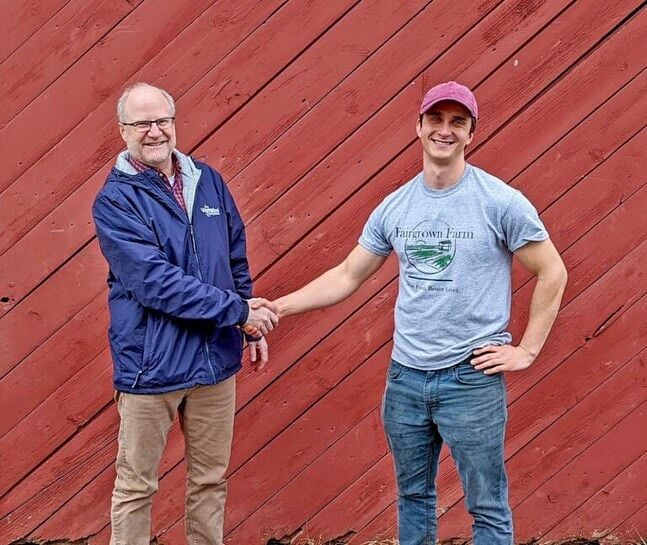
Jim Waltman, left, of the Watershed Institute, and James Klett of Fairgrown Farm. Klett and his brother, Alex, recently began leasing 12 acres of farmland in Hopewell owned by the Watershed Institute. The land had previously been home to groundbreaking Honey Brook Organic Farm. (Facebook photo.),