Born in Wilmington, Delaware in 1871, John Virtue Rice, Jr. (1871-1962) was well established with the surroundings of Bordentown at an early age.
He came from a prestigious family. His parents, John Rice (1833-1899) and Sarah Lowe Rice (1838-?) sent him to the Bordentown Military Institute when he was 12 years old in the hopes of formalizing his education. As a leading member of the Philadelphia and Delaware Bar Association, it was his father’s ambition to have his youngest son follow in the same career path that he and his older son achieved.
John’s brother, William Rice (1863-1910), was a very successful attorney in Cleveland, Ohio and his two sisters were prominent in the suffrage movement.
As a cadet in Bordentown, John didn’t always obey the rules. His discipline for one incident resulted in the grinding of India ink for his classmates as they spent a cold Saturday morning skating at the local rink.
Frustrated, John conceived the notion of a compact device that grinded the ink for him. Not only did he complete the monotonous assignment in record time, but it also allowed him to enjoy his spare time ice skating. This invention changed the trajectory of his world by switching to the field of engineering. In addition, professional draftsmen would use his device years later.
John beamed with pride after he graduated from military school in 1893. Moving to Edgewater Park, he worked long hours in a laboratory, but somehow found the time to start a romantic relationship with a stunning Philadelphia debutante named Christine Wetherill (1878-1922), whose family had a summer home in town.
Her late father, Samuel Wetherill (1821-1890), was a chemist and industrialist who developed zinc oxide as a nontoxic substitute for white lead in the process of creating paint. Married in 1897, the young couple moved into her family’s opulent mansion which was near the laboratory. However, John’s compulsive and erratic behavior contributed to the erosion of the marriage, and that led to divorce within five years. His former wife would remarry in 1908.
In 1902, John learned that a home on Bank Street in Bordentown was for sale by the Cromwell family and decided to investigate. Built as a replica of an Italian villa, complete with a belvedere, it was the former summer residence of the Waugh family, one of the country’s premiere portrait painters. Famed seascape artist Frederick Judd Waugh (1861-1940) was born in the home during the first year of the Civil War.
Fascinated by the large rooms that graced the walls and the exquisite tall windows that captured the tranquility of Crosswicks Creek, John’s enthusiasm prompted him to buy the grand estate. After some careful renovations to suite his needs, he inaugurated his efforts by throwing extravagant parties that held as many as 200 guests.
As Rice was distinguished in social realms, he found it easy to promote an elaborate list of friends for an evening of splendor and alcohol. Mailed invitations were rarely rejected. Among his friends were Thomas Edison (1847-1931) and Dr. Richard Gatling (1818-1903), the inventor of the wheat seed drill and the notorious machine gun that bore his name.
Although John found Gatling’s inventions intriguing, he toiled and tinkered in his workshop with a drill of his own design. As the 20th century ushered in the gasoline motor engine and “horseless carriage,” or automobile, John became enamored with the subject. It was the sophistication of two-stroke engines that led him to perfect a double-acting percussion rock drill.
Relying on only two gallons of gasoline instead of cumbersome steam hoses and boilers, the self-starting drill with reversible controls would operate consistently for eight hours. Patented in 1905, it punctuated a dramatic advancement in mining technology due to its efficiency in productivity.
Today it is considered the forerunner of the pneumatic drill that is used on many streets in cities and small towns across the globe for breaking up rock, pavement, and concrete. It’s also worthy to note that Rice invented a shock absorber that was used in early automobiles and airplanes.
By 1911, he had built and organized the Rice Gas Engine Company, which was located close to his home on the Crosswicks Creek. In the machine or boatbuilding shop were employed 50 to 60 skilled laborers that produced pleasure and racing crafts up to 60 feet in length.
On numerous occasions, these sleek and stylish vessels, fitted with Rice engines, attained speeds up to 35 knots, or 40 mph, as they rapidly churned the frothy water of the Delaware River. Sales were brisk, and the company was financially sound, with a million dollars’ worth of capital.
There was no “middle ground” for a remarkable figure like John V. Rice, Jr. When he was making a fortune from his inventions, he was a phenomenal spender, with no remorse for his actions. This was demonstrated in October 1912, when he was arrested in Trenton for exceeding the speed limit in his car while under the influence of alcohol. When arraigned before the city judge, he admitted that he was feeling “happy” at the time, but blamed faulty brakes for his reckless manner.
Stupefied by the response, the judge expressed his frustration toward Rice’s flagrant disregard for the law, especially considering that he was a person with “a position of wealth.” The judge sentenced him to a night in jail with a subsequent fine of $10.
Unable to sleep much with stark accommodations such as a wooden board, the inventor realized that the punishment was more lenient than anticipated and left his cell the following morning with a stiff back, an unkempt suit, and an agonizing frown.
In spite of his grand inventions, John was not a stranger to debt. He was frequently writing checks to tradesmen, banks, and workers to whom he owed money. He sold his creations far below their fair market value just so he could maintain his affluent lifestyle. On occasion when he threw parties, the decision to light the rooms in his home with candles wasn’t out of opulence but rather necessity, for not paying the electric bill.
Many years later, he was quoted in an interview as saying, “Every time I sold something, the sheriff was my partner. He was there looking over my shoulder. I was living it up, and that takes money.”
The old saying that money doesn’t always buy happiness was evident throughout John’s life. He always looked up to his older brother, William, whom he idolized as a role model for success. William was a prominent attorney living in Cleveland with a beautiful wife, four daughters, a summer home in Massachusetts, and financial assets totaling between two and three million dollars.
However, all of that was erased on an August night in 1910 when he was on his way home from work. A doctor walking in the area found his body lying on the sidewalk. He had been beaten, stabbed, and shot. There were no witnesses and the doctor informed authorities that he never heard voices or a pistol shot. Although the initial motive pointed to a random robbery gone awry, it was later concluded that the murder was a revenge killing for somebody that he had sent to prison.
A suspect was never named. At the time of William’s murder, his wife and children were summering in Massachusetts.
Despite the tragedy that had befallen his family, John had the “good fortune” in saving at least eight people from drowning during the course of his life. One known episode happened in July of 1913 while he was working in his boatbuilding shop. A five-year-old girl by the name of Augusta Kelly accidentally fell from the Pennsylvania Railroad bridge that spanned Crosswicks Creek and into the turbulent water.
Startled by the sight, a 22-year-old man by the name of Albert Buckalew, who was fishing nearby, removed his clothes and jumped to rescue the screaming child. He swam about 50 feet and was successful in grabbing the girl but the strong current exhausted him from reaching the muddy shoreline.
Hearing a desperate plea for help, John dove into the water fully dressed. He commanded the young man to relieve the girl to him while instructing directions to hold on to his shoulder. As he feverishly swam toward the bank with both victims, the young man lost his strength and sank beneath the current. The girl was saved, but unfortunately the body of the young man was found an hour later. For this courageous act of bravery, John was awarded a bronze medallion by the Carnegie Hero Fund.
Two years later, his shop was sold and converted into a fuse plant. Later abandoned, it was burned by vagrants in the 1930s. After Rice left Bordentown in 1931, he moved to the Overbrook neighborhood of Philadelphia. His former mansion, also abandoned, met the same fate, and was destroyed by fire in 1940.
Before John died in 1962, he lived in the home of this niece, surrounded by cherished mementoes from his past: a portrait of his late wife hung on the wall; a photo of his brother and his family stood on a nightstand; his medallion for bravery was placed in an unknown location; and a collection of models of his inventions were strategically displayed on the floors and shelves. Indeed, the world had changed significantly since the days of his youth.
I can only imagine what this elderly gentleman must have thought every time he walked by a street construction site with pneumatic drills rumbling.
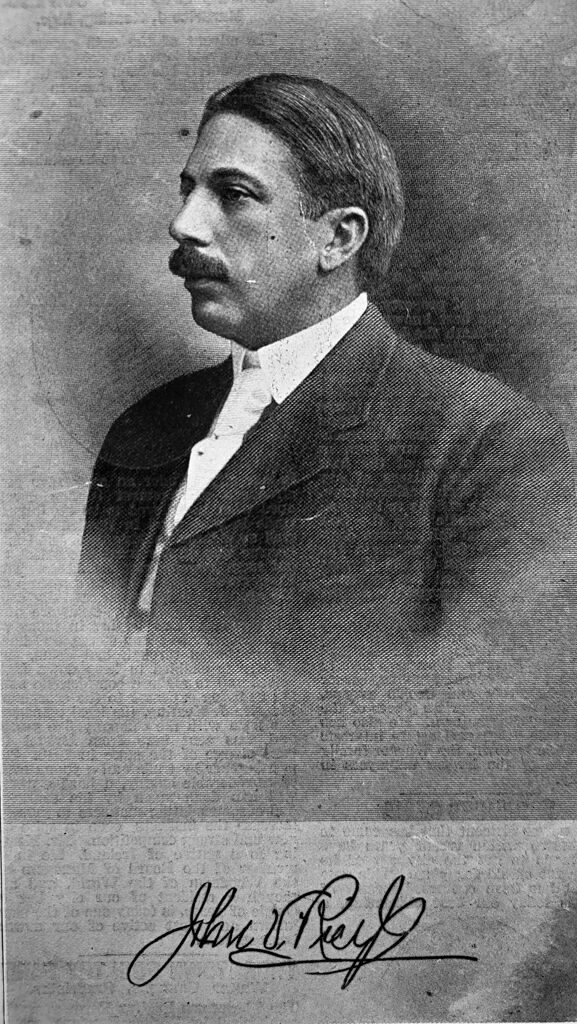
John V. Rice, Jr. (Photo courtesy of the Bordentown Historical Society.),

