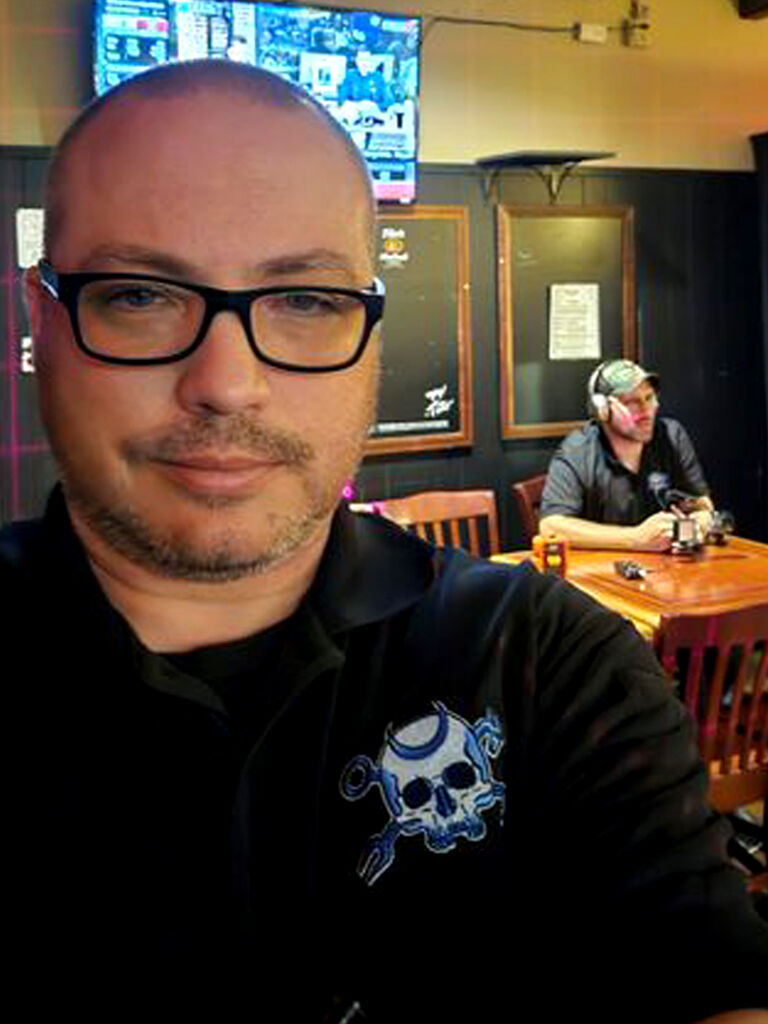
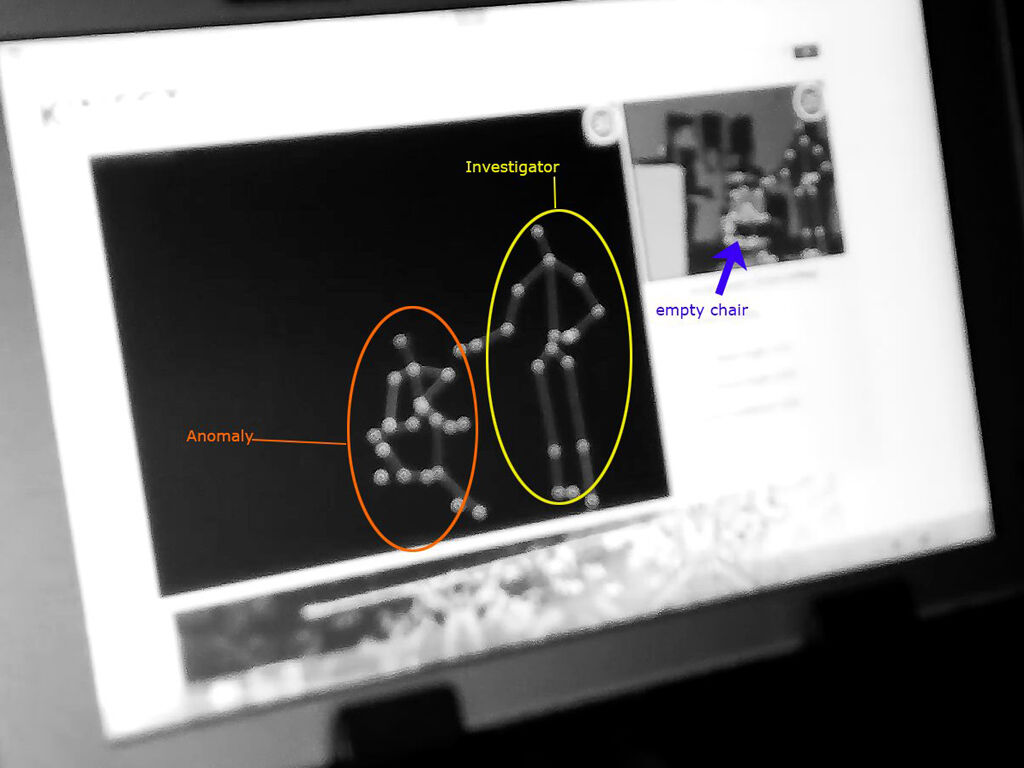
“Who you gonna call?” if you’re a paranormal investigator looking for a haunted site in the Princeton-Trenton region?
The answer to the song from “Ghostbusters” seems to be me.
That’s the lesson I learned that led to this timely October article — when the spotlight gets bright on things usually left to bump in the dark of night.
It all starts like a lot of other mystery and ghost stories with an out-of-the-blue message — in this case an email sent to my office account.
The subject line was “Trenton Hauntings.”
At first I was tempted to delete it. However, since I am generally open for business regarding subjects for articles on local goings on, I took a breath, opened the message, and read the following:
“I have just read your article ‘Ghost Writings: Trenton’s History of Hauntings.'”
I recognized the reference to the 2018 article in which I recounted ghostly tales from around the region and then continued:
The writer then continued. “I am a Trenton resident and a paranormal investigator (Collectus Obscurium Paranormal) and found your writing to be very compelling.
“Do any of these locations allow for organizations like mine to do formal investigations? I would love to get into the closed portion of the asylum. I was a paranormal guide for Pennhurst Asylum for a number of years, and I am familiar with the protocols for being present in physically dangerous buildings.
“Any help you could offer would be appreciated. I have been investigating for over 15 years but have never been able to secure an investigation in Trenton.”
The note was signed, “Sincerely, Eric Tschachler – Collectus Obscurium (President).”
Trenton Psychiatric Hospital (TPH) was specifically mentioned for several reasons. One is that according to paranormal lore, prisons and hospitals are hots spots for unexplained occurrences — no wonder that a 2017 Cosmopolitan Magazine national listing of ghostly spots called the TPH the most haunted place in New Jersey.
TPH also has a disturbing bonus. It was once the laboratory of Dr. Henry Cotton, author of “The Defective Delinquent and Insane: The Relation of Focal Infections to Their Causation, Treatment and Prevention.”
Employing a theory that insanity and bacterial infections were connected, Cotton performed nearly 700 aggressive and painful operations that he claimed cured the patients — often by killing them.
Interestingly, I had also been thinking about TPH. I recently learned that the hospital had a small museum and had gotten the name of someone to contact.
So, in perhaps an uncanny way, Tschachler, who recently moved to Ewing Township, found the right guy.
Again, I paused to consider whether I wanted to get involved or not, but I was intrigued and wrote, “Thank you for the note. Why don’t we set up a time to meet? I’d be glad to share what I know and interview you, too.”
He agreed and soon Tschachler, his wife, Jen Shea, and I are in the Ewing Diner for an evening gathering.
“It is a paranormal research organization,” Tschachler says about the group. “We verify or debunk paranormal activity in a person’s home, business, or historical locations.”
Tschachler and Shea run the company with another married couple, CJ and Jess Senn, and grew it out of an earlier endeavor that Tschachler had joined several years ago, the Shore Paranormal Research Society.
“I was not a founding member. I was a main investigator. It was not well managed. Others left, and it was left to me,” he says.
The two are currently working on finalizing the organizational structure. And while an LLC is mentioned, so too is a nonprofit.
The reason for the latter is that Collectus Obscurium does not charge for services.
They say if money were involved, clients may expect particular results and attempt to influence investigations for various reasons, including marketing.
“Some people want their places to be haunted,” says Tschachler.
Instead, they say that “sometimes we pay to do an investigation.”
The reason is that bona fide historic sites — like Whitehill Mansion in Fieldsboro — will ask researchers to make donations to support the venue. The couple mention a rate of $100 per hour.
While Tschachler and Shea don’t have a brick-and-mortar office and maintenance costs, they still have needs that they handle out of pocket.
High on the list is equipment. “There is a whole array of different sensors — things that measure temperature, electromagnetic fields, ways to visualize documents things, infra cameras, still camera, digital audio reporters, ITC devices, and motion sensors,” says Tschachler.
They add that multiple devices provide more information about a phenomenon. For example, they say that the experience of hearing a voice during an investigation will have more value if several electronic monitors record the same. “It is harder for a skeptic to deny,” he says.
The two say the various costs are covered by their day jobs. He works at Bind Right in Robbinsville. She’s a teacher.
And since investigations also include reviewing audio and visual data and providing clients with written and digital reports, they limit their investigations to about two a month.
Not surprisingly, they say that the Halloween season is a busy time and note two sites they’re interested in: the period Captain’s House at the reconstructed Tuckerton Seaport on the New Jersey Coast and the Phareloch Castle in Basking Ridge.
As to clients, Tschachler says, “In the beginning you had to go get them. Then after a few investigations, people began to talk. We recently did the Long Beach Island Museum.”
But what about them?
Tschachler is from Jackson. His father was an assembly line worker at general motors in Linden. Shea is from outside Detroit. Her father designed computer systems for corporations. Her mother worked in the state attorney general office.
Tschachler says while he spent some time at a community college, he got a job with a printing company, continued with it, and started living in the Trenton area about a decade ago.
Shea studied art photography, moved to New York City, became a freelance news photographer, and was a parttime college instructor. She also began working on a photography series. She is interested in exploring human relations and how people work out their place in the world.
After the two met on an online dating service, they married (in Salem, Massachusetts), and put down roots in the region. They are currently moving from a rental in Hamilton to their recently purchased house in Ewing.
“When I was a kid, I was interested in the strange and unusual,” says Tschachler about his involvement with the paranormal.
He remembers getting interested in being a paranormal investigator after seeing such characters in the 1982 film “Poltergeist.”
His family was Roman Catholic, so his mother wasn’t happy and tried to convince him that it required a great deal of study and training. “So I started studying philosophy and world religions,” he says.
Shea, also from a Roman Catholic background, says her interest is connected to an aunt who “owned an antique store. Her house was filled with antiques, and she used to do tea readings and Ouija boards. As a child trying to process what death was, the potential of being able to communicate with someone that had passed was comforting and intriguing.”
On the topic of training, Tschachler says, “The problem is that (paranormal investigation) is not regulated. So there’s nothing stopping people from saying, ‘I’m a paranormal investigator.’ I suggest people reach out to a reputable organization and train and read. But don’t just read books on the paranormal, read about psychology and consciousness.”
He says by doing so, a person doing an investigation can also consider “who is perceiving the events” in the first place.
Some of the authors the two mention are Carlos Castaneda, Stan Gooch, and Lloyd Auerbach. One shared favorite is Hans Holzer. “He was one of the earliest known paranormal investigators. He’s an interesting guy,” says Shea.
Tschachler says they approach an investigation as skeptics. “We will report things that are interesting but inconclusive. I am not going to call something paranormal unless I’m convinced it’s paranormal.
“But you never know. When you see an object moving from point A to B it may not be a ghost. Paranormal activity could include people’s abilities. Who is perceiving the events? Living people may be doing things that they may not know they’re doing.”
One such theory connects the activity of poltergeists ( aka crashing spirits) moving household furnishings or kitchenware to adolescent girls experiencing unresolved anger, stress, or sexual yearnings — think Stephen King’s novel “Carrie.”
While Tschachler says he hasn’t witnessed anything like a poltergeist, he says he has seen unexplained phenomenon while conducting investigations and tours at Pennhurst Asylum.
“It has had every situation happening: Shadows, disembodied voices, objects thrown at us. We’ve been pushed. We’ve had a full spectrum of anomalies.”
Nevertheless, they say most of their “investigations don’t turn up anything.”
The reasons range from over active imaginations or the frequency of activity.
For example, they say, if a person lives in a house where they experience a seemingly supernatural occurrence three times a month, “the chance of us of being there when something happens is low.
“More often than not, you get nothing. It is part of the deal. If an investigator tells you that they get activity everywhere they go, I would be suspicious of those people.”
However, if Tschachler and Shea do think something is paranormal, they then work to determine its nature. In other words, they determine if it is a residual or conscious entity.
“A residual haunting is a moment that is recorded in time. When you hear stories that there’s a woman in white dress (appearing over and over), it is a residual haunting. Something that it has been doing for many, many years and invested a lot of emotion. They are not aware.”
“Some people will say they have unfinished business or love a building,” Tschachler says, adding that they can attach themselves to objects, property, or moved or reconstructed buildings.
Tschachler says he feels that happens because “people are not just body and soul. They could pass and parts of them could keep going on.”
Asked if they believe in ghosts, Shea says she isn’t sure. However, Tschachler says, “I do think that the consciousness can survive the physical death and remain intact. I don’t believe that every (deceased person) can interact with the physical realm.”
Then turning back to what they do and why, he says , “I am not trying to get believers, but get people open to the possibilities.”
Then as we leave, Tschachler and Shea say they have a busy October finishing up some investigations.
And as for me? I’m also on the October paranormal trail.
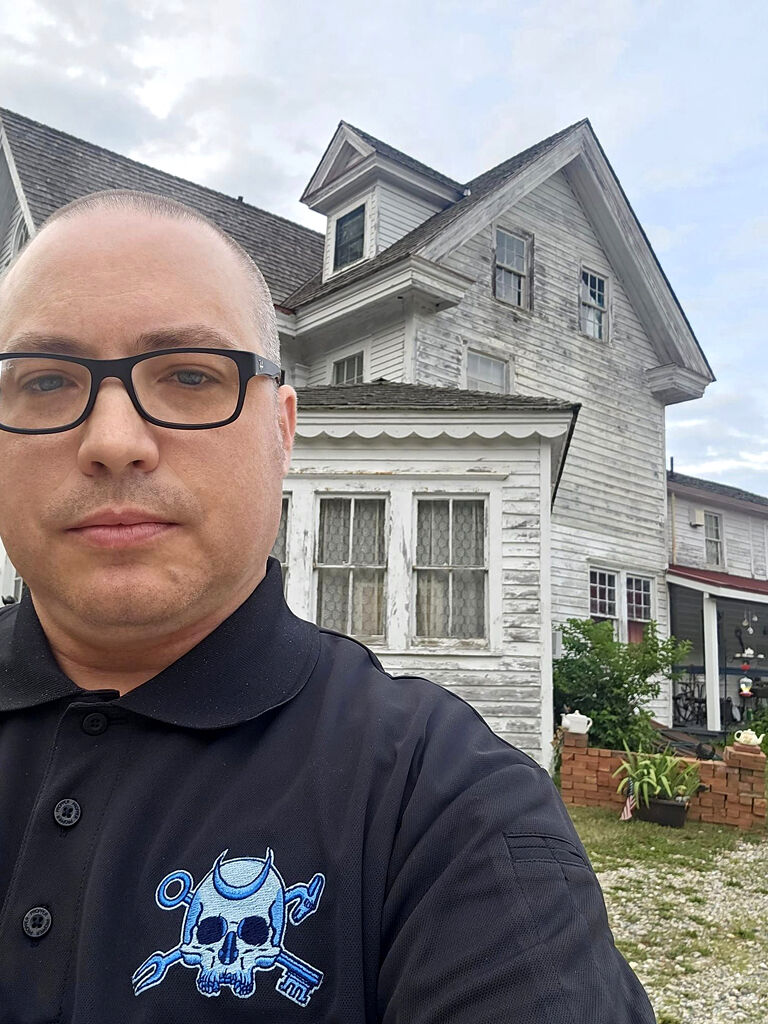
Eric Tschachler of Collectus Obscurium in front of the Captain's House at the Tuckerton Seaport.,