Without a doubt, the bucolic fabric of our country and the world changed with the advent of an industry known as railroading. It transformed quaint simple towns into robust cities brimming with necessities needed to manufacture goods.
From the fertile landscapes, factories grew. Smoke puffing from towering stacks drew individuals and immigrants alike in their quest to earn a decent living. Freight yards were dangerous places but critical factors in the transportation of commodities such as coal, lumber, stone, agricultural products, general merchandise and U.S. Mail.
Passenger lines were a part of daily life too. Everything could be shipped great distances within a matter of hours or days instead of weeks or months. People were now reaping the rewards of an outside world that they had never dreamed would have been possible years earlier. In the nineteenth century, the definition of a “workhorse” changed from heavy animal labor to industrial machinery.
When inventor John Fitch introduced his vessel along the Delaware River near Bordentown, he recognized the fact that steam-powered ships would one day rule our waterways. However, he never would have imagined that his premonition applied to the land as well.
One individual that had witnessed Fitch’s propulsion system in action was John Stevens (1749-1838), a lawyer, inventor, self-taught engineer and proponent of the steam engine. Unlike Fitch, Stevens had considerable wealth and a stellar Revolutionary War record. He had the ambition in realizing his goals.
In 1804, he introduced a steam-driven ferry service that crossed the Hudson River from Hoboken to New York City as the first in the world to operate on a regular schedule. Despite its success, influential New York monopolists forced Stevens to discontinue its service in less than two years.
During the War of 1812, when merchant ships were relentlessly attacked by British ships in the Atlantic, Stevens dove deeper in his pursuit to promote his railroad as the most viable solution in countering these problems. In doing so, the uncompromising 65-year-old decided to survey the proposed route himself and present the findings to the New Jersey Legislature. It is considered the first railroad survey in the nation.
The logical land route went from the Delaware River to the Raritan Bay with Bordentown serving as the ideal destination between the land and water. Despite the approval of state legislation in 1815, the charter plan for funding the country’s first railroad was met with failure. Stevens never gave up hope, and a decade later built the first locomotive on a circular track around his Hoboken estate for all to see.
Known as the “steam waggon,” it proved its worth with politicians, but it was five years before the state’s first commercial railroad to be incorporated by charter as the Camden and Amboy Rail Road and Transportation Company along with its fierce adversary, the Delaware and Raritan Canal Company. Although rejuvenated with delight, at 81 years of age, Stevens instructed his son, Robert, to execute the next phase of the plan by sailing to England to purchase a locomotive and almost 600 iron rails (16’ in length), since rolling mills in this country were incapable of producing them.
According to tradition, it is said that Robert Stevens (1787-1856) spent his free time onboard ship whittling a wooden model of the world’s first flanged T-rail and spike with his jackknife. Like his father, he was a hungry businessman, with a ferocious appetite for inventing.
Arriving at the shop of builder Robert Stephenson, Stevens was impressed seeing an actual steam locomotive in action and enthusiastically ordered a similar engine to be shipped to the United States. Taking time, 5,000 parts of the locomotive were made from rolled iron including rods and bolts. The wooden drive wheels were made from locust wood, with the width between them measuring 4 feet, 8 ½ inches, which was the standard or gauge. Most railroads in the U.S. emulated the gauge sizes in England. Ten tons of iron were packed in crates and shipped to Philadelphia before the final destination up the Delaware River to Bordentown.
On Sept. 4, 1831, the veil to the future of rail travel was raised. About a mile or two south of town, where the large wharf loomed, the distorted image of an approaching sloop came into view. Standing close to the water was Robert Stevens, his brother Edwin (the financial genius of the family), several investors from the Camden and Amboy Railroad, curious townsfolk, and a 21-year-old Irish-born steamboat mechanic (newly hired by Robert Stevens) named Isaac Dripps (1810-1892).
Also in attendance was Matthias Baldwin, a steam engine machinist from Philadelphia who rode the ferry every day for a week to carefully inspect the parts for his own purposes. In his lifetime, Baldwin would build 1,500 locomotives. But on this day, nobody other than Robert Stevens had ever viewed one before.
Given the formidable task of assembling the locomotive without any drawings or written instructions, Dripps persevered for 10 days. He improvised a missing tender with a whiskey cask that was procured from a local storekeeper and placed on a cart as its water supply. A shoemaker from town volunteered to cut and sew a hose made of shoe leather from the barrel to the boiler. Indeed, one of our country’s first locomotives had elements from Bordentown incorporated into its features.
The muscle of Irish immigrants supplied most of the hard labor as the iron rails were laid on stone blocks measuring two feet square and weighing 300 lbs. apiece. These blocks, referred to as “sleepers,” were initially quarried by prisoners housed at the newly built Sing Sing prison in New York State, but due to the distance from the Hudson River to the Delaware River, the blocks couldn’t be shipped fast enough to the Bordentown wharf. Ultimately, stone was transported by wagon from a quarry north of Trenton.
On Sept. 15, the locomotive was on the rails and ready for testing. Dripps loaded wood into the firebox, checked the water supply and steam pressure, and opened the throttle amid the piercing screams from heated valves and billowing smoke with glowing embers of ash emanating from the stack. Despite fears of an imminent explosion, the hulking iron beast jerked forward at a low speed. With only a short distance of track built, the test proved to be a success.
On Nov. 12, the Stevenses performed another test in Bordentown. This time it was a public spectacle, with pageantry involving state legislators, dignitaries, and businessmen eager to board the two open coaches behind the locomotive for this great moment in history. Prince Lucien Murat and his wife, Caroline Fraser, were also seated.
It has been said that she was one of the first woman in the country to ride a train. But this was hard to notice over the screech of the engine reaching unprecedented levels. With Dripps at the controls, the power unleashed from the engine threw passengers forward as they tried to grab stationary fixtures. Between the thunderous belching and snorting that occurred when it backed up to get a full head of steam, the locomotive chugged slowly over a slight rise before accelerating to 35 mph.
Although it only traveled the length of a mile and a quarter, it was apparent that the dawn of railroading was now underway. Around 23 miles of track existed in America at the time, with Bordentown commanding a generous share.
Within two years, the Camden and Amboy Railroad was completed, with 63 miles of track plowing through forest and swamp. As this young railroad began its regular service, it had developed several monumental achievements. Flanged T-rails were standard. Bulky stone blocks were replaced with hewn wood cross ties. The Stevens locomotive was renamed the John Bull by its engine crew as the personification of its English-built origins.
Dripps and Stevens fitted the John Bull with a frontal oil lamp for night, a steam whistle for signaling the train crew, a bell for alerting people that a train is coming, an enclosed cab to protect the crew from the weather, and an iron cowcatcher with pilot wheels that stabilized the front of the engine upon entering curves as well as pushing aside animals and other objects in its path. Practically every train that was built for decades in the 1800’s shared these components.
As America expanded to the Pacific coast, more and more trains were built with better technology. By the time that the John Bull retired from service in 1866, forty thousand miles of track crisscrossed through prairies, forests, and mountains.
Outliving its usefulness, the old Bull was stored in the Bordentown rail yard for years until the Smithsonian Institute gave it a new home. On occasion, it was trotted out to world’s fairs and other worthy celebrations, but for the most part now leads a quiet existence as the world’s oldest surviving steam engine.
The old Bull may be out to pasture forever but oh what a magnificent life it led.
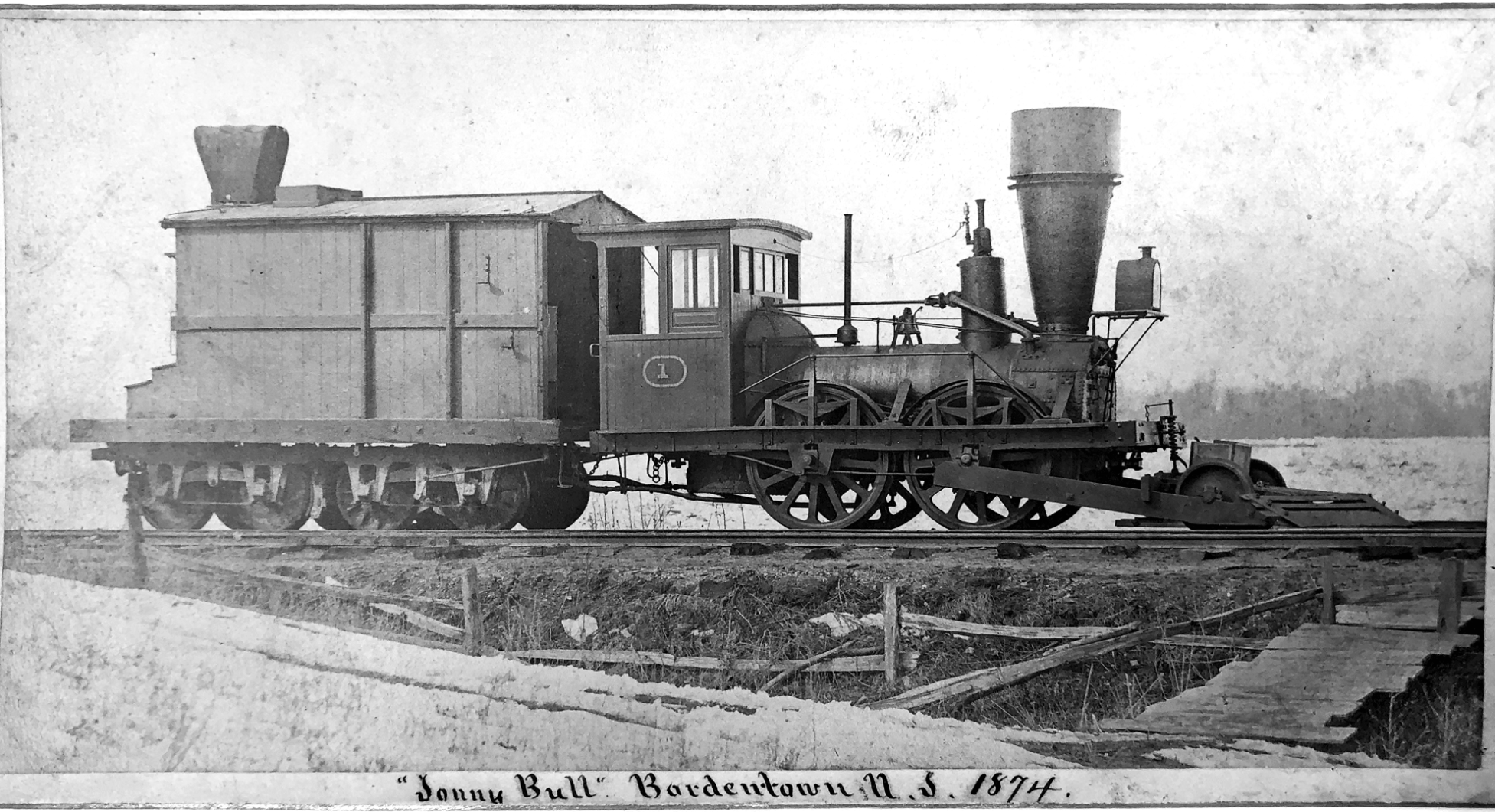
The “John Bull” locomotive, 1874. (Photo courtesy of the Bordentown Historical Society.),

