Jacob Francis, like many men who lived in Colonial America, was a farmer and a soldier.
Born in Amwell in 1754, Francis served in both the Continental Army and the New Jersey Militia during the American Revolution. After the war for independence between the colonists and the British was over, he bought a farm in his hometown, married, and raised a family with his wife, Mary.
But Francis’ story is different from the story of many of his contemporaries in one significant way: Francis was a free Black man, living in a time when a great many Black people were enslaved, in New Jersey and throughout the Colonies.
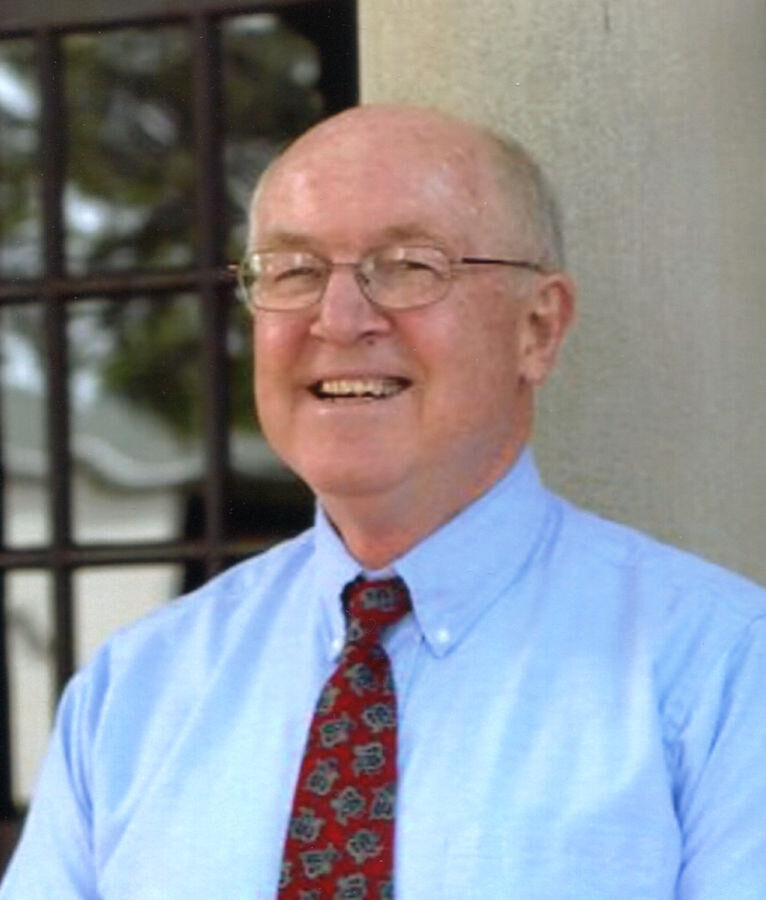
William L. (Larry) Kidder, a local author and historian, has recently published a book about Francis, entitled The Revolutionary World of a Free Black Man: Jacob Francis 1754–1836. Kidder will give a Zoom-based presentation based on his book on Thursday, Feb. 3 at 7 p.m. Those interested in attending virtually can register at tinyurl.com/francisJacob.
In addition to the virtual online presentation, the Hopewell Branch of the Mercer County Library will also livestream the talk in the library. To reserve a seat at the Hopewell Branch, call (609) 737-2610 or email hopeprogs@mcl.org. The presentation is co-sponsored by the Hopewell Valley Historical Society, the Hopewell Museum and the Hopewell Branch of the Mercer County Library.
Kidder, a Ewing resident, is a former president of both the Hopewell Valley Historical Society and the Ewing Township Historical Preservation Society. He taught history for 40 years, including 8 years at Ewing High and 32 at The Hun School in Princeton. He has also been a volunteer at the Howell Living History Farm in Hopewell’s Pleasant Valley for more than 30 years. The Revolutionary World of a Free Black Man is his sixth book.
He first came across the story of Jacob Francis when he was researching his book on the history of the Hunterdon Brigade of the New Jersey Militia during the American Revolution. Francis served in both the Continental Army and the Hunterdon militia during the Revolution, but it wasn’t until 1832, when he applied for a veteran’s pension, that his story took shape in a form that could be discovered by a historian almost two centuries later.
“In order to apply for the pension, he had to prove that he had served for at least two years in a combination of the Continental Army and the New Jersey Militia,” Kidder says. “And he served in both — he was a Continental before he served in the militia.”
Francis gave a statement of service to a Hunterdon County judge, and the judge recorded it. In discovering this document, Kidder found that Francis had done more in his statement than merely account for his time in the military. He told many other details of his life story as well.
“He was an exceptional human being,” Kidder says. “And in addition, he was a free Black man, and I wanted to find stories of free Black men. I was not really able to do that for the (book) project on the New Jersey militia, but he stuck with me, and I continued to have interest in him.”
Kidder says one reason that he wrote the book was because he wanted to learn about — and relate — some of the history of the free Black population during the late 18th and early 19th centuries.
“He was a free Black man, and I wanted to find out what that meant for his life: what obstacles did he have as a free Black man that a free White man didn’t have? In some ways, he was in a situation where he was neither white nor enslaved. What kind of systemic racism did he have to deal with? That was one of the questions I wanted to answer,” Kidder says.
Kidder says that in those days, if a White person ran across Francis, they would automatically assume he was enslaved, unless he could prove otherwise. For decades, New Jersey law required free Black persons to carry a government pass indicating that they were free.
“This automatic assumption that because they were Black, they were enslaved, was something that Jacob had to live with and deal with on a daily basis,” Kidder says.
In the Black community around Francis during his lifetime, there were both enslaved and free people. Early in his life, there were more enslaved than free. By the time of his death in 1836, there were still enslaved people in his community, Kidder says, but the ratio of free and enslaved had reversed.
“He was a survivor. He was a tough guy, and I mean tough in the sense that he hung in and wasn’t discouraged by things,” Kidder says. “He was actually a very friendly person, and people commented on that, but he wasn’t going to give in. He was going to keep striving through whatever obstacles were put in his path. He demonstrated that very strongly as a soldier in the Continental Army.”
Francis fought in the Battle of Trenton. He had already been in the army for 14 months at that point, as a member of a Massachusetts regiment. He had lived through the siege of Boston and the New York campaign and was battle tested.
“The army had lost so many men, to disease and desertion and combat fatalities, prisoners of war — there were so many ways the Continental Army had been depleted, and Jacob was still there,” Kidder says.
After the Revolution, he married Mary, an enslaved woman. Her owner sold her to Francis on their wedding day, after which he freed her. They had nine children, most of whom would eventually move out of the area.
Francis settled into life as a farmer in Amwell, eventually owning his own land even though Whites imposed many obstacles designed to prevent Blacks from doing so. “He wasn’t a rich farmer by any means, but he was certainly approaching middle class status,” Kidder says. “He passed the farm on to his children.”
Most of his children eventually moved out of the area, but one stayed on the farm, living until 1880 or so. He also had a child who continued on, but after that, Kidder says, history does not record what happened to Francis’ family.
When he died in 1836, Francis was buried in the Baptist Church Cemetery in Flemington. He received an unusually long death notice in the Flemington newspaper. “The editor went to the degree of giving almost a biographical sketch of Jacob and pointing out how well respected he was by the officers in the Continental Army and the militia, his long membership in the church in Flemington,” Kidder says. “That shows just how respected he was.”
Kidder was born in California and lived in a number of places around the country before finding a home in Mercer County. His wife, Jane (Micklewright), grew up in Ewing, and also worked at Hun for many years as the community service director.
Kidder says Jane loves history as much as he does, and that the family would often travel to historic sites on vacations. They have two daughters, Susan and Debbie, who are both educators. Susan is a second grade teacher at a private school in New Jersey, and Debbie is chair of the history department at Butler County Community College in western Pennsylvania.
If Kidder discovered the story of Francis because of his interest in the Hunterdon County Brigade of the New Jersey Militia, then he grew interested in the militia because of his long relationship with the Howell Living History Farm.
He used to take his students out to the farm to get hands-on experience while learning about the history of farming when he taught at Hun. Later, he also took students there to do community service projects. He has since volunteered for many years there as an interpreter and historian for the farm, as has Jane.
He says that he always hoped that he would write books after he retired from teaching. “All the research and everything started before I retired, but when you’re a teacher in a private school, you don’t have time to do all the writing,” he says. “Actually having the time to put it all together, that had to wait for retirement. But I’ve always been interested in history as something to do, not just something to learn.
“History is trying to learn and understand about the past. It’s like a treasure hunt, a detective thing, always looking for new information to bring out and help the understanding of things. I always tried to do that as a teacher, both for myself and my kids.”
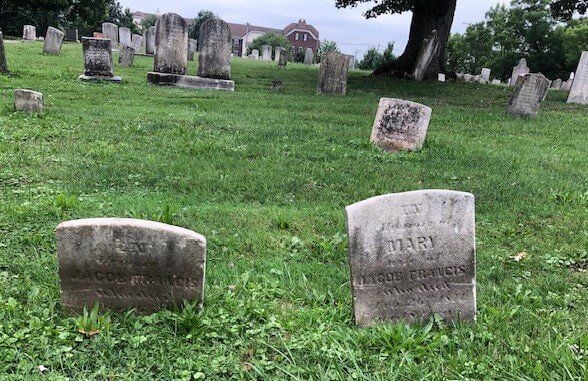
The headstones for Jacob and Mary Francis in the Flemington Baptist Church cemetery.,