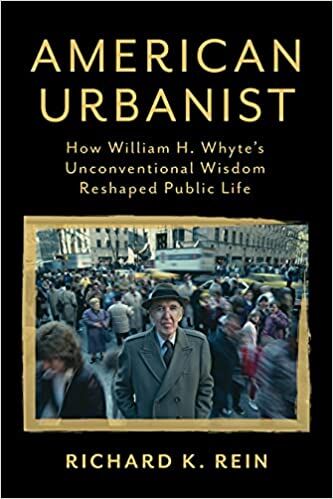
Richard Rein’s critically praised biography of urban critic William H. Whyte, American Urbanist: How William H. Whyte’s Unconventional Wisdom Reshaped Public Life, reads, in part, like a review of 20th Century America.
Yet, in addition to seeing Whyte’s methods at work, area readers will get something more: a review of the game-changing era when corporate developments began to fill the formerly open lands along the Plainsboro-Lawrence-West Windsor region of Route 1.
Rein is the retired editorial director of the West Windsor & Plainsboro News. He founded the paper in 2000.
He was also the on-the-scene reporter for his newly launched U.S. 1 newspaper in the 1980s, which truly makes Rein’s efforts the proverbial “one for the books,” as the following excerpt shows:
In the early 1980s two new office centers loomed on large, undeveloped tracts in the Princeton-Route 1 corridor. One development, the Princeton Forrestal Center, was started by the deep-pocketed Princeton University, which wanted to protect its nearly one thousand acres of landholdings from urban sprawl.
The university foresaw a large corporate center that would eventually attract large-scale users such as Merrill Lynch, Siemens, and the headquarters of the Robert Wood Johnson Foundation. At Forrestal the main development was linked to the outside highways by just three entrances. Several high-capacity interior roads connected the clusters of buildings. A hotel and conference center, suited for corporate events, occupied an isolated site, providing guests with the feel of a rural environment.
The other, the Carnegie Center, on nearly five hundred acres about four miles south of Forrestal on Route 1, was developed by a for-profit group. The Carnegie investors imagined that an urbanist, people-centered development could gain a competitive advantage, especially against the stand-alone office buildings popping up along the highway.
Alan Landis, an accountant by training who became a developer early in his career, assembled a group of commercial real estate investors who envisioned clusters of offices arranged around open greens. The interior roads were narrower than those at Princeton Forrestal Center, and the road network included seven connections to existing streets and Route 1, more than double the connectivity at Forrestal. Mindful of short- and long-term costs, the private developers of the Carnegie Center realized that roads, sewers and utilities would cost less if the buildings were closer together.
To tie it all together Landis hired the prominent Boston-based architect Hugh Stubbins, who had designed the Citicorp Center in Manhattan, among other projects. As the first phase of the center was underway, the Carnegie developers realized they “needed a team to complement Hugh,” recalls Bill King, then the center’s director of design and construction. Hiring an anthropologist or sociologist would also be helpful. At that point King recalled reading “The Organization Man,” [the 1956 bestseller by William H. “Holly” Whyte]. The Carnegie Center soon added Holly Whyte to the list of architects and planners mentioned in the center’s promotional materials.
The first Carnegie Center cluster was anchored by a Hyatt Hotel, not of the commuter style located along highways but rather a “regency” model designed for urban downtowns. Whyte first visited the project when it was barely underway in the early 1980s, with the first cluster of buildings just being completed. He asked the developers to take him outside so he could walk around. It was midmorning and the central plaza was empty. Whyte pointed to the various landscaping elements. By lunchtime, he predicted, someone would be sitting on a planter eating a bag lunch. There would be two people sitting on a retaining wall, and another person would be standing facing the two, chatting with them. And on the interior roadway there would be two groups of people walking side by side. Bill King recalls exchanging skeptical glances with his partners. When lunchtime came they returned to the same spot. Almost everything Whyte had predicted was happening. “This guy is a character,” the developers concluded. “But he knows what he’s talking about.”
The Carnegie Center advertising agency eventually boiled the concept down to a catchphrase: “Urban convenience meets with suburban comfort.” Landis explained to a local reporter: “We wanted Carnegie Center to be unique. It’s neither urban nor suburban, but combines the best of both worlds. It’s planned meticulously, both in its land use and in its architecture. . . .We have worked closely with ‘Holly’ Whyte to help us create public areas, gardens, and greenways that our tenants can really use.”
Whyte praised Landis’s concept as “splendid,” especially for putting “cars in their places, quite literally,” and for making the spaces between the buildings “pedestrian spaces, in scale and feel and function.” To emphasize the pedestrian scale, the center added gazebos and pavilions at strategic points.
The second series of buildings would “enclose some of the most interesting topography of the site” and would include a small lake, an amphitheater, and a greenway that would link it to the other clusters.” To “seed the place with activity,” Whyte suggested that Landis borrow from the practices of the best European squares and create “generators” of activity on the periphery of the buildings and let them push the activity outward into the open space. The first-floor cafeteria should provide outdoor dining, with lots of tables and — of course — movable chairs.
The Carnegie Center management, Whyte advised, “should play it loose” as to where people place the chairs. “Nobody is better at judging where they like to sit best than people.” And the outdoor spaces intended for people should whenever possible be at the same grade as the adjoining land. “A park with a wall around it goes unnoticed,” said Whyte, reflecting one of the lessons learned from Bryant Park in Manhattan.
Whyte suggested an additional amenity: “recreational activity within the central spaces. Few things could so liven up the scene as some people having a good time doing something within these key spaces.” It would not take many, as just a handful of ice skaters animating Rockefeller Plaza in New York proved.
Overall, he felt, the Carnegie Center had realized most of its goals: “The cafes, lakes, ponds, ducks, and setting look rather jolly. There is reason to be there and to stay there.”
Both office centers, Princeton Forrestal Center and the Carnegie Center, stopped most of the ticky-tacky development that was sprouting up along the Route 1 highway to the north and south of them. But despite the pleasing aesthetics, the centers still suffered from underlying sprawl. Whyte saw it instantly. “The open space is inefficiently used. Too much of it is institutional: vast lawns setting off the corporation’s logo [a feature of Princeton Forrestal Center more than of the Carnegie Center]; interminable stretches of unrelieved greenery.”
For an example of how to do it better, Whyte believed, one needed only to look across the highway. “There is one development in the corridor that is an exemplar in this respect. It has a wealth of open spaces; they connect with one another; they are enjoyed day in and day out by a great many people, and on foot. Yet the development density is much greater than in the Route 1 developments. I refer to the campus of Princeton University.” Whyte noted that the density of development on the campus was about three times greater than that of the Route 1 office parks. “Yet for all the infilling that has taken place, the open spaces do not feel cramped. The very enclosure the buildings afford makes the spaces congenial in scale. Pathways provide fine linkages. And people walk.”
The competition between Princeton Forrestal Center and the Carnegie Center was fierce. Eventually the market spoke. The Carnegie Center outperformed Princeton Forrestal Center in terms of rental levels and vacancy rates. The Urban Land Institute, an independent real estate and land use association, produced a 160-page study on the value of landscape, site planning, and amenities in 1994. One of its case studies was the Carnegie Center, which “generally led Forrestal Center in rental rates by about $1 a square foot, or five percent of the going rate.”
It was a victory for the urbanist approach. “Amenities at Carnegie Center are generally closer to the office buildings and more easily reached,” the Urban Land Institute reported. “The notable difference between amenities at the two projects is that Carnegie Center features the greenway, with all of the amenities located along it. Tenants at Carnegie Center can walk to all of the amenities and activities, while tenants at Forrestal are more likely to need to drive to them.”
After a reporting career that included stops at Time and People magazines, Richard K. Rein launched U.S. 1, the business and entertainment journal that helped the Princeton-Route 1 corridor become more than an “edge city.”
He founded the West Windsor-Plainsboro News in 2000 as a sister publication to U.S. 1 and became editorial director for Community News Service, which publishes the News, in 2012, He retired in 2019.
Rein’s first book, “American Urbanist,” was praised by the New York Times as “a marvelous new biography” that serves as an “elegant counterweight” to other books in the urbanism field. The American Conservative called Rein’s biography “an excellent examination of [Whyte’s] work and advocacy.”
“American Urbanist: How William H. Whyte’s Unconventional Wisdom Reshaped Urban Life.” Copyright © 2022 by Richard K. Rein. Reproduced by permission of Island Press, Washington, D.C. To purchase the book, go to islandpress.org/books/american-urbanist.
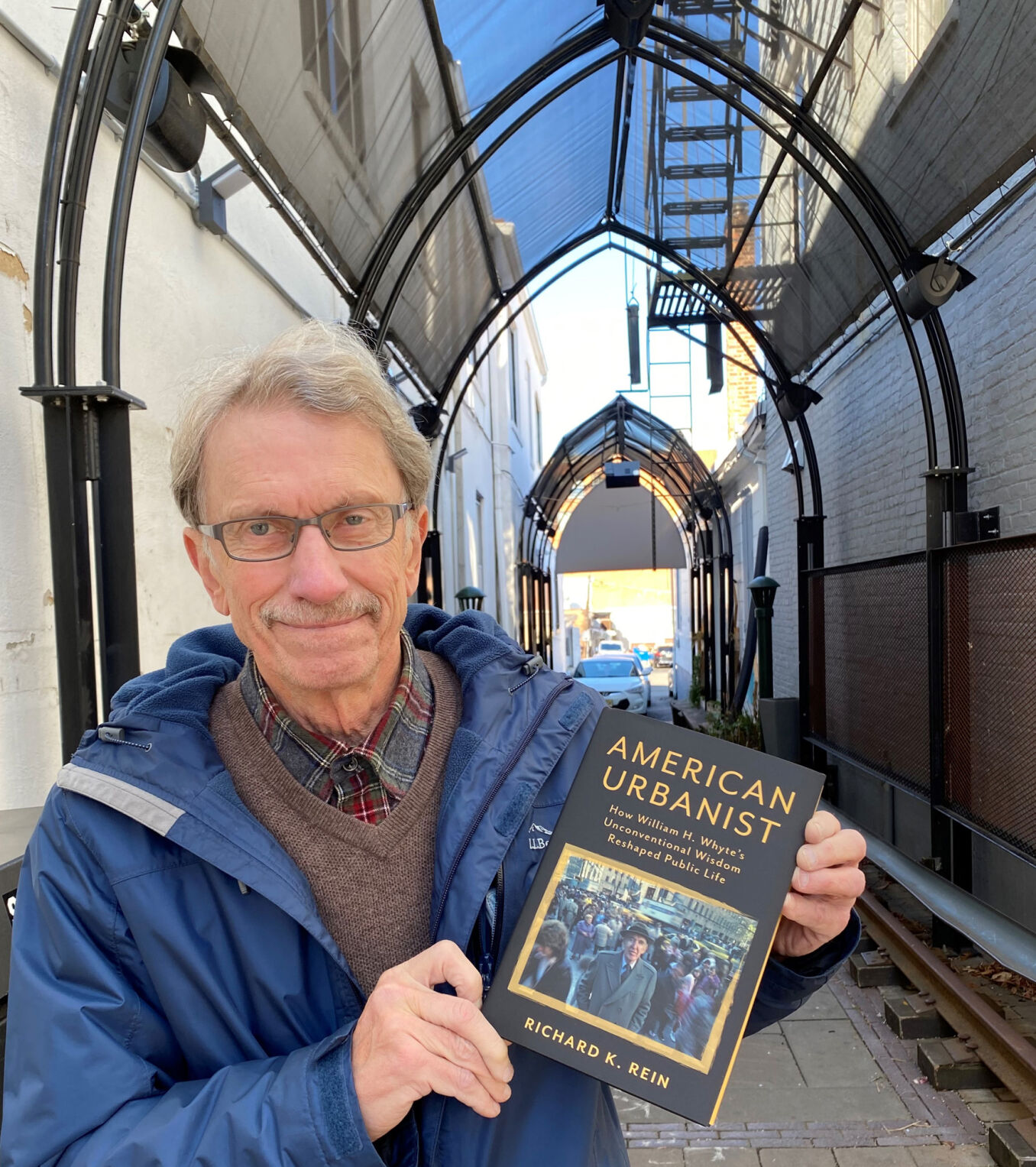
‘American Urbanist’ author Richard K. Rein in Princeton’s Dohm Alley, a site that helped inspire the book project.,