How does one get to be a producer of a New Jersey and syndicated television program?
For Trenton resident Eric Schultz, the answer is simple: study the cello.
And while this sounds like the punch line for a joke, it isn’t.
The trained cellist who bowed his way into being the producer of the “State of the Arts” television program will make a musical statement when he performs at the Trenton City Museum on Saturday, April 30.
The presentation closes the exhibition “Painting the Moon and Beyond: Lois Dodd and Friends.”
And while the show highlights the artistry of New Jersey-based American artist Lois Dodd, it also thematically connects to the celestial and the collegial.
The former is the fact that Dodd and circle frequently painted at night. The collegial is that circle of friends and other artists.
That includes nationally known Trenton artist Mel Leipzig, whose painting of Dodd in her New York City studio is in the exhibition.
According to “Painting the Moon” curator Ilene Dube, that painting also was the catalyst for the show’s creation.
Dube’s recent participation with “State of the Arts” programming was also the catalyst for asking Schultz to close the exhibition with a cello performance.
During a recent interview at his home in the Glen Afton section of Trenton, Schultz says over the past six months Dube — who also is an arts writer and painter — has been contributing video material to his home and office.
Schultz says, “Sometimes, when she arrives, I’m playing my cello to relax. At one point, she says, ‘We’d love to play a recital at Ellarslie’” (the name of the 19th century mansion that houses the Trenton City Museum).
The idea resonated with Schultz for a few reasons.
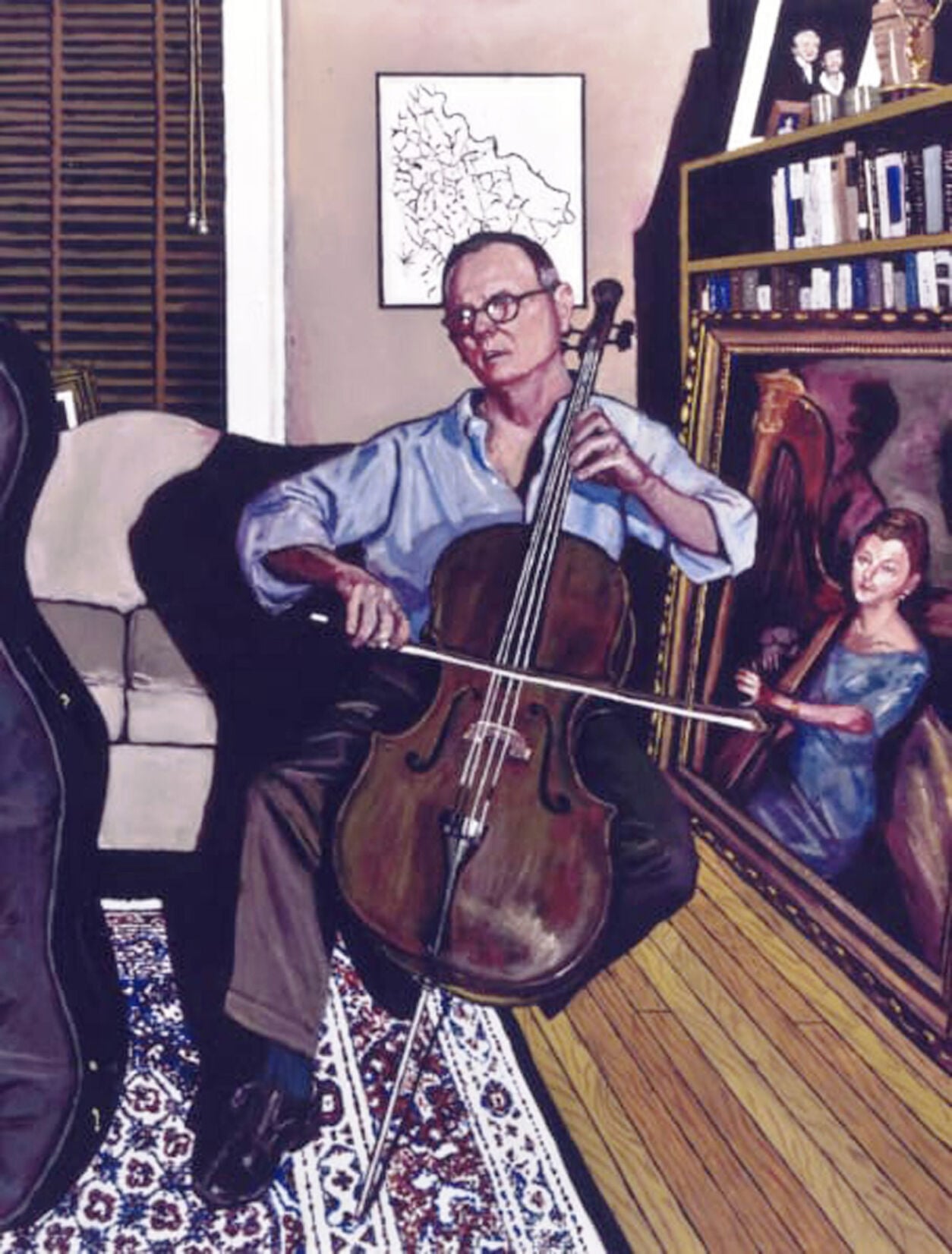
One is Leipzig. The artist is not only Schultz’s neighbor but the creator of a painting of Schultz playing the cello.
Pointing to the reproduction of the painting in his home, Schultz says it will be on view at the concert.
Another reason is timing.
Schultz says although he hasn’t performed in such a solo concert for about 40 years — he has appeared with orchestras -— he thought it would be fun and has unintentionally been preparing for it.
“Over the past few years, during the pandemic, I’ve been playing,” he says. “I have an elderly, infirmed mother, aged 88. She’s been confined to a room at my sister’s house in New Rochelle. Almost every day at 5 p.m., I would get on Zoom (to play), and she had a glass of wine.
Schultz says one of the regular pieces he performed was Jules Massenet’s “Meditation” from the opera “Thais.”
While Schultz used a cello transcription of the famous piece for violin, it caused his mother to tearfully recall her violinist grandmother performing it.
“I would have to practice,” he says wanting to maintain a standard relating to his own grandmother, who played harp for the Philadelphia Orchestra, and the master who ignited his interest in the cello when Schulz was 12, Pablo Casals.
The Pelham, New York, raised son of New York market researcher says his stay-at-home mother took him to an outdoor concert where Casals’ performance of the “Song of the Birds” Spanish carol memorably affected him.
“There is something emotional about the sound of the cello,” he says.
The arrival of a cello owned by his great-grandmother to his family’s home sealed a path that he would follow in public school.
Although he took a two-year detour studying English at Colby College in Maine, Schultz says he wanted to return to the cello and enrolled in the New School of Music in Philadelphia.
He was attracted to the school’s program developed and led by the members of the Curtis String Quartet, all of whom had attended the Curtis Institute.
The experience there led Schultz to pursue graduate studies at Michigan State University, where the Juilliard String Quartet was in residence.
It was also there that his career changed.
Although Schultz had received a master’s in cello performance and entered the doctorate of musical arts program, he says, “I realized that I wasn’t going to be a cellist. I didn’t have it in me.”
Nevertheless, he entered a competition where the prize was to play the cello on a Michigan State-produced public television program.
Schultz won and met the producer, Don Pash.
An educational television pioneer in the 1950s and 60s, Pash developed programs featuring student recitals and distributed them to broadcast venues around the country.
When he learned Pash was about to retire, Schultz applied for the position. “I had no background in television but the recitals. The cello led to the job at public television. It opened the door for me, and I had a job at the university. It was an accident, but I had to learn how to do it.”
Schultz says while he was running the public television component of the university, he took advantage of the institution’s educational resources and earned an MBA. His thesis was on public television consolidation.
The degree “proved to be very helpful. Business law was important. And I liked finance and finding out how to deal with balance sheets and cash flow reports. I’ve become an expert in Quick Books,” he says.
But after 12 years in Michigan, Schultz says, “I wanted to move back East. I thought I should do something else. I remember having an interview with an (investment company) and a publishing company. I then noticed (the Public Broadcasting publication) Current had a job opening at New Jersey Network. It was a lower end job, but it had an arts component.”
The position was for the New Jersey Network-produced “State of the Arts.”
The show premiered in 1981 and grew a reputation as the only statewide television program that showcased New Jersey arts and culture.
Rather than apply, Schultz called and set up a time to talk to producer Nila Aronow while he was traveling to see his New York family.
“We hit it off,” he says and soon moved to New Jersey with his cello, suitcase, and partner, now of 27 years, Peter Wagner.
His first NJN job was to do a story on an artist in Jersey City in 2001, right after the World Trade Center attacks.
His last was 10 years later when the Christie Administration pulled the plug on New Jersey Network.
In between there were hours of New Jersey artists and organizations being introduced to state audiences.
In order keep the arts program on the air, Schultz and other “State of the Arts” producers met with the funders that had been supporting the nonprofit NJN and worked out a structure to continue the program.
The result is partnership between Stockton University, New Jersey State Council on the Arts, and PCK Media, the latter being an LLC created by the NJN producers, including Schultz.
Now operated by Schultz and Susan Wallner, the company using family initials works on contract to provide services for organizations and institutions and works with Stockton University’s School of the Arts and Humanities to produce “State of the Arts.”
“We produce 10 to 12 shows a year,” Schultz says. “We shoot documentary-style in the field. There are usually four stories in each segment. We also provide a weekly schedule using an inventory of shows created over the past two or three years.”
He says broadcast outlets include WNET, NJPBS, All Arts, Worldwide Cable, PBS affiliates (including the probable renewal with WHYY in Philadelphia), and YouTube, where Schultz says they’re at about 3 million views.
About their approach to producing stories, the PCK websites says, they “tell thoughtful stories that are emotionally engaging and visually stunning.”
Schultz says they look for geographic, artistic, and subject diversity.
“We’re interested in profiling people. We do people from all kinds of backgrounds — emerging as well as established artists and always have some connection to New Jersey.
“We find there are things so ineffable about the arts that it is that it is told best from the artist rather than a correspondent.”
To make the point, he says some of the upcoming shows include segments on the late dancer Nai-Ni Chen and how her company is planning to continue, Montclair-based drummer and National Endowment for the Arts Jazz Master Billy Hart, Trenton photographer Edwin Torres, new American Repertory Ballet artistic director Ethan Stiefel, and Deborah Willis, the curator of the traveling exhibition “Posing Beauty” at the New Jersey State Museum.
He also adds that sometimes a “State of the Arts” subject requires more attention and deserves wider distribution. In that case, he and Wallner work with the nonprofit Stockton University Foundation to raise money through a “producer’s circle.”
But during the time of the interview, Schultz is planning his cello recital and addressing the exhibition’s themes in the following manner:
For night, he will play cello transcriptions of a Chopin nocturne as well as three night-themed Puccini arias. For collaboration, he will present the opera pieces with pianist and Boheme Opera co-founder Sandy Pucciatti and also perform duets with New Jersey-based cellist and Rutgers University Young Artist Program instructor Mira Khan.
The collaboration also involves Leipzig’s painting and art history. The cello used in the painting is the same used by famed American artist Thomas Eakins in his 1896 painting, “The Cello Player.”
Schultz encountered the instrument during a visit to a music shop in Philadelphia. Knowing Leipzig admired Eakins, the producer arranged to borrow it for the painting.
“The entire presentation will connect to Leipzig’s painting,” says the producer who owes the image and his career to a cello.
“Painting the Moon and Beyond” Closing Reception, Trenton City Museum, Cadwalader Park, Trenton, Saturday, April 30, 1 to 4 p.m. www.ellarslie.org. For more Eric Schultz and PCK Media, visit pckmedia.com.
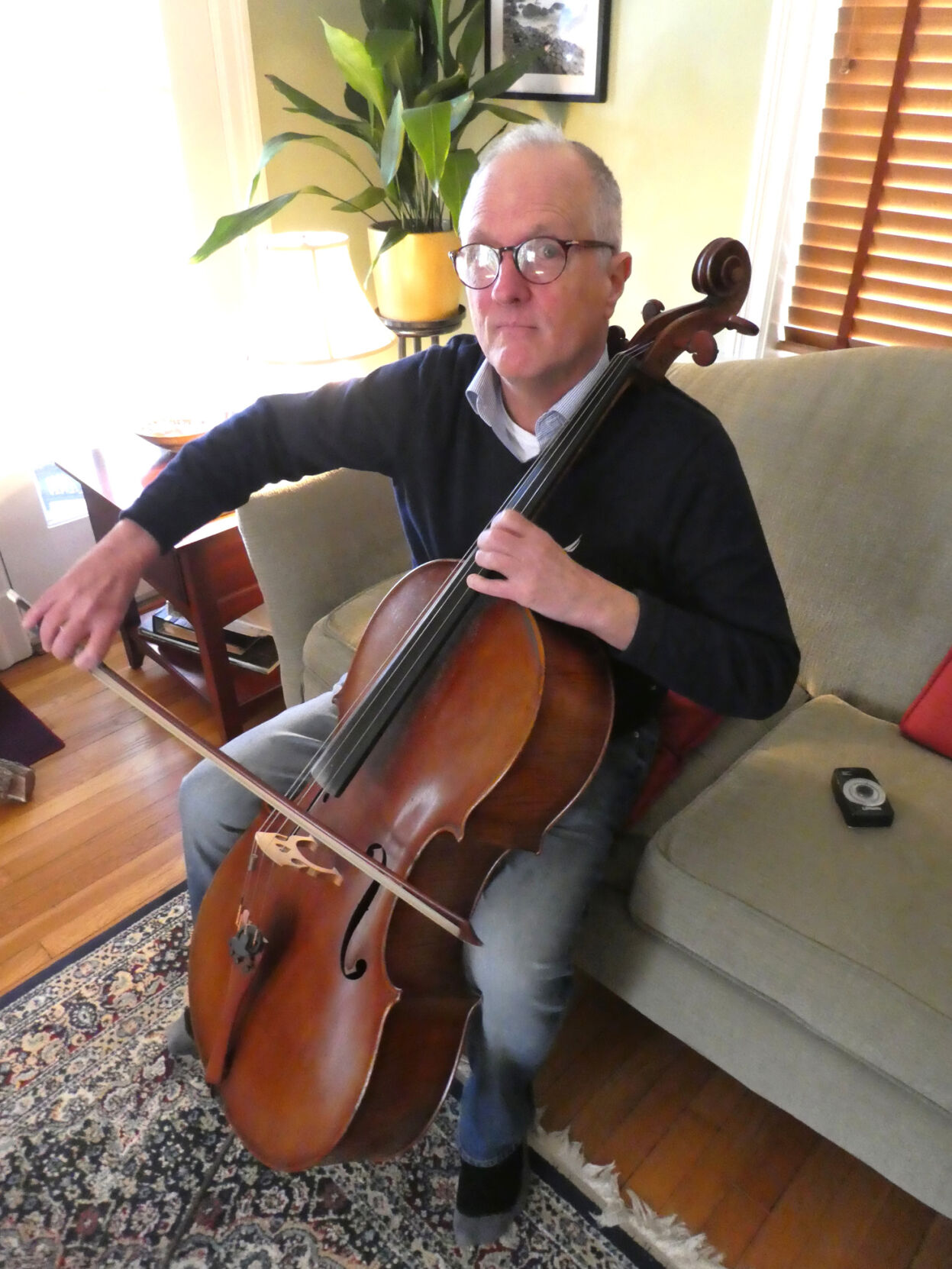
Cellist Eric Schultz performs at Ellarslie on Saturday, April 30.,