When Matthew Michibata played baseball for the West Windsor Little League, he was good enough to make All Stars. That honor, however, wasn’t enough to hold his interest on the diamond.
“I got a lot of cracks from my baseball coach about sitting in the outfield picking grass,” Michibata said. “I was athletic enough to get up and get a ball when it came to me. But that’s not something I can do in tennis.”
And tennis is the sport in which Michibata has excelled since focusing on it fulltime at age 12. The rising senior is preparing for his final season of collegiate competition at The College of New Jersey, where he has been first or second singles and No. 1 doubles throughout his career.
“It went super fast,” Michibata said. “It’s been such a weird time with COVID and everything. It felt really short, but also long at the same time. I took a guest semester and it gave me extra time to work on my tennis and I’m also using my extra year of (COVID-related) eligibility, which is nice. But I just don’t want it to end.”
The 2018 West Windsor-Plainsboro South graduate has tuned up for his final season by hitting with friends this summer. He planned on playing in the Jack Cryan Tournament in late July, and also played on grass for the first time when he was a Middle States representative at the Church Cup tournament in Rhode Island. Michibata won both his singles matches on grass.
“I think that was a really good experience,” he said. “Going into it, I knew I would do well on grass because it fits my game so well. The serve and volley game works best there and that’s my favorite style, so I was able to transition into it pretty smoothly.
“I didn’t quite expect it to be that much fun. I think after one experience it’s my favorite surface.”
“It’s too bad,” he added with a laugh, “that colleges don’t play on all different surfaces.”
Michibata comes from a tennis family. His mom, Angie, plays the sport and strings rackets at West Windsor’s Princeton Tennis Program (PTP), while his dad, Glenn, is a former USTA tour player.
Glenn reached the second round of all four grand slam tournaments and gained the men’s finals in doubles at the 1990 Australian Open. He was ranked as high as No. 5 in doubles in 1991 and No. 48 in singles in 1986.
The former head coach at Princeton University, Glenn is currently a PTP instructor and teaches several nationally ranked players. Not too shabby a coach for his son.
Bue to Glenn’s modesty, it took a while for Matthew to understand how good dad truly was.
“When I was young, I knew about him but it didn’t really register,” Michibata said. “It wasn’t until high school when my tennis friends started coming up to me saying ‘Hey, your dad has a Wikipedia page. We didn’t know he was a pro tennis player.’ I was like ‘Whoa.’
“Maybe it’s not great that I didn’t know he had a Wikipedia page, I don’t know. I don’t even know if he knew.”
Despite his success in the sport, Glenn never pushed Matthew to follow him. In fact, he and Angie greatly enjoyed attending the little league games. But they could see his interest start to wane.
“Right around 11 or 12 he wanted more action,” Glenn said. “Sometimes when you’re in the outfield and the ball doesn’t get hit to you; and then it’s not your turn to bat when your team’s up, you can go a whole inning without doing anything. One day he said ‘Dad I want to see how I do in tennis.’ Once he started he never let go.”
Due to Matt’s athleticism, Glenn felt his strengths were as a net player and doubles player, where reaction time is key.
“He’s got very quick reflexes and is very quick on the first step, he’s got good agility,” the coach said. “You can use those skills when you play baseline but it’s really suited for the net. It’s not the usual baseline, big serve, all groundstroke. I thought he would be best served by learning to play the net and coming to the net more often than what’s typical of today’s players. He embraced that.
“I also put a priority on him learning the game of doubles. That’s probably been his strength through Juniors and college. He plays good singles but his doubles are really strong. I think he enjoys that teammate aspect too; that there’s someone on the court with him.”
Matt jumped at the chance to play a faster paced game. Considering his outfield impatience waiting for fly balls, it made sense.
“Oh yeah, I don’t think grinding at the baseline is my thing,” he said. “I always loved quick paced tennis. The net game really is good for that. I have been working on my game so I don’t get impatient, but that’s just who I am.”
After enjoying a strong career playing for some WW-P South powerhouses, Michibata decided on TCNJ because of its proximity and strong nursing program. He had originally planned on majoring in General Health with ideas on being a physical therapist.
“I’ve been injured so many times, I kind of know what goes into it,” he said. “But a lot of my family’s friends are nurses, they highly recommended to go into nursing instead.
“My goal right now is to get through nursing school. It’s been super-tough balancing nursing and tennis at the same time. I’ve been told by upperclassmen, other nursing students, that I should drop tennis to focus on nursing because it’s that hard. But I wanted to keep on with tennis because it’s such an important part of my life.”
It has also been a successful part of his college life.
As a freshman, Michibata was the New Jersey Athletic Conference’s Co-Rookie of the Year and made All-NJAC in singles and doubles. He led the Lions with 15 singles wins and was second with 18 doubles wins, and his 33 total victories were the most on the team in four years.
As a sophomore, Matthew reached the finals of the ITA Regional Tournament. His 11 singles wins led the team and his 12 doubles wins were second. Last year he went a combined 13-3 and was All-NJAC in both singles and doubles for the third straight season. The classroom whiz also made the NJAC All-Academic team for the second time.
In discussing his success and enjoyment with doubles, Michibata said “It’s very quick paced, but I feel like in doubles I know what I’m doing. I always have a plan, everything has a purpose. Where singles has a lot more variables, I really like that about doubles. You don’t have to be playing amazing to do well in a match, you just have to have a system and know what you’re doing.”
As he enters his final year, Michibata’s goal is to reach the NCAA Tournament as an individual and as a team, and to win the ITA Tournament.
After graduation, he still plans on playing in some form or another.
“Tennis is a huge part of my life,” Michibata said. “Its taught me a lot of things even outside of tennis, like how to carry myself as a person, what to focus on. I don’t think I’ll ever stop playing tennis, by choice at least.”
Glenn has been Matthew’s coach from day one, teaching him individually and in PTP clinics. That prompted the pupil to quip “I haven’t fired him yet.”
In looking at his son’s exploits, the two things that make dad proudest are his tenacity and conduct.
“One thing I love about him is, win or lose, he fights for every point,” Glenn said. “It doesn’t matter what the score is. The other guy could be well ahead and he could still be fighting for that last point. That’s awesome.
“Like a typical dad, I’m really proud of my son. He pursued tennis and gave it everything he had; plus he made it a priority to show good character on the court. He won various sportsmanship awards throughout his career. That actually means more than winning tournaments or any ranking he got. He pursued it with the right attitude and had respect for his opponent and respect for the sport.”
And not once did he ever sit down to pick grass out between cracks on the court.
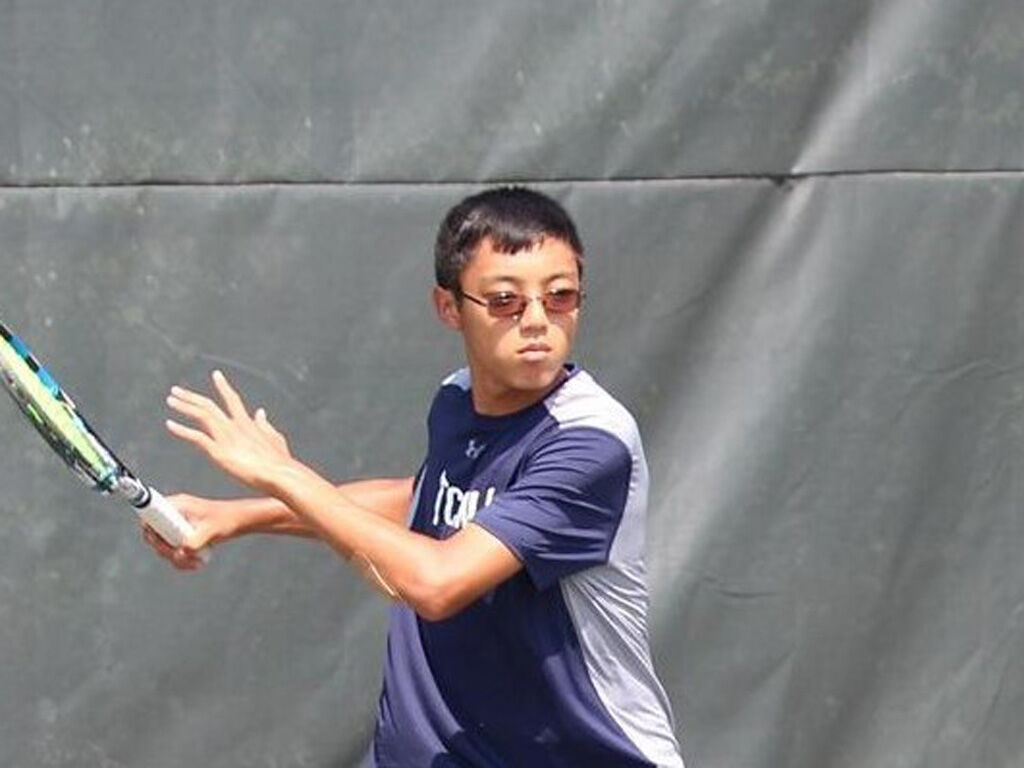
Matthew Michibata has been first or second singles and No. 1 doubles throughout his career at The College of New Jersey.,

