In 1881, a clergyman by the name of William Bowen (1833-1891) acquired a 5-acre boarding school for boys known as the New Jersey Collegiate Institute on Park Street in Bordentown and transformed it into a prestigious academy of learning known as the Bordentown Military Institute.
A graduate of Wesleyan University in Connecticut, Bowen held his position as head of the school for three years until internal strife forced him to resign. In his place, the site was skillfully honed into a college preparatory school for the next 30 years under the direction of Rev. Thompson Hoadley Landon (1830-1917), an honored pastor of the Methodist church and fellow alumni of Wesleyan University.
Married to Sarah Durland in 1864, Rev. Landon and his wife raised three children. As an educator, he taught Greek and Latin languages, as well as mathematics at several seminaries across New York and New Jersey.
His ability to excel as principal of an important military institute while maintaining high moral standards, earned him a spot to run for the governorship of New Jersey under the platform of the Prohibition Party in 1898. Although he lost, he was humbled by the outpouring of support expressed by students and faculty members alike.
In 1889, his two sons entered a partnership with his blessing. His oldest son, Thomas Durland Landon (1865-1934), attached to the New Jersey National Guard as Captain, was in command of Military Instruction. By promoting physical development through this department, cadets cultivated habits of virtue and discipline.
As the years progressed and instruction changed, Thomas became head of the school’s Military Department with his only absence occurring during the Spanish-American War when he promoted to the rank of Major and during World War I when he achieved the rank of colonel. When his father passed away in 1917 at age 87, he was more than prepared to handle the reigns of responsibility for the next generation of qualified college-bound cadets as the institute’s next principal and commandant.
By the end of 1918, over 400 former students had served in the war. Many held high positions as officers. Extremely proud of each graduate, Thomas held an untarnished record of over forty years of unwavering devotion to the standards of the institute.
A year before his death in 1934, his final rank was elevated to brigadier general. Without a doubt, he was the quintessential essence of the institute’s motto: “Rather Be Than Seem.”
The centerpiece of the campus was a large four-story brick structure of French design known as “Old Main.” The northern portion of the building was built by exiled king of Naples and Spain, Joseph Bonaparte, as a residence for his personal secretary, Louis Mailliard.
It was referred to as the “tower,” and his only child, Adolphe, lived here with his family until they relocated to California for health reasons at the conclusion of 1867. After extensive construction improvements occurred during the institute’s first decade, the building proudly retained its architectural integrity and charm.
Within the gaslit halls of its 36-by-100-foot frame, “Old Main” housed executive offices, an assembly hall, classrooms, and living quarters for approximately 60 cadets and staff. As more students were being accepted, accommodations for offsite dormitories (primarily on Park Street), became a necessity.
By 1970, 10 neighborhood homes served as living quarters for cadets and facility members and their families. Meals took place in one of the school’s dining rooms around a large table for gatherings. The homes, with prominent names such as the Raymond House, the White House, and the “Hop” (or Hopkinson ) House, still stand as private residences today. An unusual rustic style structure, known as the “Y” Hut, served as a recreational facility to relax, play games, and purchase snacks.
The largest reminder of the institute’s past can be seen on Third Street, where current medical and business offices once held a dormitory known as Landon Hall. Landon Hall accommodated up to 44 summer school students; a physical science building; and an infirmary that was rated one of the best in New Jersey in the 1960’s.
In the course of its 91-year existence, the Bordentown Military Institute offered young men ages 12 to 18 the motivational techniques to harness a strong character, a sense of responsibility, and a vigorous mind and body. Faculty consisting of caring instructors and counselors were the primary force of guidance for assuring a favorable appraisal of each cadet. These values remained consistent through time.
In 1884, board and tuition for an academic school year cost $260, and enrollment was less than 100 students. Services provided for living on campus included laundry cleaning, instruction in military tactics, and the proper care of firearms.
Cadets had to furnish their own bibles, dictionaries, towels, clothes bags, bed linens and blankets with personal identification. Extracurricular activities such as sports, music, art, and even religious worship were highly promoted and encouraged.
The four-year program of study for college preparation consisted of arithmetic, Latin grammar, and outlines of history for the first year; algebra and Latin and Greek grammar for the second year; geometry and Latin prose composition for the third year; and mathematics, Roman history, and Latin and Greek prose composition for the fourth year. These programs were in addition to science courses, electives, and sports. The bugle sound of “First Call” began the day.
In contrast, by 1970 board and tuition for an academic school year cost $3,600, and enrollment averaged 300 cadets. The faculty comprised at least 30 teachers on the immaculate 75-acre campus.
The four-year program of study for college preparation consisted on algebra, Latin, Earth Science, and typewriting for the first year; geometry, mechanical drawing, biology, and modern history for the second year; public speaking, trigonometry, economics, and advertising for the third year; and analytical geometry and calculus, physics, sociology, and business administration for the fourth year. The last three years also included the study of foreign languages such as French, Spanish, and German.
From 1932 to 1968, the embodiment of the school was not a structure or a motto but rather one remarkable man: Dr. Harold Morrison Smith (1888-1971).
Beginning with his tenure as dean, his guiding wisdom and compassion shaped the nature of the cadets and the institute until his retirement as president and headmaster. His belief that “everyone to someone is a beacon” was a moral code that he demonstrated daily with personal conviction.
Despite the institute’s reputation for academic excellence, the anti-military sentiment from the endless and unpopular Vietnam War curtailed its enrollment and placed a heavy burden on its finances. In 1972, a decision was made to merge the school with the Lenox School in Massachusetts in order to ensure its survival. However, it proved to be ineffective, and administrators had no choice but to permanently shut down the school in 1973.
Although the Bordentown Military Institute no longer remains, its legacy continues in the hearts and minds of those that attended and their families.
In 1895, the great English novelist, short-story writer, poet, and Nobel Prize Laureate Rudyard Kipling (1865-1936) wrote his most famous poem, If. It was a powerful poem about challenges faced through life. Its message seems appropriate when compared to the principles of the Bordentown Military Institute.
…If you can talk with crowds and keep your virtue,
Or walk with Kings — nor lose the common touch,
If neither foes nor loving friends can hurt you,
If all men count with you, but none too much:
If you can fill the unforgiving minute
With sixty seconds’ worth of distance run,
Yours is the Earth and everything that’s in it
And — which is more — you’ll be a Man, my son!
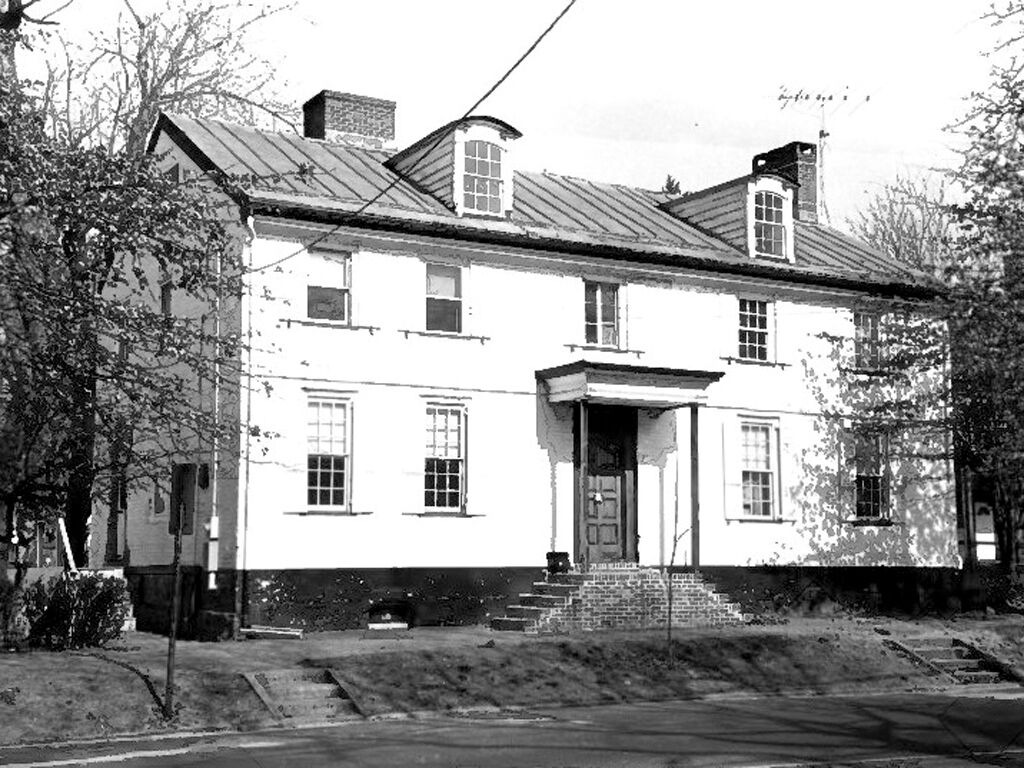
Historical image of the Bordentown Military Institute’s Hopkinson House. (Courtesy of Lawrence McCarter/Facebook.),

