On Aug. 9, the Department of Environmental Protection and the administration of Gov. Phil Murphy issued a statewide drought watch. A week later, seven counties received upgraded classifications to “severe” drought conditions, with Central Jersey being hit hardest.
A drought watch includes voluntary conservation measures. If conditions worsen, a declaration of a drought warning or a drought emergency with mandatory water use restrictions could become necessary. At the time of this writing, the DEP’s water supply advisory council was considering a move from a drought watch to a warning.
These state advisories are becoming more frequent, as high temperatures associated with climate change encourage and intensify drought conditions. Voluntary conservation measures at the watch stage can help to avoid more serious and restrictive drought conditions later.
Several Hopewell Valley organizations started far earlier, and can point to sustainable measures that have resulted in not only significant reductions in water use, but also improved air, land and water quality.
Bill Johnson, farms and grounds manager, has been with Janssen Pharmaceutical Companies for 32 years, and said that since day one, their direction has been guided by the corporate credo that includes, “We must maintain in good order the property we are privileged to use, protecting the environment and natural resources.”
Janssen campus buildings and grounds are River Friendly and LEED certified. Both required extensive recordkeeping to maintain and prove sustainability outcomes. Janssen’s approach to grounds keeping is a model in best practices, beginning with their land use.
Manicured lawns are well known to be awful for the environment. They require tremendous amounts of water. Fertilizers, herbicides and pesticides used to keep turf green are bad for soil and water. Gas-powered tools, such as mowers, edgers and blowers, contribute to both noise and air pollution.
Janssen moved to Titusville in 1992, and the property at the time comprised 60 acres of manicured lawn. They began their wildflower program in 1995, and today less than 25 acres of manicured lawn remain.
Replacing lawn with native wildflower meadows ensures more water is retained in the land due to the deep root system and results in less storm water runoff. Groundwater is recharged, while providing an inviting natural landscape.
Further, the lawn they do maintain is only fertilized once a year and they have dramatically cut back on chemical use. Finally, there is no irrigation system.
“We have raised our threshold toward perceived imperfections and spot treat areas with weeds or pests, rather than treating the entire lawn,” Johnson says. “In addition, our grounds staff has attended tons of education at Rutgers, and we’ve learned what pests come out when and what to look for. So, we can anticipate and eliminate recurring problem areas.”
The grounds team also switched to battery-powered mowers and tools. Not only is it far quieter, but since Janssen also houses a day-care facility, they’ve eliminated concerns about fumes impacting the campus’s youngest occupants.
While Janssen’s sustainability actions provide beautiful wildflower-lined walking trails for staff and conserved natural resources for the greater community, the company has also taken steps to encourage similar conservation initiatives outside of their campus.
In 2017, Janssen provided $10,000 grant to Friends of Hopewell Valley Open Space as its inaugural Community Conservation project to initiate the first Hopewell Valley Regional School District Outdoor Learning Area at Bear Tavern Elementary School.
After converting their manicured lawn to a native plant pollinator garden designed for outdoor learning, Bear Tavern Principal Chris Turnbull leveraged those results to encourage additional partners to fund ponds, greenhouses, vast wildflower meadows, and nature trails extending throughout the grounds.
Peg Forrestel, director of community impact for Janssen, praised the Bear Tavern project for supporting hands-on STEM learning and promoting the health benefits associated with being outdoors. She was especially appreciative that it went a step further by actively involving many additional community members and groups.
Janssen continued providing FoHVOS Community Conservation grants for more outdoor learning areas including one that removed the lawn and installed the flagship rain garden that fronts Timberlane Middle School.
FoHVOS, often propelled by Janssen funding, went on to facilitate Outdoor Learning at every district school. The HVRSD superintendent credited outdoor learning for helping to keep schools open during the pandemic.
New naturalized outdoor spaces contributed to HVRSD schools also receiving River Friendly certification. At a 2022 spring ceremony, Jim Waltman, executive director of The Watershed Institute, said that this was the first time that all schools throughout a district received certification.
While Capital Health is the newer on scene than Janssen, joining our community in 2011, they too have focused on integrating sustainability with their core healthcare mission.
Capital Health President and CEO Al Maghazehe, says, “When Capital Health Medical Center Hopewell opened, we knew we had a unique opportunity to marry the high quality health care we offer with a beautiful natural setting that provided for a healing environment.”
He pointed out that the building was awarded LEED Gold certification for the design and practices that were part of the campus.
A decade later, Capital Heath has engaged in more initiatives to celebrate the natural environment.
Most recently, they began working with Steward Green, also a Timberlane raingarden partner, to actively manage their landscape to naturalize the landscape to maximize conservation practices and provide a more peaceful space for our patients, visitors, employees and the broader community.
“One of the first things we’ve done is restore and add additional native plantings that use less water and we are more effectively managing things so we can protect the plants that are native to our area from invasive ones. We are also more aggressively managing our landscaping to ensure more infiltration as part of our stormwater management,” Maghazehe says. “As part of this work, we are paying close attention to the ponds on our property and recently removed blockages that were created by animals so we could drop the level and provide a more sustainable environment for other local wildlife.”
Capital Health has also enhanced its rooftop gardens, adding still more native plantings and color while also trying to use less water. All this was done with a specific focus on making outdoor, peaceful spaces that were accessible to our patients and, of course, our employees.
All of those things contribute to the beauty of the campus,” Maghazehe says. But they are also intended to support the natural environment and the community we are a part of.
“As part of our efforts over the next several years, we are looking to add additional educational resources along our walking trail and at other locations on campus to highlight and educate our employees, visitors, patients and community about the natural elements on campus and we have already installed webcams so we can watch our progress with respect to encouraging more birds to nest here and make the campus more friendly to wildlife,” he says.
They are excited to share their campus for events and “offering additional opportunities for both employee and community engagement.”
Janssen, HVRSD, and Capital Health are all major landowners taking positive land stewardship action.
In addition, conservation organizations Friends of Hopewell Valley Open Space, Watershed Institute, NJCF, and D&R Greenway, as well as the Township of Hopewell and County of Mercer all own significant amounts of Hopewell Valley lands and also promote native plantings and positive conservation practices.
As drought warnings become more frequent, remember that during the summer, more than 30% of water demands come from outdoor use.
Following the lead of organizations featured here will help businesses, public land managers, and private property owners to reduce their water usage while keeping the environment healthy and beautiful.
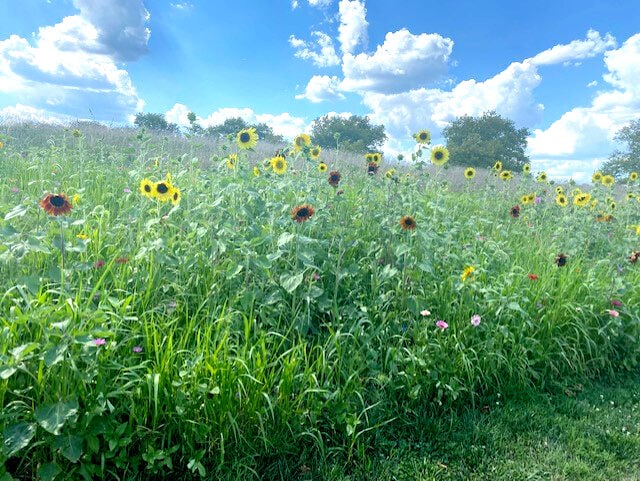
Sunflowers in a meadow on the grounds of Janssen Pharmaceutical, where acres of manicured lawn have been replaced by more environmentally friendly landscaping.,

