A recent study published in the Journal of the American Medical Association estimated that worldwide, 10.4 million children lost one or more parents, or caregivers, due to Covid-19. The authors noted the many consequences these children would face, including burdens brought on by traumatic grief.
In Mercer County, the number of Covid deaths alone is close to 10,000 people. It is likely that each death has caused a ripple-effect of grief among family members and friends, but most of all children.
Fortunately, our area has two organizations that can provide help. One is called Good Grief, a nonprofit based in Princeton and Morristown. And the other is called the Traumatic Loss Coalition based at Rutgers University.
The Traumatic Loss Coalition provides support to members of a community, or a school district after a traumatic event such as a suicide, a homicide, or another incident which seriously impacts a group of people. Trained clinicians provide counseling to those in need.
George Scott, a therapist who works with the Traumatic Loss Coalition, defines grief as “an internal process of feeling a loss.”
And while we most often experience grief from a death, Scott says there are many different kinds of losses in life which can trigger the emotion. Essentially, “the loss of anything of significance in your life” he says, can cause grief.
“Mourning, or grieving, is the outward sign of internal grief,” Scott adds. He maintains that grief is like an open wound that needs cleaning and care in order to heal properly. But even then, for some people, there may always be a scar. Everyone’s journey through grief is different due to the nature of the loss, personal experiences, and the ability to access help to “realign” one’s personal inner world, Scott said.
Evelynn Moon works as the Director of Education for Good Grief. She has been with the organization for about 18 months. She talks about grief being a form of learning which happens over time, and usually not in a linear fashion.
You don’t get over the grief of loss, Moon says. Rather, as the grief gets processed, it becomes another experience which makes you, you. As the information packet for Good Grief notes: “We do not believe that there is a problem to be ‘fixed,’ but rather a new reality to learn to live with.”
Grief is a “lifelong journey” Moon says. People will experience an “acute phase of grief” which can come and go forever. She notes there are triggers which re-awaken the grief first felt by the initial loss. There are smells, places, music, the holidays, all kinds of triggers might bring back the grief.
The goal is to build resilience, to try to find joy in the memories as opposed to sadness.
Good Grief was started in 2004 by people who believed grieving children needed advocates to support them as they grieved. The initial model for the Good Grief program came from the Dougy Center, also known as The National Center for Grieving Children and Families, in Portland, Oregon, which was founded in 1982.
The Dougy Center gets its name from Dougy Turno, who in 1981, as he was dying from a brain tumor, wrote to Dr. Elisabeth Kübler-Ross, a psychiatrist; and, at the time, the leading voice on dying. Turno asked the doctor: “Why won’t anyone talk with me about dying?”
Kubler-Ross connected him with a former nurse, Beverly Chappell, who answered his questions and supported his family until his death. She also started peer groups where children could come and talk about loss.
The mission of Good Grief is to “provide unlimited and free support to children, teens, young adults and families after the death of a mother, father, sister or brother through our peer support programs, education and advocacy.” Moon stresses Good Grief does not provide counseling; rather, through biweekly peer support groups, volunteers help build a grief community for children, teens, young adults and parents.
It’s a place where those grieving can share their thoughts, fears, tears and hope in a safe place.
“One client described it this way,” Moon says. “We all arrived on different boats, but we all came to the same island.” And on that island, every word used, every planned evening, happens for a reason. At Good Grief, “everything is intentional,” Moon says.
“Words matter. The way we say things matter. We don’t use euphemisms; we use appropriate words like ‘death and dead,’” Moon adds. “We never use ‘loved one’ because we don’t want to assume there was love in a relationship. We talk about empathy and compassion.”
Located on Mapleton Road in Princeton, the home of Good Grief is sprawling and welcoming. There are rooms where young children can play with one another and ask questions about loss. There is a teen room. Young adults up to the age of 30 have their own space; there is a room for parents to connect.
“We really want to support the kids,” Moon says, “but we also want to provide and support everyone in the home. While the adults have their own group, family members are always in the loop about what has happened with their children so conversations can continue beyond the night.”
The Princeton location opened in 2012. Between the Princeton location and the program in Morristown, Moon says Good Grief is helping about 600 people a month. Peer Support Groups run like a school year, from September through June. There is a short summer offering for younger children.
Good Grief also runs groups in schools, and actively trains teachers and counselors to conduct groups in their own educational settings.
Those interested in participating in a Peer Support Group are asked to attend a brief orientation which includes a tour of the facility. Participants must also fill out a short questionnaire. Participants begin an evening at 6:30 p.m. with pizza; the individual groups run from 7 to 8:15 p.m.
Volunteers, trained by Good Grief and background checked, run the peer support groups.
“We recently celebrated 5, 10 and 15- year volunteers,” Moon notes. “They are getting so much out of it; volunteers come back year after year. We all have our own stories of grief that we carry with us. I think our volunteers want to be the support that they wish they had had.”
The youngest volunteers are college students; most of the volunteer staff are retirees. The next training session will happen in January 2023. Interested persons should reach out to Susan Laird susan@good-grief.org
In 2008, the Highmark Caring Place, based in Pittsburgh, helped to establish the third Thursday of November, the week before Thanksgiving, as Children’s Grief Awareness Day. This year, the date is Nov. 17.
The late Fred Rogers was the Honorary Chair of the organization from 1985 until his death in 2003. The foundation notes: “Before they graduate from high school, one child out of every 20 children will have a parent die.”
The Highmark Caring Place is sponsoring a virtual event for Children’s Grief Awareness Day called “Illuminating Hope”. Anyone can add a message to a virtual butterfly and share it.
Locally, Good Grief will be hosting a Zoom Event on Nov. 17, with Dr. Christina Liparini who will talk about the four stages of bibliotherapy which involves reading popular titles that touch upon grief and loss.
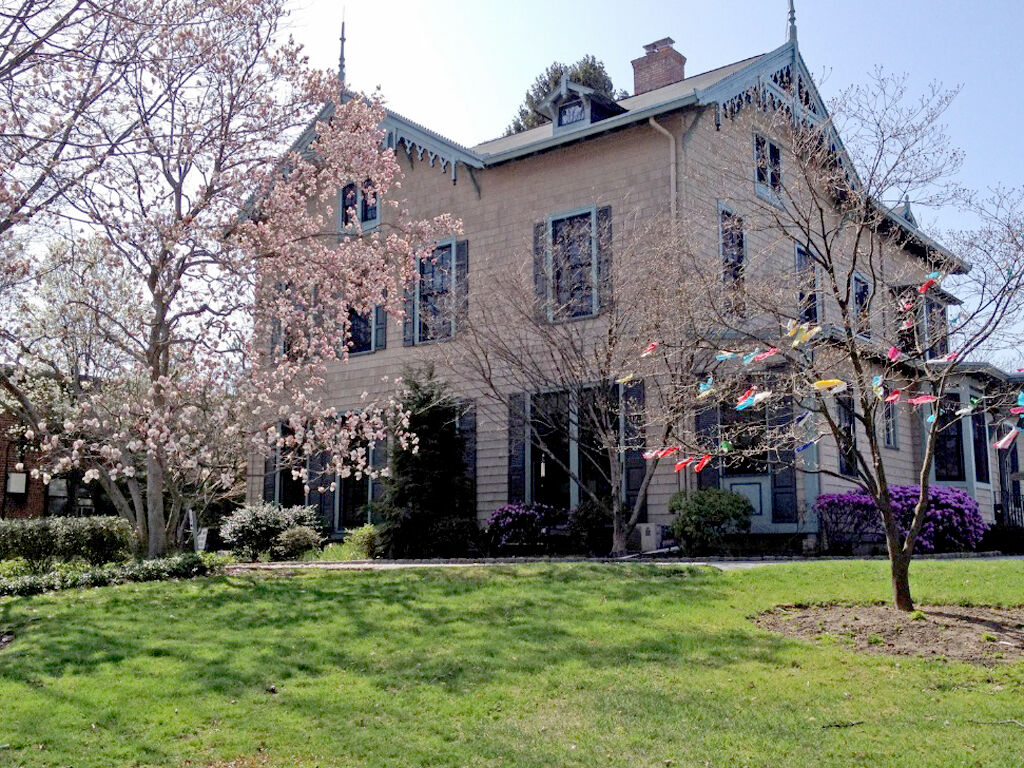
Good Grief has centers in Princeton (pictured) and Morristown. (Facebook photo.),

