Trust me — Chuck Thomas, Hamilton Township’s Director of Public Works, and Jim Wyrough, Hamilton Township’s Clean Communities Coordinator and Municipal Recycling Coordinator aren’t green and furry; they don’t live in trash cans.
But, like Oscar the Grouch, they love to talk trash. Well, let’s say for this story, they love to talk about recycling trash.
Thomas has been employed in the Department of Public Works since 1981, when he was hired for summer help. A graduate of Hamilton High West, Thomas became the Interim Director of Public Works in 2021, leading to his permanent appointment in January of 2022.
Residents reading the township’s website quickly discover Thomas has a lot to oversee for a town of nearly 92,000 residents: “The DPW consists of the Division of Roads, which is responsible for the maintenance and improvement of approximately 625 lane-miles of roadway and the Division of Public Properties, which is responsible for the maintenance and upkeep of all public buildings and parks.”
All of that work is done with a staff of about 140 people.
Thomas oversees a group of multi-talented individuals. “We use the same manpower for brush and leaves as we do for snow,” Thomas said. “Our teams do it all. If there is snow in between brush collections, then the staff is shifted to other responsibilities. We just change our priorities as seasons change.”
Wyrough, another Hamilton High West graduate, has been with the department since 1985 when he worked as a student assistant. In 2010, he became the Clean Communities Coordinator and Municipal Recycling Coordinator for the Department of Public Works.
In his role, he does grant writing, oversees the solid waste contracts and does community outreach.
Wyrough has landed another Clean Community Grant for Hamilton Township; this year, in the amount of nearly $195,000. The funds will pay for graffiti removal on public property, litter abatement like the river and creek cleanups, street sweeping, and stormwater management.
The history of recycling in New Jersey, and subsequently, in Hamilton Township, actually began after a national story about a garbage barge named Mobro 4000. The brainchild of Lowell Harrelson; an Alabama builder on the verge of bankruptcy; Harrelson thought he and investors could make money by sending trash-loaded barges from Islip, New York to North Carolina. The Mobro 4000 was the test case.
The Tar Heel State had no interest in the Islip trash after a reporter sighted a bedpan among the barge garbage. That discovery stirred fears that medical waste had been sent South. The barge floated hither and yon for five months, ultimately ending up in the New York City area where the trash was incinerated in Brooklyn by a judge’s order.
When the “Garbage Barge” set sail on March 22, 1987, conversations about shrinking landfills and the need to recycle had already started here in New Jersey. On April 21, 1987, then Gov. Thomas Kean signed into law the New Jersey Source Separation and Recycling Act (N.J.S.A. 13:1E-99.11). While Oregon and Rhode Island had passed recycling legislation by then, New Jersey’s legislation was the first in the nation to require all residents to recycle.
One of the provisions, Wyrough said, forbids putting leaves collected during the months of November and December into landfills. “In 1987, every town in New Jersey had to figure out how to dispose of the leaves, which were biodegradable,’’ Wyrough added.
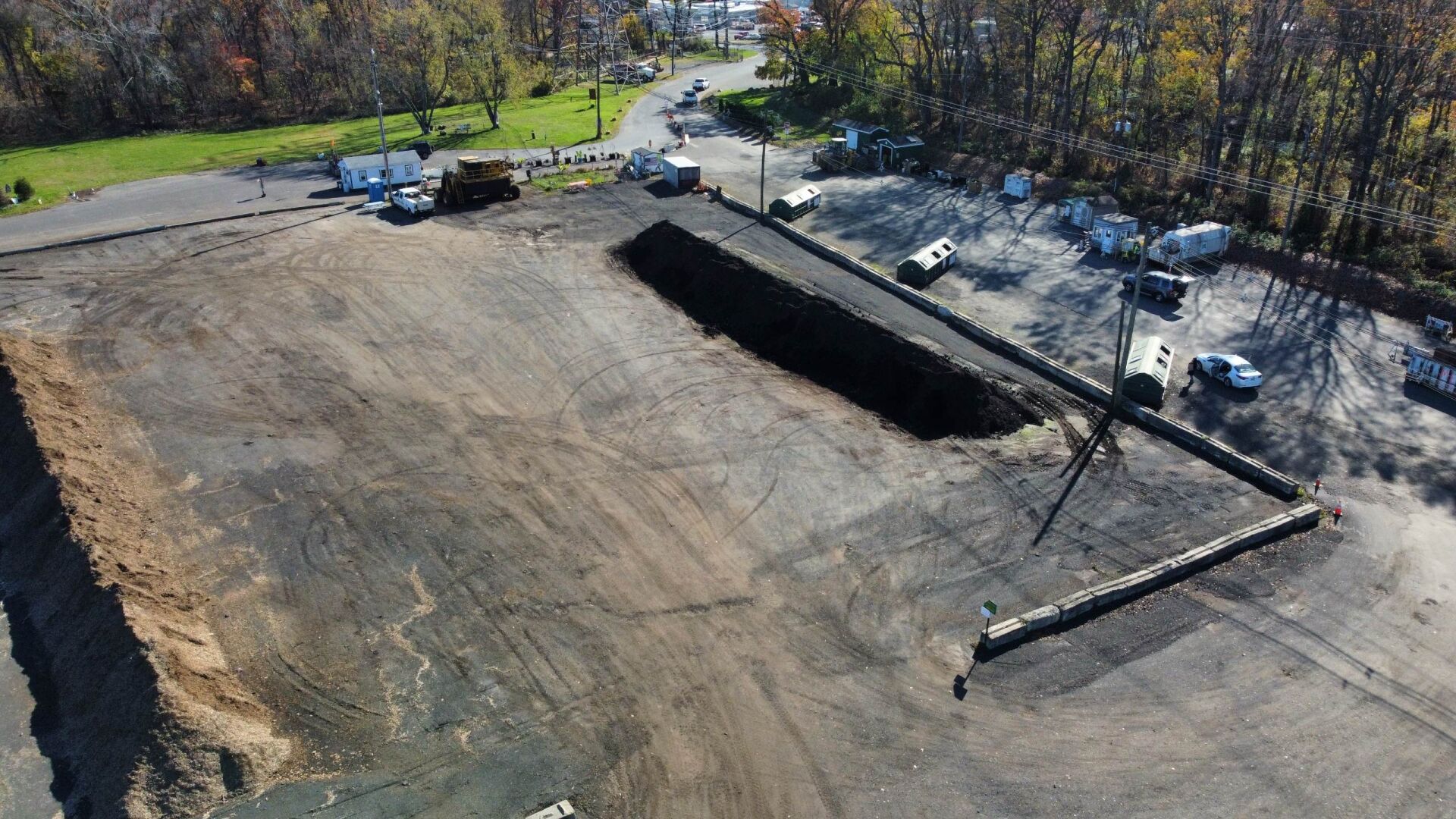
Enter Harry J. Bonacci, then Hamilton’s director of public works, and the man whose name adorns the ecological facility. Bonacci started the Hamilton Township recycling program on Kuser Rd. by transforming a 70-acre township landfill.
About 23 acres became the ecological facility. The remaining acres have become the location for the Department of Public Works to store materials and equipment.
Bonacci died of a heart attack in 1996, at the age of 54. The news story which ran in The Trenton Times on Oct. 24, 1996, noted: “Bonacci was known for his most successful project, the Hamilton Ecological Facility. Bonacci conceived the idea, and designed, built and operated it off Kuser Road.”
When learning of Bonacci’s death, former Hamilton mayor Maurice Rossi told a reporter Hamilton’s facility was one of the largest in the state. The mayor said locals referred to the site as “Harry Land.” It was while talking to that reporter, in the aftermath of Bonacci’s death, that Rossi suggested naming the ecological facility after Bonacci.
The Hamilton Department of Public Works ran the township ecological facility until 2009, when then newly elected Mayor John Bencivengo made the decision to privatize the operation. The Trentonian reported that Bencivengo declared the township would save $700,000 by privatizing the facility, and those savings would go to pave township roads.
Britton Industries won the operating contract, which cost the township $95,000 a year for the service. Six years later, Britton wanted $150,000 to run the facility.
By then, Kelly Yaede was mayor, and Britton had received several violation notices from the Department of Environmental Protection. Yaede’s business administrator, John Ricci, ran the numbers and decided the township should take back control of the facility.
Coming out of privatization cost the township about $271,000 in new equipment and security cameras. And that investment has meant the Hamilton’s Ecological Facility is quite busy. In 2021:
12,000 tons of mulch was processed from trees trimmed or removed, and chipped, by DPW employees, and is provided for free to residents who can pick it up at the facility.
7,500 tons of compost was made from leaves collected around the township, and is also offered free to residents.
40 tons of tires were recycled and 210 tons of cardboard sold to a local company.
150 tons a year of electronics like TVs, computers, etc. goes to the Morristown-based recycling company Covanta.
45 tons of motor oil was processed.
225 tons of what are called white goods—refrigerators, stoves, dishwashers and other metals are sold to local scrap dealers.
“Everything that goes on at the Ecological Facility saves taxpayers dollars,” Wyrough said. “It costs the town roughly $194 a ton to dispose of trash.” Consequently, the kinds of waste residents get rid of and how they dispose it matters.
For example, Thomas and Wyrough want residents to know that putting leaves in plastic bags slows down the collecting process. Placing leaves in brown paper disposable bags, and not plastic bags, makes collection far easier.
They can make compost out of leaf-filled paper bags, Thomas said. Otherwise, crews have to open the plastic bags at the curb and dump the leaves into the truck.
Starting Tuesday, Jan. 3, 2023, residents can leave holiday trees curbside for pickup. All ornaments and tinsel must be off the trees. Trees should not be put in bags. Teams of workers will make their way around the township to collect trees.
“We ask residents to be patient,” Thomas said. “If we get hit with snow, everyone gets shifted to snow removal,” he noted.
That means other services get temporarily put on hold.
“We have been affected like every other business and company,” Thomas added. “We have lost people through attrition. But the people we do have, work hard to get everything done.”
* * *
And here’s the footnote to this story.
There’s a bit of an antique vibe at the ecological facility. Castoff decorations from residents have been turned into a fun display thanks to the artistic creativity of DPW employee John Stetzick with the help of his co-workers.
Stetzick makes the castoffs look like treasures in the Metropolitan Museum of Art. The roadway leading to where residents check-in is lined with statues, old toys, outdoor furniture and other items. Rutgers fans can’t miss the knight!
Stetzick has worked at the ecological facility for the last six years. Growing up, he loved to draw.
“My wife says I missed my calling,” Stetzick said. “She tells me I have ‘an eye’ for stuff like this.”
About a year ago, Stetzick said, the guys he works with kept finding cool items either while collecting leaves, or answering resident requests for pick-ups of heavier items. They gather the cast-offs little by little; the display evolves over time.
Foreman Dave Scott, who has worked at the facility for 17 years, said residents love to see their items repurposed as they drive into the facility.
“A lot of residents now bring us stuff,” Scott said, “including their old toys.”
One resident pulled a small knight out of someone else’s trash and dropped it off. Another resident stopped on his drive in and asked about a certain item on display.
“Where did you get that?” the resident asked. He was told DPW employees had picked the item up by Alexander school. “I put that out!” the resident said.
Scott and Stetzick invite everyone to come visit the ecological facility during the month of December to see the holiday display. In October, the facility gets decked out for the season too.
And when visiting, don’t forget to bring a shovel and barrel to get your free compost and mulch!
Harry J. Bonacci Ecological Facility, 1360 Kuser Road, Hamilton NJ. Open Monday through Saturday, 8 a.m. to 3:30 p.m.
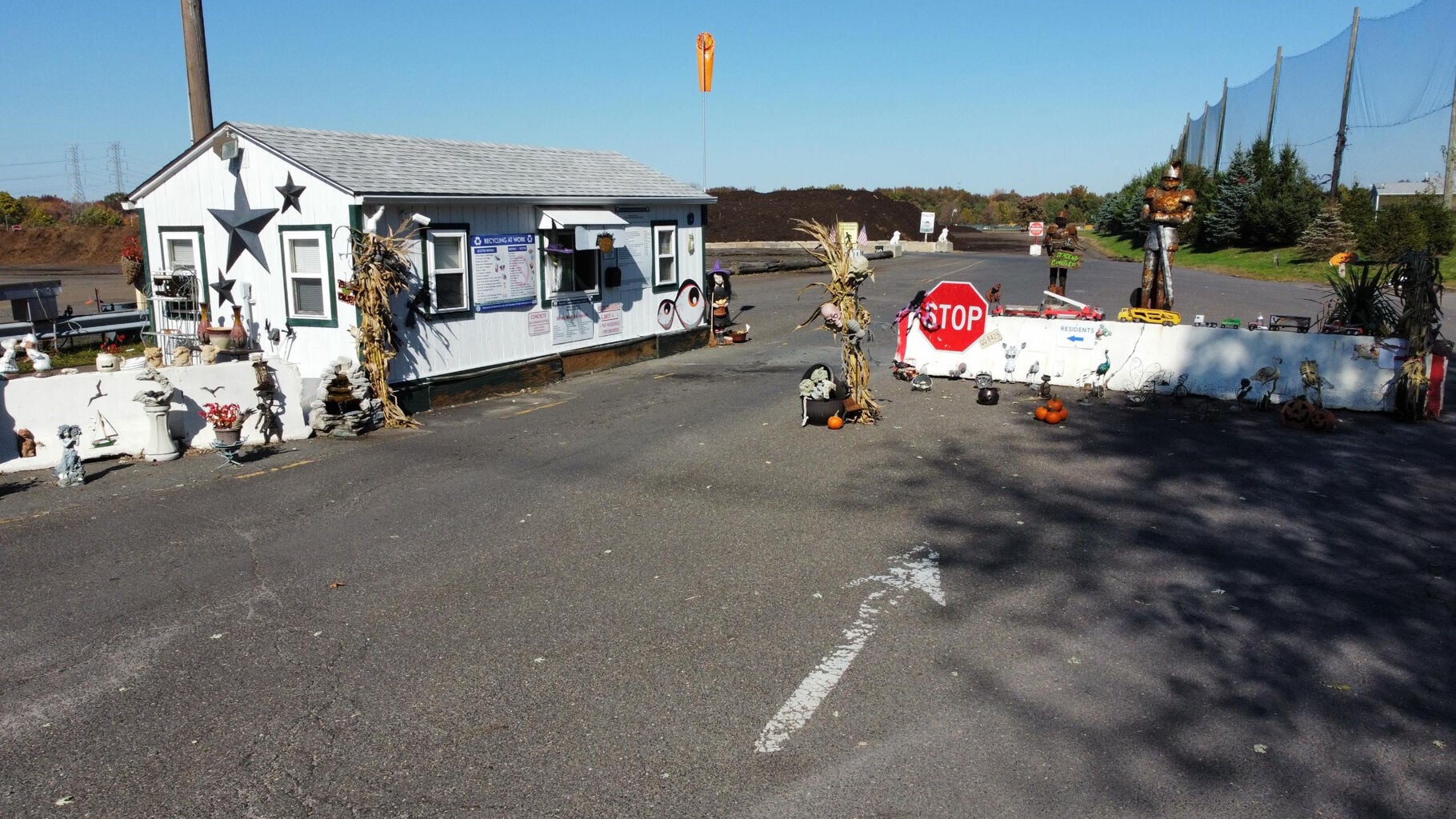
Township employees often make whimsical — and seasonal — decorations to the entrance of the Harry Bonacci Ecological Facility in Hamilton. (Photo by E.M. Hume.),