In 2020, while we navigated the pandemic, a 50-year-old nonprofit called American Rivers named the Delaware River its River of the Year for “momentous progress for water quality, river restoration and community revitalization.”
With the announcement, Bob Irvin, president and CEO of American Rivers, called the Delaware River “a national success story” thanks to “the hard work of many local advocates who understand that a healthy Delaware River is vital to the health of millions of people.” According to American Rivers, more than 17 million people get their drinking water from the Delaware River basin, including New York City and Philadelphia. The Delaware river begins in Hancock, New York, and flows through five states on its way to the Atlantic Ocean.
Adding to that continued success, in 2020, the Bordentown Township Committee agreed to acquire 72 acres of land along the Delaware, paying a developer $4.6 million, thus saving the property from redevelopment for housing. According to Bordentown Township administrator Mike Theokas, “the township committee saw the value of leaving the area as an open space.”
At a meeting in October 2022, the Bordentown Township Committee reviewed a conceptual presentation for a waterfront park which contains mainland property on the west side of the railroad tracks which run along Rte. 130, and property on the eastern end of Newbold Island. Theokas said that while the township is excited about the land acquisition and conceptual plan, it’s going to take time” to get the park to where it can be enjoyed by people.
The new waterfront park will allow for hiking, kayaking and canoeing. Motorized vehicles will be prohibited. There will be swaths of land preserved for the native wildlife and flora on the property, especially on the portion of Newbold island where eagles nest.
Theokas stressed the development of the park will take place over time, beginning with the construction of a parking lot, trails, and educational signage. A portion of the property is contaminated and will need remediation.
The Bordentown Township acquisition came on the heels of Bordentown City’s purchase of property at the confluence of Crosswicks Creek and the Delaware River in conjunction with the New Jersey Department of Environmental Protection and D&R Greenway. The property, once owned by Divine Word Missionaries, was the remaining 60 acres of land which once belonged to Joseph Bonaparte, Napoleon’s brother.
But while we celebrate the continued efforts to protect the river, we can’t forget that the river’s tributaries play an important role in the life of the river, as do the marshes in the area. Of the 3,000 acres of preserved wetlands in this area, 1,200 of those acres are marshland. And the majority of the marshlands are within the boundary of Hamilton Township.
Collectively, the marshlands in Hamilton, Trenton, and Bordentown are referred to as the Abbott Marshlands in order to align the area with the Abbott Farm National Historic Landmark. The Department of the Interior placed the farm on the National Historic Register in 1976.
Charles Conrad Abbott, an early archeologist and naturalist who grew up in Trenton, lived along the marshlands in Hamilton. He trained at the University of Pennsylvania to become a physician.
He was a surgeon during the Civil War, but beyond that, never practiced medicine. Instead his intellect and curiosity led him to explore the natural world around him.
According to a page on the Abbott Marshlands site, in 1872, Abbott “reported finding man-made implements in the Trenton glacial gravels on his farm. This discovery sparked an international debate and 40-year controversy concerning the antiquity of man in the New World.”
And even though Twitter didn’t exist then, the debate put Abbott and his farm in the spotlight. (If you want read more, Boston University archeology professor Curtis Runnels wrote about it here: blogs.bu.edu/runnels/2022/01/02/dr-charles-conrad-abbott-and-the-curious-case-of-the-american-palaeolithic.)
To appreciate the marshlands, one has to understand how they articulate with the river.
The marshlands in this area are tidal because the Delaware river is tidal. Therefore, twice a day, water flows in and out of the marshlands.
Mary Leck, the founder of the Friends for the Marshlands, and a member of the organization’s advisory board, has been studying this area for more than 40 years. She is an emeritus professor of biology at Rider University, and has published extensively about her adventures in a place she loves.
“I spent many years in the marsh,” Leck said. “It’s a fascinating place. I am interested in the seeds in the soil. There’s a lot of seed movement with the tidal flow.” Leck explained, “the tidal action allows for aeration of the marsh and allows for more decay, which provides more nutrients for animals in the area.”
“That’s the fun part of our marsh,” Leck added with excitement. “The marsh has a great diversity of plants and animals.”
Pat Coleman, the president of Friends for the Marshands, noted that “historically, marshlands had no value because people couldn’t build on them, except in certain places along the river. In the 50s, before the laws changed, it was okay to build parking lots and let them drain into the marsh. There are over 50 street drains that connect with the marshland.”
Leck added: “It used to be that people would just put storm drains into marshlands. And, because of the tides, the surface becomes littered with plastic. In recent years, drainage basins have been required to prevent this problem. People are much more aware now of the importance of wetlands.”
PSE&G holds acres of land in the marshlands and along the river. For example, the company owns the remaining portion of Newbold Island, located in Burlington County. In the mid-seventies, the company had intended to build nuclear power facilities there, but was forced to move those operations further south to Salem and Hope Creek. Currently, PSE&G is negotiating with NJDEP to sell its Newbold Island holding to the state under the Green Acres program.
Recently, Chicago-based Hilco Redevelopment Partners purchased 132 acres on Duck Island from PSE&G. The site used to contain two coal-fired power plants. According to a 2019 story in NJ Spotlight, PSE&G reviewed two dozen proposals, finally selecting HRP.
The story said the utility company based its decision on HRP’s “strong environmental track record and success in managing complex redevelopment projects.” HRP has done similar conversions in Boston and Chicago.
The site has been redeveloped into a regional warehouse-distribution hub. Called the HRP Mercer Logistics Park (hrpmercer.com/), the company notes “this state-of-the-art development will access over one-third of the nation’s population and has near proximity to the region’s significant seaport and airport infrastructure.”
How the site and the enhanced traffic will impact the marshlands remains to be seen.
At the moment, Coleman and Leck are more focused on climate change.
“Climate change can increase water levels due to the melting of glaciers. As that water rises in the Delaware Bay and river, it affects the water in the wetlands,” Leck said.
Many people think the marshlands are salty or brackish because of the tidal action; but Leck said the salt line is below Philadelphia. But, climate change could change all that.
“The saltwater line could move up,” Leck said. And she noted Philadelphia gets its drinking water from the Delaware River.
“If the salt water moves up river,” Leck said, “then Philadelphia would not have the same access to drinking water.”
Coleman observed that a lot of the marsh in the winter, at low tide, looks like mud flats. “In the summer, the marsh is rich with plant life. Change the water level and some plants could disappear,” Coleman said.
And so members of the Friends for the Marsh continue their stewardship of these important marsh areas in concert with many other groups who take care of the river and the tributaries.
“Our role is to increase public awareness of the importance of this resource,” Coleman said. “For example, we recruit stewardship volunteers to help clean trails.” Currently, one of the trail projects involves rerouting a trail on the Bordentown bluffs just north of the property where the Bordentown City Offices now call home. The rerouting of the trail is designed to prevent erosion and involves raking and leveling out a new path for hikers.
People interested in learning more about the marshlands, walking along the trails within the marshlands, or wanting to volunteer, can visit abbottmarshlands.org.
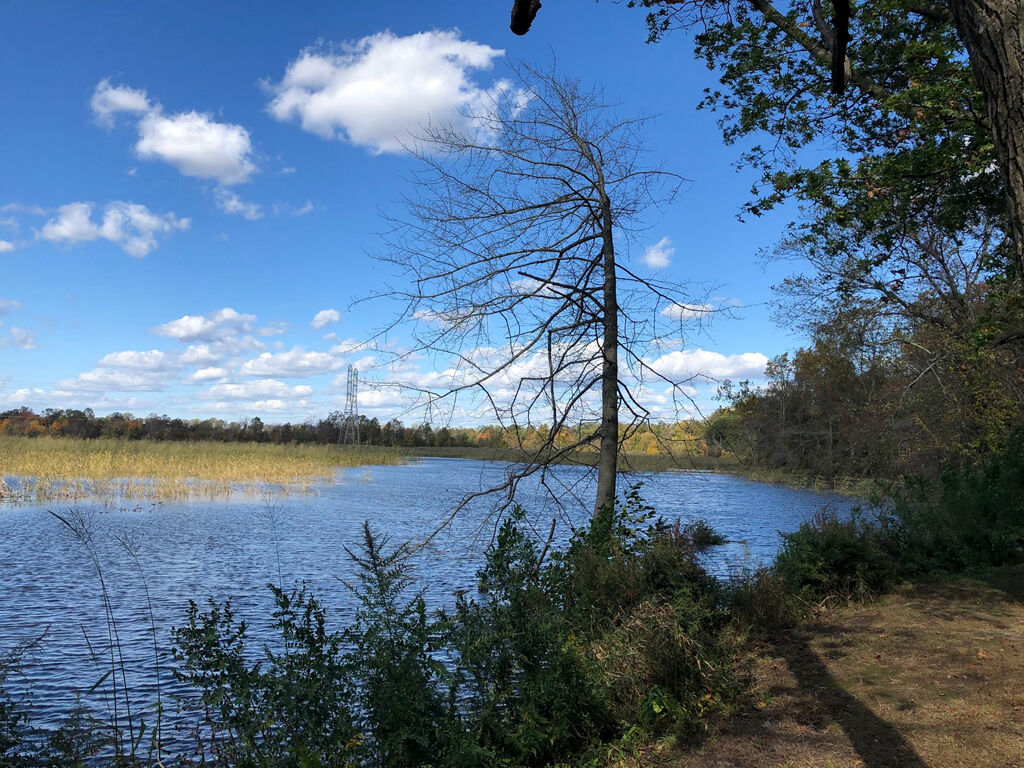
The Abbott Marshlands in Hamilton have some serene settings despite the intrusion of modern conveniences like powerlines and highways. (Staff photo by Joe Emanski.),

