This article was originally published in the July 2018 Princeton Echo.
In an era when there seem to be near daily revelations about long-respected celebrities’ past wrongdoings, it was only a matter of time before the news arrived that Princeton’s best known and most beloved genius had a dark side.
Turns out Albert Einstein was a little bit racist.
This is the major takeaway from a new translation of Einstein’s travel diaries covering a journey to the Far East, Palestine, and Spain in 1922 and 1923, edited by Ze’ev Rosenkranz of Caltech and published last month by the Princeton University Press.
“Albert Einstein’s travel diaries are, by far, my favorite documents penned by him,” Rosenkranz writes. “I have always enjoyed his quirky style, his acerbic quips about the individuals he met, and the colorful descriptions of the hustle and bustle in his ports of call. It was only later that I started to notice the more troublesome entries in his journal, in which he, at times, made what amounted to xenophobic comments about some of the people he encountered. I began to ask myself: how could this humanist icon be the author of such passages?
“The answer to this question seems very relevant in today’s world, in which the hatred of the Other is so rampant in so many places around the world,” Rosenkranz continues. “It seems that even Einstein sometimes had a very hard time recognizing himself if the face of the Other.”
The views Einstein expresses weren’t necessarily out of the ordinary for a white, European male of the era, but they fly in the face of everything the public has known about his saintly persona. Einstein, himself a refugee as a German Jew before World War II, was once the face of a U.N. Refugee Agency poster campaign, Rosenkranz notes. And it was he who, in the time of segregation, took in the singer Marian Anderson when she performed to rave reviews at McCarter Theater but was denied lodging at the Nassau Inn because she was black.
The diary shows the inner workings of a brilliant mind — segueing from thoughts on physics with hand-drawn graphs, to reflections on his surroundings and the people he encounters, to the deeply personal, including a brief entry referencing a bout of “enteritis with ghastly hemorrhoids” ably cured by a Japanese physician on board. (A note in the introduction states that while Einstein’s reasons for keeping the diary are unknown, “we can be certain that he did not intend it for posterity or for publication.”)
But it’s in his descriptions of people and places that the noted problems occur. He describes China as a “peculiar herd-like nation,” where the Chinese “often more like automatons than people.” Einstein seems sympathetic to the poverty he encounters along his route, but at the same time uses his acknowledged position of privileged to look down on those he meets. Arriving in Colombo, Sri Lanka, he writes, “We saw here for the first time an elderly Indian, fine, distinguished face with gray beard, who brought us two telegrams and — begged for a tip. We saw other Indians as well, brown to black sinewy figures with expressive faces and bodies and humble demeanors. They look like nobles transformed into beggars. Much unspeakable pride and downtroddenness are united here.”
Outside of Shanghai, he observes, “Inside and outside the terrible bustle, quite happy faces. Even those reduced to working like horses never give the impression of conscious suffering. A peculiar herd-like nation, often a respectable paunch, always sound nerves, often resembling automatons more than humans. Sometimes curiosity with grinning. With European visitors like us, comical mutual staring.”
Of course, he was equally direct with praise for the enjoyable encounters of his trip, and his harsher words were not reserved solely for the Asian cultures he visited. Notes from one day include: “Visit by crazy American woman who believes she can cure other nuts, 2 p.m.”
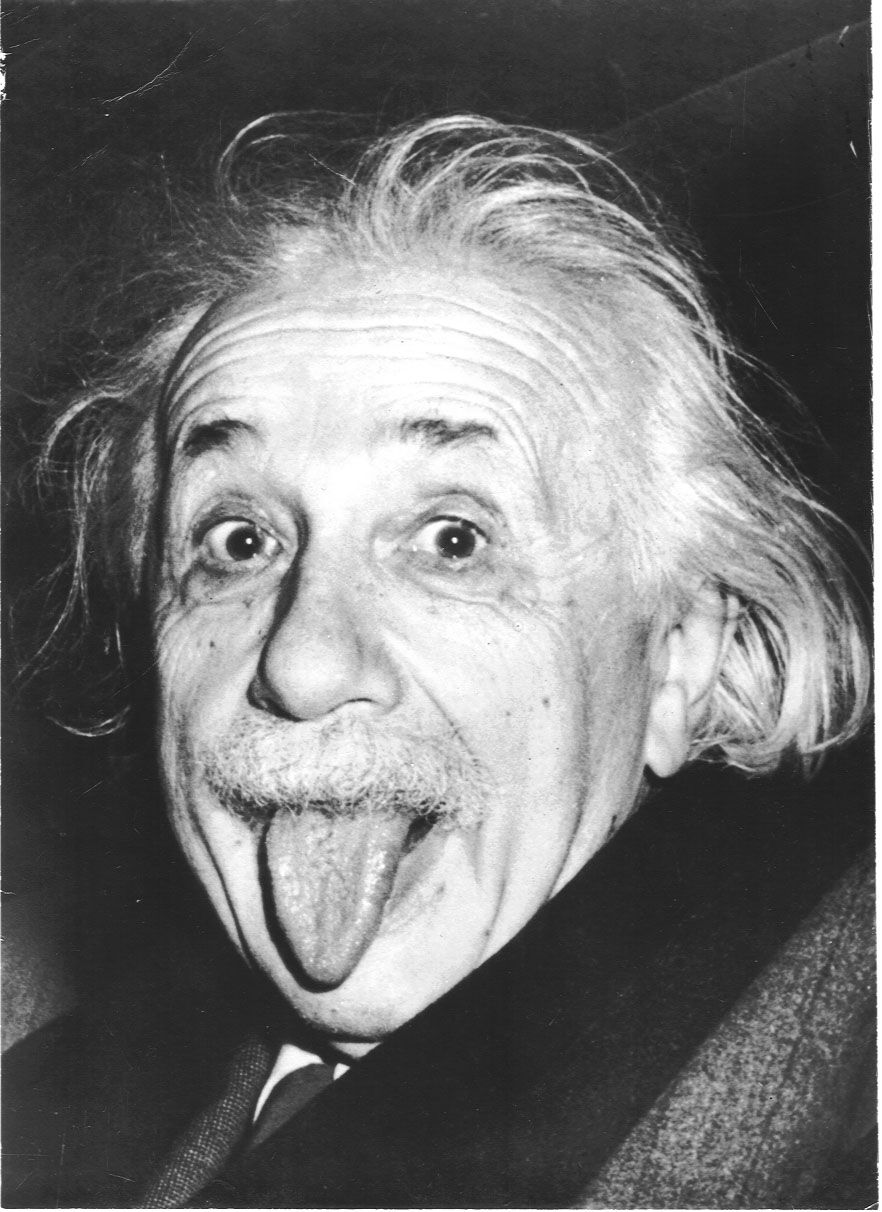
Albert Einstein,

