In mid-December, WWP News editor Bill Sanservino sat down with Mayor Shing-Fu Hsueh for an extended interview about his years as an elected West Windsor official.
The first part of the interview ran in the Dec. 26 issue of The News and can be read online. Below is the conclusion. The interview has been edited for clarity and length.
It’s seems to me that your main impediment from getting things done in this town was the inability of council and mayor to come to work together. What’s the story from your perspective?
I think as a mayor I tried to do whatever I could, but I found that most of the councils were not willing to gain a more clear understanding of the roles of council and mayor.
They were looking at neighboring municipalities, who have the township committee form of government. They all wanted to have a lot of involvement in terms of a lot of the decisions that were made.
They don’t understand that in this form of government, the mayor is 100 percent responsible for making recommendations and the council votes them up or down. That’s checks and balances.
But they want to get into decision making, and it makes the whole process more difficult.
I have always thought that council members should sit down with an expert for a couple of hours to teach them about their roles in the government.
In fact, during my first year as mayor, I recommended a retreat for this purpose. A friend of mine who was teaching at Rutgers, and who was very well known in the planning profession, offered to come to talk as a moderator about how to work together. He was willing to do it for free because of my relationship with him, but I knew he would have been neutral.
Alison Miller (who was on council at the time) was the first one who was opposed to it. “He’s your friend.” So she would not trust him. She didn’t take it nicely.
This has been the problem. Council members feel like I must have some hidden agenda. They don’t understand I don’t. How can I explain to them that I just wanted to do something good for this town. That’s the trust that we don’t have here.
What is your advice to Hemant as he takes over the mayor’s job?
My advice to him would be regarding dealing with all levels of government agencies. Don’t rely on the court system to make decisions for us. You have to do your homework and, as mayor, know exactly what you are doing. That is probably not going too be easy.
I have interests in a lot of different subjects, but not everybody is like that. I like sports, arts and a lot of other things. I have curiosity to learn a lot of different things.
I don’t know if somebody like Hemant has the personality to do all of that. He has to be more open minded while talking to different people.
I think he’s going to be much better off now, since I am the first one with different appearance to be the mayor of West Windsor. People will probably accept him a little bit better than me, I hope.
I would also ask him to trust the experts in town hall. One of our problems is that council members don’t trust expertise. Some of the council members like to ask the engineer how to do their engineering work and ask the landscape architect how to his design.
I know we have to listen to different ideas, but at the end of the day we want our professionals to listen to different ideas and come up with a final recommendation.
The public’s reaction is also important, because the experts don’t always understand the reactions from the residents or from specific neighborhoods. So they have to be willing to listen to all of these things.
At the end of the day, they have to use their professional judgement to incorporate all of these average people’s ideas into a professional design.
As an engineer myself, I try to talk to people with different ideas and then I have to make a judgement about what’s right and what’s wrong. What is doable and what is not doable. From my own personal experience, you have to trust the experts.
Based on the way I’ve seen things work in West Windsor over the years, I think it’s possible that Hemant will be met with the same skepticism and reluctance that every other West Windsor mayor has had to deal with. It’s going to be a learning process for him too.
Based on my conversations with him so far, I agree. I think he’s going to have a big surprise. It’s not as simple as he thinks it is.
It’s often easier to be an opponent of something, and it’s hard to be an opponent when you’re the mayor. You have to be proactive and support things.
It’s interesting you bring this up. Marvin Gardner (former planning board chairman and long-time Hsueh supporter and friend) did talk to me about what you just said. He said I have a tendency to always push for something, or be a proponent. He said I need to say “no” more often. I told him that as mayor I could not do that.
I’m very optimistic as a mayor. That’s why I tried to push for a lot of agendas. Some of them never got through, but most of them did. I don’t believe there have been too many mayors—probably none before me—who ever got so much accomplished and over such a long period of time—16 and a half years.
You were certainly the longest-serving mayor in the history of the town.
Probably the first hands-on mayor in this town. Most of the previous mayors came here to town hall just to sign papers and that’s about it.
Well both Tom (Frascella, the first directly elected West Windsor mayor), and Carole (Carson, the second mayor and Hsueh’s predecessor) both had full time jobs that they had to attend to. And Carole also had plenty of problems to deal with from within her own party as well.
That reminds me, the first time I ran for mayor, the day before the election, Carole put little American flags on mailboxes all over town with a piece of paper attached to it that said, “Vote for a true American.”
When I saw that, I said, “Thank you very much.” I knew I was going to win, because she apparently misjudged the voters feelings.
The night you won that election, I was assigned to cover Carole’s election headquarters.
One of the old party stalwarts—and this goes back to the racism we were talking about earlier—said that all day he had his people watching the polls, and he thought Carole was doing well, and he thought she was going to win. Then he said, “Around 7 p.m. they started showing up at the polls—Shing’s Yellow Army.” That’s what he called the Asians who came to vote. “Then I knew we were in trouble,” he said.
I know who you are talking about, and he was a racist. He spent a lot of time talking to me, and I didn’t believe a lot of his remarks he made because he belongs to “that” generation. He said a lot of things that made me say, “This guy’s so stupid.”
What are some of your plans for after you retire as mayor? You have mentioned you want to write an autobiography?
Yes, I feel that I need to write all my personal experiences down to provide inspiration and incentive for future generations.
Another thing I’m looking at is at Grounds For Sculpture. One of the sculptors, who is a retired art professor from the Tulane University, has agreed to have me as his apprentice. So that is something I am considering.
Also, I’m on the transition team for Phil Murphy, the governor-elect. If I have the opportunity to help at a state-wide level, I would be happy to do it, but we’ll see how it goes. We’ll see what position I have, and if it fits my personality and what I want to do. If I don’t get anything that’s fine, but if I can do something for the whole state, I will be happy to.
My wife says she is so afraid of me continuing to be like a teenager. I have a lot of ideas and dreams. But again, that’s what life is all about. You just have to have something to do.
You have taught tai chi at the senior center for many years. Will you continue to do that?
I would continue to teach whatever I’ve been teaching, but not more. I’m moving into the 24th year doing it and I will continue to teach unless my schedule will not allow me to do it.
Everyday I wake up at 6:30 a.m., I do meditation and I practice tai chi and then prepare my breakfast. Then I read the news about this country and Taiwan, because I care about what’s going on in Taiwan. Then I come to my office and start my day.
I used to come here day and night, but now I only come in the morning. If there’s nothing important, then I will stay home because its quiet. It’s so hard to focus on anything here. People and employees always like to talk to me here.
When employees here have a question or a problem they come to me, because they want to hear my advice. I am probably the first mayor—whether there will be mayors in the future like this I don’t know—who has always been always available to people, whether it be in engineering, the landscape architect, planner and even some of the inspectors. I’m available to talk to them. I want them to all come together.
That is one of the things I feel really good about. The employees here really share my vision. They try to work with me. I cant say 100 percent, but most of them. I plan to buy lunch for all of the workers here to show my appreciation for them.
How would you like you legacy as mayor to be viewed?
I have been thinking a lot about the future of this town, and that is what I call vision. My vision is that 50 years from now the whole area is going to be one special metropolitan area.
It’s going to be one of the more highly populated areas in New Jersey, and the train station will be a central point. And Princeton University will also be a focal point. And all of the museums and art centers together will add to the culture of all of the communities in this area.
This is inevitable. Eventually we will be moving in that direction, so we have to prepare for that.
People don’t have to remember me, or that I was the mayor, but I’m hoping someday people will think about the fact that there was someone who pushed for some of the transportation or traffic improvements in this area.
I also would like people to remember me for Nash Park. John Nash was part of this community, and the reason I did all of that was because I knew I wanted West Windsor to be recognized. One person who could help West Windsor to get up there is John Nash.
Some people couldn’t understand what I was trying to do. A lot of what I did was for diversity to be accepted as the norm in this community.
I also would like to see all of the churches—whether they be Muslim, Christian, Hindi, Buddhist or Jewish—to keep working together to do the right things for the community. We are all together. That’s why in my final speech, I mentioned that out of many, we are one. Hopefully I will have that impact of the future of this community.
You just mentioned Nash Park, and that reminds me that there was a problem with the Beautiful Pavillion there. It got hit by some high winds and wound up tilting a little bit. What is the state of it now?
The insurance company is taking care of that with the township. I suspect the reason it happened is that we were not allowed to have Chinese craftsmen come help assemble the pavilion. Instead we had to try to figure it out for ourselves.
There must be something that we didn’t do right, because a replica with the same exact design and same architects was built right next to the Gobi Desert and the winds gust much stronger than what we have here, and the building is still in one piece.
We already stabilized it, but now we are looking for a long-term solution. We are working with an engineer hired by the insurance company and try to come up with something that will be doable not only to meet our construction code, but also will be able to maintain the kind of structure originally designed by the Chinese architects.
Going back to Nash Park, there are other things that we had talked about adding to the park. I think it’s going to be important for West Windsor to have a something that is different and unique in the downtown. Something international.
You would be surprised. People come from all over—even Russia and China—and they all know the movie A Beautiful Mind. When I used to Google John Nash, Princeton came up. Now it says West Windsor and Princeton Junction.
That is what I have been saying all along. We need to have a sense of place. What is important here is how future generations feel about their home town.
I always say to myself that every night when I go to bed I want to be able to sleep nicely. That I didn’t do anything against my own conscience. And if you ask my wife, she will tell you that every time I go to bed, 1-2-3, I just fall asleep.
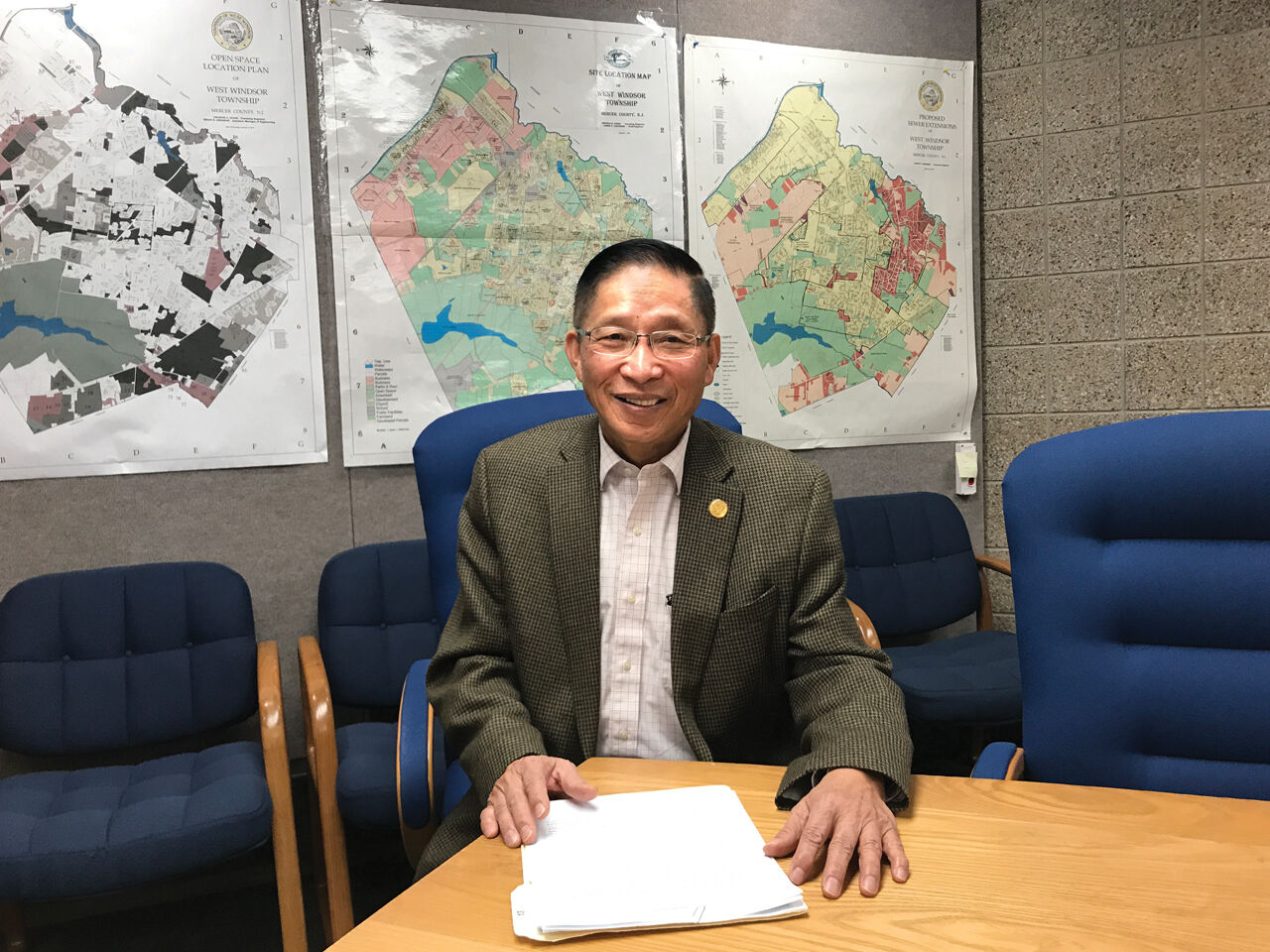
Retiring West Windsor Mayor Shing-Fu Hsueh with some paperwork in a conference room at the municipal building. (Staff photo by Bill Sanservino.,

