This article was originally published in the May 2018 Trenton Downtowner.
‘I began teaching a class of 28 prisoners at a maximum-security prison in New Jersey,” says writer Chris Hedges. “My class, although I did not know this when I began teaching, had the most literate and accomplished writers in the prison. And when I read the first batch of scenes it was immediately apparent that among these students was exceptional talent.”
Hedges’ words are part of a first-person statement he wrote for the online publication Truthdig. They reflect the Princeton-based Pulitzer Prize-winning journalist, New York Times bestselling author, former professor at Princeton University, activist, and ordained Presbyterian minister’s experience with an artistic phenomenon: the creation of “Caged.”
That’s a theater work created by and giving voice to a hidden segment of American society. Hedges refers to it as, “the mass incarceration of primarily poor people of color, people who seldom have access to adequate legal defense and who are often kept behind bars for years for nonviolent crimes or for crimes they did not commit.” That situation, he says, “is one of the most shameful mass injustices committed in the United States.”
According to the nonprofit Prison Policy Initiative, the American criminal justice system holds more than 2.3 million people in 1,719 state prisons, 102 federal prisons, 901 juvenile correctional facilities, 3,163 local jails, and 76 Indian Country jails as well as in military prisons, immigration detention facilities, civil commitment centers, and prisons in the U.S. territories.
“Caged,” written by the New Jersey Prison Cooperative and directed by Jerrell L. Henderson, has its world premiere at Trenton’s Passage Theater from May 3 to 20.
Hedges says he “saw the class members had a keen eye for detail, had lived through the moral and physical struggles of prison life, and had the ability to capture the patois of the urban poor and the prison underclass. They were able to portray in dramatic scenes and dialogue the horror of being locked in cages for years.
“And although the play they collectively wrote is fundamentally about sacrifice — the sacrifice of mothers for children, brothers for brothers, prisoners for prisoners — the title they chose was ‘Caged.’ They made it clear that the traps that hold them are as present in impoverished urban communities as in prison.”
Hedges says the weekly scenes written by the students “grew, line by line, scene by scene, into a powerful and deeply moving dramatic vehicle. The voices and reality of those at the very bottom rung of our society began to flash across the pages like lightning strikes. There was more brilliance, literacy, passion, wisdom, and integrity in that classroom than in any other classroom I have taught in, and I have taught at some of the most elite universities in the country.”
He says through the creation of the dramatic work the class was transformed into a place of reflection, debate and self-discovery. A place where offhand comments reflected the pain, loneliness, and abandonment embedded in the lives of the students and created moments that left the class unable to speak.
As Hedges puts it, “The various drafts of the play, made up of scenes and dialogue contributed by everyone in the class, brought to the surface the suppressed emotions and pain that the students bear with profound dignity.
“A prisoner who has been incarcerated for 22 years related a conversation with his wife during her final visit in 1997 (saying) ‘I told you when I got found guilty to move on with your life, because I knew what kind of time I was facing, but . . . just don’t keep my son from me. That’s all I ask.’ He never saw his child again. When he handed me the account he said he was emotionally unable to read it out loud.
“Those with life sentences wrote about dying in prison. The prisoners are painfully aware that some of them will end their lives in the medical wing without family, friends, or even former cellmates.” And that “often no one comes to collect the bodies. Often, family members and relatives are dead or long estranged. The corpses are taken by the guards and dumped in unmarked graves.”
Hedges continues with accounts of isolated prisoners adopting mice as pets, naming them, bathing them, talking to them, and keeping them on string leashes. Then there are the dying prisoners who would ask him to hold their hand.
About the writing, Hedges says, “The students wanted to be true to the violence and brutality of the streets and prison — places where one does not usually have the luxury of being nonviolent — yet affirm themselves as dignified and sensitive human beings. They did not want to paint everyone in the prison as innocents. But they know that transformation and redemption are real.”
The result is a play that “has a visceral, raw anger and undeniable truth that only the lost and the damned can articulate.”
The writers’ dedication reflects that truth: “We have been buried alive behind these walls for years, often decades. Most of the outside world has abandoned us. But a few friends and family have never forgotten that we are human beings and worthy of life. It is to them, our saints, that we dedicate this play.”
They also said, if the play was ever produced and made money, it should “go to funding the educational program at the prison.”
Hedges says his response was, “I will make it heard. I do not know what it takes to fund and mount a theater production. I intend to learn.”
Caged, Passage Theater, Mill Hill Playhouse, 205 East Front Street. May 3 through 20. $13 to $38. 609-392-0766 or passagetheatre.org.
An excerpt from ‘Caged’
Here an older man tells a young inmate what to expect from the correction officers (Cos).
Ojore (speaking slowly and softly): When they come and get you, ’cause they are gonna get you, have your hands out in front of you with your palms showing. You want them to see you have no weapons. Don’t make no sudden moves. Put your hands behind your head. Drop to your knees as soon as they begin barking out commands.
Omar: My knees?
Ojore: This ain’t a debate. I’m telling you how to survive the hell you ’bout to endure. When you get to the hole you ain’t gonna be allowed to have nothing but what they give you. If you really piss them off you get a ‘dry cell’ where the sink and the toilet are turned on and off from outside. You gonna be isolated. No contact. No communication.
Omar: Why?
Ojore: ’Cause they don’t want you sendin’ messages to nobody before dey question some of da brothers on the wing. IA [internal affairs officers] gonna come and see you. They gonna want a statement. If you don’t talk they gonna try and break you. They gonna open the windows and let the cold in. They gonna take ya sheets and blankets away. They gonna mess with ya food so you can’t eat it. An’ don’t eat no food that come in trays from the Vroom Building. Nuts in Vroom be spittin’, pissin’ and shittin’ in the trays. Now, the COs gonna wake you up every hour on the hour so you can’t sleep. They gonna put a bright-ass spotlight in front of ya cell and keep it on day and night. They gonna harass you wit’ all kinds of threats to get you to cooperate. They will send in the turtles in their shin guards, gloves, shank-proof vests, forearm guards and helmets with plexiglass shields on every shift to give you beat-downs.
Omar: How long this gonna go on?
Ojore: Til they break you. Or til they don’t.
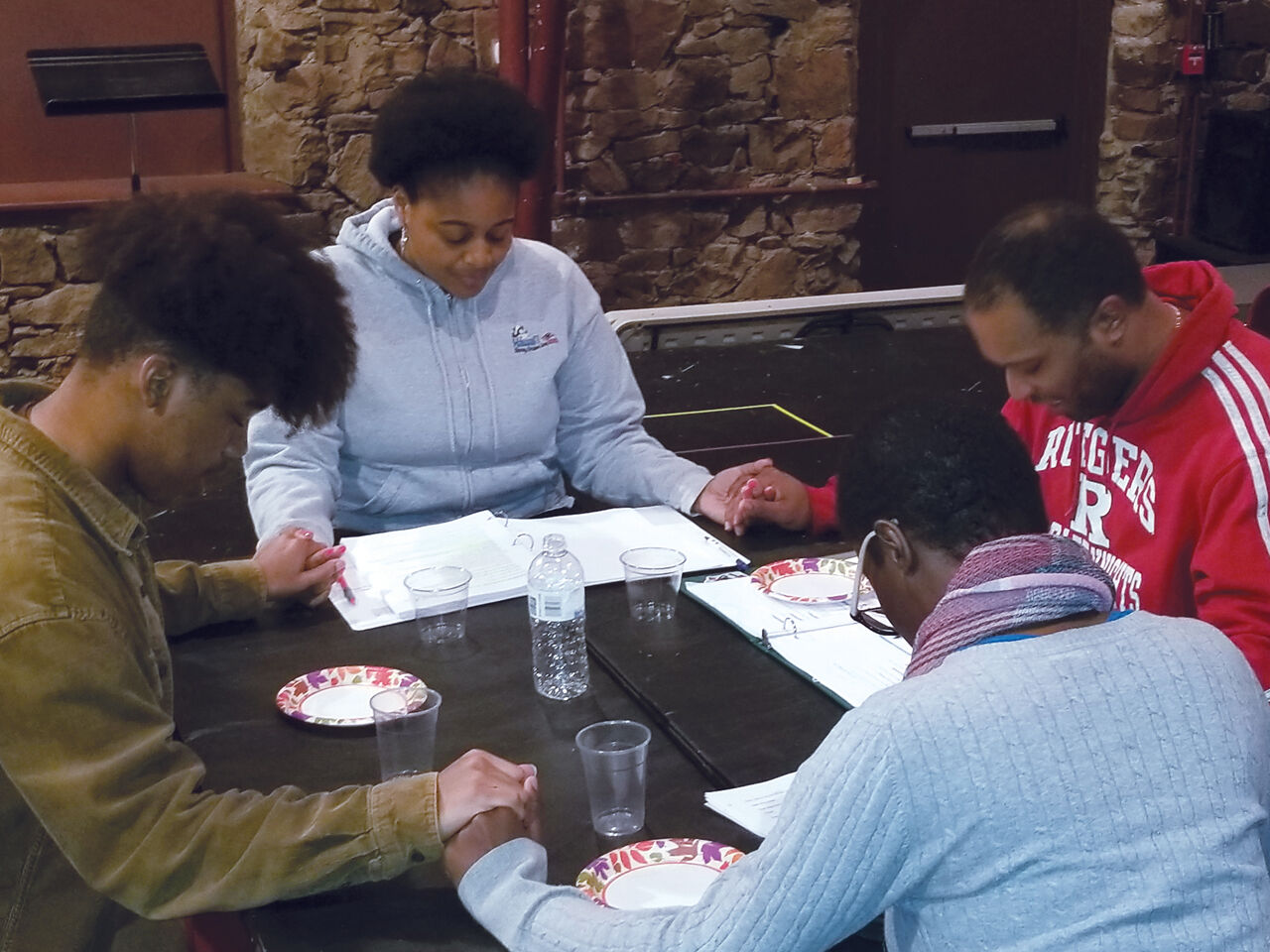
Ural Grant, left, Nicolette Lynch, Monah Yancy, and Brandon Rubin rehearse for ‘Caged’ at Passage Theater.,