This article was originally published in the June 2018 Princeton Echo.
To research his most recent book, Michael Robertson sought out his own little piece of heaven in a remote village in the Scottish Hebrides. There, with only 12 permanent residents, he spent a week during which “there was seldom anyone in sight. I could hear nothing but the bleating of sheep, the cry of gulls, and occasionally — if the wind was right — the bell of the ferry between Iona and Mull. Bathed in sunshine, breathing in the cool, salt-tinged air, I couldn’t help saying to myself, ‘This is utopia!’”
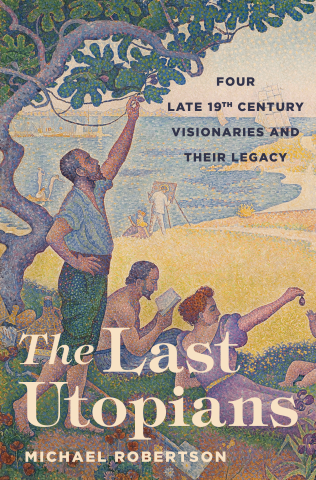
The book he was researching is “The Last Utopians: Four Late Nineteenth-Century Visionaries and Their Legacy,” published last month by Princeton University Press. The book explores the biographies of Edward Bellamy, William Morris, Edward Carpenter, and Charlotte Perkins Gilman, four 19th-century thinkers and writers of utopian fiction who envisioned a simple life characterized by peace and equality. Robertson speaks at Princeton Public Library on Monday, June 4, at 7 p.m.
The topic of his talk is “Utopias Then and Now,” and in the book he connects ideas from the late 19th century with modern manifestations of utopian thinking. While utopian fiction fell out of style around the time of World War I, he argues, these writers’ legacy is alive and well and cites a range of modern institutions driven by utopian thinking, from Occupy Wall Street to Princeton’s own Montessori school.
“The last utopians, imperfect creatures of their time, dared to publish their dreams, and millions of people in the U.S. and U.K. were thrilled by their visions,” Robertson writes in his introduction. “A hundred years later, we’re rightly fearful of grandiose schemes, and the audience for conventional utopian fiction has shrunk toward the vanishing point. Neverthless, lived utopianism — the contemporary manifestations of what Ernst Bloch called ‘the principle of hope’ — is widespread. Visions of social transformation remain essential to progressive political thought and practice.”
Robertson, a Princeton resident and professor of English at the College of New Jersey, holds degrees from Stanford, Columbia, and Princeton. He has previously written books on Walt Whitman and Stephen Crane and is working on a biography of William Morris, the 19th-century poet and novelist. Robertson’s wife, Mary Pat, retired in 2016 as director of Princeton Ballet School.
,

