Handling technology in a way that builds on its strengths and minimizes its challenges is a skill important to both schools and parents. In a recent interview on Terry Gross’s “Fresh Air,” Alan Alter spoke about his new book, “Irresistible,” reporting that the average person’s attention span has been reduced from 12 to 8 seconds over the past decade.
To help parents, educators, and students manage this environment that encourages jumping quickly from one subject to the next, the Bridge Academy of New Jersey will screen the documentary “Screenagers” on Thursday, April 6, from 6:30 to 8 p.m., 1958 Lawrenceville Road, just south of Rider University (tickets are available at screenagersmovie.com). A brief introduction will precede the film, and it will be followed by a facilitated discussion and snacks.
“Screenagers” is filmmaker and physician Delaney Ruston’s response to learning that the average kid spends 6.5 hours a day looking at screens and wondering about its impact on her own children. The film explores “struggles over social media, video games, academics and internet addiction,” says its website, and “reveals how tech time impacts kids’ development and offers solutions on how adults can empower kids to best navigate the digital world and find balance.”
“It’s a short documentary that is extremely well written, and it just keeps flowing,” Bridge Academy principal Susan Morris says, noting that the film looks at the perspectives of both parents and children. She thinks it may be particularly interesting for parents to view screens through their children’s eyes and to learn “how easily they fool their parents into thinking they are doing one thing on technology when they are doing something else.”
Morris had seen the film at Chapin School and wanted to bring it to her school, which she says “is designed for kids who are average to very bright, with language-based learning disabilities, primarily dyslexia.”
“We clearly are a school that has an emphasis on being in the moment so they can learn and stay present; we are really working to engage the students at a high level throughout the day with their education, and the technology becomes a large distraction,” she says.
Whereas Bridge students, who range from age 8 to 18, are good about not using their cell phones in school, they struggle with managing technology outside of school and as a result, Morris says, “it leaks into school.”
“We need to take time to help them navigate this world these kids are growing up in,” Morris says. “If we don’t teach them well, we are going to inherit that later on.”
The Waldorf School of Princeton, with students from early childhood to eighth grade, takes a proactive approach to technology, allowing none in school and advising its parents to minimize technology at home. “In a Waldorf education,” says Jamie Quirk, its admissions and marketing director, “technology is seen as a valuable tool, but one that should be introduced when age appropriate.” For Waldorf, that age is adolescence.
Explaining why Waldorf allows no technology, Quirk says, “We want the children to first have a solid foundation in real world experiences. We want them to learn mainly through human interaction and their own sensory experience. Once they have these real world reference points—they know what it feels like to poke a frozen puddle with a stick, to swing from a tree branch, to sing a song, or have to create something with their hands—then when software and computers, those things that make life easier, are brought in at older ages, they become a tool for the child rather than having it be a driving force.”
‘We are trying to get across the idea of using technology in a thoughtful and mindful manner.’
Waldorf recommends no exposure to television, movies and iPads before age 7 and no cell phones through the middle grades. “When you open the door to all that stuff, it rushes in and it is hard to stop it and put any boundary on it,” Quirk says.
Knowing Waldorf’s approach to technology, most parents minimize technology use at home, Quirk says, although home technology use varies among Waldorf families. But Waldorf teachers can see when a child has too media rich an environment at home. “The child is not able to sit still and to focus, has trouble socially connecting with other people, is not able to play as unself-consciously, as freely,” Quirk says.
Waldorf also hosted a screening of the film in November at the Princeton Garden Theatre, Quirk says, because the school saw value in “bringing people together to address this issue that all parents have to face at some point.”
The film shows parents sitting down with their children, putting a technology contract in place and then executing the plan. But it also points to a reality that Morris doesn’t understand: parents keeping their cell phones in their bedrooms day and night, which in the latter case can result in serious sleep deprivation.
What happens, Morris says, is that her students “will text in a group [messaging] chat and feel that if they don’t keep up with it during the night they will be left out.”
But it gets worse than just exhaustion. “Somebody says something in the chat that is misinterpreted, because there is no context, no facial expression, no emotion, no tone of your voice, and it ends up becoming a social issue for kids,” Morris says. “They are angry with each other when they don’t need to be angry. It interferes with their ability to learn, they are distracted by it, they are unhappy, and they are overtired.”
Technology use can also affect the nature of relationships, as children play online video games, not only with children they see in real life, but with others, and even adults, from all over the country. Morris says, “I hear kids saying, ‘These are my friends,’ yet there is no authentic time they spend with each other—no conversation, no sharing of common experiences.” Another worrisome reality she points to are students who prefer texting to talking on the phone.
Of course, technology also has great value for her students, who find writing laborious and time consuming. Spell and grammar checkers, graphic arts and text to speech software that allows students to listen to what they have written all help students to develop the skills they need and to play on their strengths to demonstrate comprehension.
“As long as our students use the technology as a tool, we are preparing them to be good critical thinkers and do well in the future,” Morris says.
The Bridge Academy also makes students aware of the dangers of internet use, like posting photos on Facebook that suggest underage drinking or drug use and may prevent a prospective employer from making a job offer. “We are trying to get across the idea of using technology in a thoughtful and mindful manner, but their ability to be mindful is only the ability to be mindful of a 12 year old,” Morris says.
Morris grew up in Earlton, New Jersey, now part of Cherry Hill. Her father, a Wharton School graduate, worked in small real estate office but played two-hand touch football every Saturday with his children. Her mother went to college as adult and became a certified public accountant.
She went to Trenton State College, now the College of New Jersey, initially with the idea of teaching health and physical education in a public high school and coaching varsity sports. But a college experience with special education students during Saturday gymnastics classes showed her how well suited she was to this work, and then a friend suggested she apply to the Princeton School for Exceptional Children. She stayed there for 17 years (also finding time to coach at Princeton High School after school), first as a teacher and eventually as principal.
Then, 13 years ago, a group of parents and educators joined forces to create the Bridge Academy, and Morris became its principal.
Quirk, who grew up in Bergen County and lives in Griggstown, started her career as an editor in trade publishing. At some point, she was looking to change course and having met some impressive children who attended a Waldorf School in New York, she started to look at schools near where she lived. She took a job as an administrative assistant at the Waldorf School in Princeton eight years ago and now her two daughters, 4 and 6, are students. She was promoted in July to be director of admissions.
What “Screenagers” deals with, Quirk says, is more with “the potential for addiction that comes in in adolescence—children who can’t put their phones away, who don’t know how to navigate social situations or relationship without that phone, or how to occupy their time without video games.”
Admitting that even Waldorf acknowledges that it is impossible to remove all technology influence from a child’s life, Quirk says the school is committed to educating parents, for example, with a film like “Screenagers.” “If a child is having three hours of TV on the weekend, that’s three hours they are not doing something else that they might need to develop in the healthiest manner,” she says.
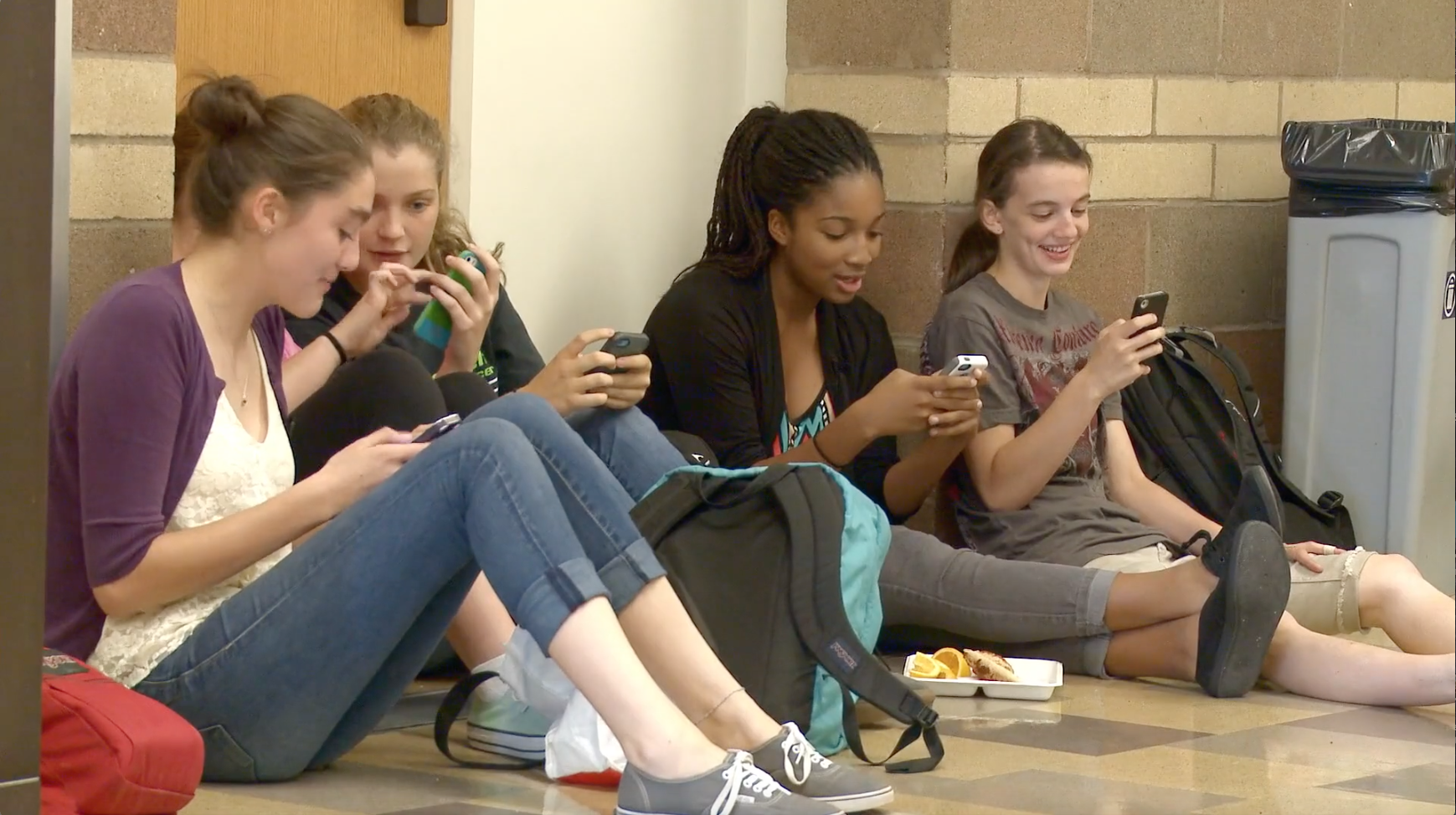
A still from the film “Screenagers,” which will be shown at the Bridge Academy April 6. The movie focuses on kids and technology.,

