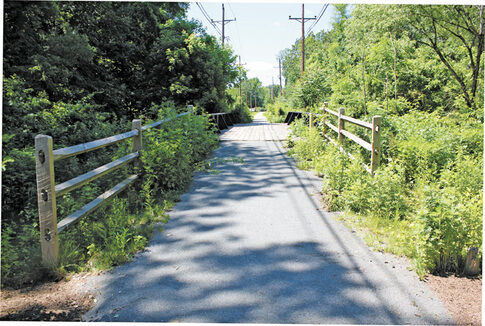
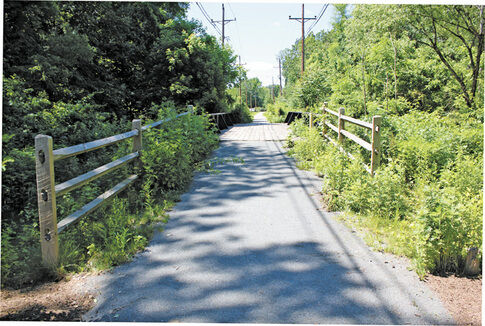
On a sunny summer afternoon, runners and walkers can be seen traveling down Johnson Avenue. What they may not realize, however, is they’re traveling down a historic Mercer County landmark that was, until recently, nearly forgotten.
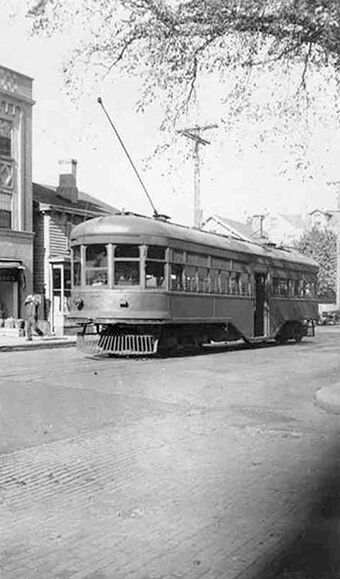
What is now a path for joggers and bikers was once the location of the Johnson Trolley Line, a passenger trolley that connected Trenton and Princeton. The Johnson Trolley Line ran from 1901 until 1940, when people began to use cars as their main mode of transportation. The line was used to haul freight between Trenton and Lawrenceville until 1974, when truck traffic permanently put the line out of business.
The trolley line was dormant for a few decades, until officials in Lawrence and Ewing turned the remaining land into a walking trail.
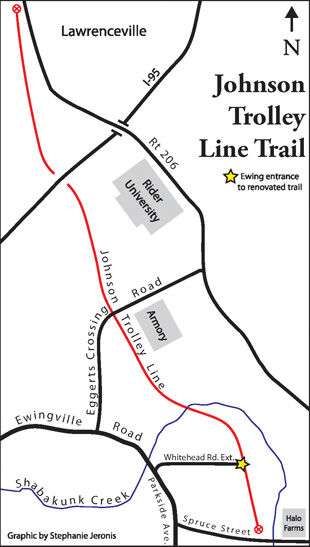
On June 4, National Trails Day, Mayor Bert Steinmann and other officials held a grand opening ceremony for their portion of the trail, which runs from the Shabakunk Creek, past the Whitehead Road Extension and down to 5th Street. Ewing used Lawrence’s trail—which was first renovated in 2006—as a model for their own renovation.
Lawrence has two sections of the Johnson Trolley Trail intact. The south end is just under a mile long, and starts at the Shabakunk Creek and ends at I-95. The north end of the trail picks back up on the other side of I-95 at Denow Road. It cuts through a neighborhood for a mile and ends at Gordon Avenue.
Before Ewing’s renovation, the trail on the other side of the Shabakunk Creek was in bad shape. Ewing Business Administrator Jim McManimon said there were potholes throughout the trail and it was overgrown with weeds. It didn’t appear to be anything more than an abandoned dirt road, let alone something with a historical legacy.
“At the beginning, it was simply an overgrown dirt track,” said Lee Farnham, chairman of the Ewing Environmental Committee, adding that volunteers worked to clean up the trail long before the township got the Recreational Trails Program Grant in 2012 to fully repair the path.
Just like the trail across the Shabakunk Creek in Lawrence, the trail in Ewing was redone using stones and gravel, although the section between the Whitehead Road Extension and 5th Street is still mostly dirt. McManimon said Ewing is still working to make some repairs along that portion of the trail.
McManimon said that Steinmann advocated for the project and the grant to proceed was obtained under the mayor’s administration.
The Lawrence trail is much more diverse in its surroundings and terrain. It starts as stone and gravel at the Ewing border in the woods, and turns to paved walkways once the trail cuts through neighborhoods.
The diversity of the trail in Lawrence, now combined with the trail’s extension into Ewing, has attracted many different types of outdoor enthusiasts, from athletes to locals taking a casual stroll through town.
Lawrence Township Manager Richard Krawczun said that the trail is an amenity that only offers people a “safe and effective” form of active and passive recreation.
While runners, cyclists and those looking to spend a few spare minutes outdoors can now enjoy a peaceful trip along the trail, a century ago it was the fastest way to travel across Mercer County.
In the 1890s, electric trolley lines were rapidly expanding all across the nation, according to the Electronic Traction Quarterly, Vol. 4 No. 1-2, by Barker Gummere and Gary Kleinedler. The trolleys replaced horse drawn cars as the primary mode of transportation for many Americans.
Construction on the Johnson Trolley Line first began in February 1899 near Ingham Avenue in Trenton, according to Electronic Traction Quarterly. The line continued up through Lawrenceville, all the way to Stony Brook, just two miles shy of Princeton.
Just as everything was on track to open to the public, Albert L. Johnson, president of the Lehigh Valley Traction Company of Allentown, purchased the line. Johnson wanted to build a high speed line connecting Philadelphia and New York City—a rather ambitious plan for 1901—and he needed a line that ran through Mercer County.
Johnson died a few months later, however, and his Pennsylvania-New York line never came to fruition, according to Electronic Traction Quarterly.
Work continued on the line for in-county use, but since Johnson’s company started construction for a high speed line it now had major upgrades. A steel bridge was erected over Stony Brook, allowing the track to be extended all the way to Witherspoon Street. In Trenton, it was expanded to West Hanover Street. Today a section of the track that crossed over North Olden Avenue into Trenton can still be seen at the 5th Street intersection.
While there were other trolley lines that took passengers across Mercer County, the Johnson Trolley Line—originally known as the Princeton Fast Line—was by far the quickest. On Nov. 17, 1901 the first car successfully traveled 15 miles from Trenton to Princeton in just under 40 minutes.
A 40-minute commute seems painfully slow by today’s standards, but in 1901 it was an incredible feat. Before the Johnson Trolley Line opened, the average cross-county travel time was about an hour, Lawrence Township Historian Dennis Waters wrote in a 2011 Lawrence Township Historical Society newsletter.
People anticipated the line would bring big changes to Mercer County. According to a July 1902 New York Times article “Trolley Line Invades Princeton,” people believed this line would break Princeton University’s tradition of seclusion. They expected big crowds to come in from Trenton to visit the campus.
Ironically, the line may have had the opposite effect. Waters wrote that the line was often used by Princeton students to travel into Trenton on the weekends.
Throughout the early 1900s, over one million passengers rode the Johnson Trolley Line each year. The trolley’s speed and cost—just a few cents per ride—made it a popular way to travel around the county.
Signs at the trail’s entrance at Ewing and Lawrence also claim that Woodrow Wilson would ride the trolley when he was governor of New Jersey and toss pennies to children as he passed by.
Despite its popularity, the line itself wasn’t without its troubles. A few accidents happened along the line, the worst being a head-on collision between two cars, which injured nine passengers, according to the Electronic Traction Quarterly.
“Cars on the Princeton route suffered several accidents in the early years,” Gummere and Kleinedler wrote. “On one occasion, car 12 was derailed after hitting a cow.”
Collisions and wildlife aside, the cars and tracks weren’t properly maintained over the years. By 1911 the line was in disrepair, which caused frequent breakdowns and delays.
World War I drove up the price of operating expenses, but revenues remained stable, according to Electronic Traction Quarterly. Fixing the tracks was expensive and companies who owned trolley lines began to lose money. The Johnson Trolley Line was bought and sold by a few companies over the years, with each one trying new methods to bring in new customers. Companies tried everything from added different cars to lowering their rates.
Despite the changes, the lure of driving an automobile pulled most passengers away from trolleys. By 1940, just 235,000 passengers were riding the trolley each year—a huge decrease from the 1.65 million of the early 1920s, according to Electronic Traction Quarterly.
On Nov. 1, 1940, the trolley made its final passenger journey across the county. Automobiles put the trolley out of business for a second time in the 1970s, when companies began using trucks to transport goods instead of freight trains.
Overtime, sections of each trolley line across Mercer County were torn up, as new neighborhoods were built in their place. The remaining sections of trail were left vacant, until officials realized the space would be a perfect fit for hiking paths.
“Like a lot of things in the ‘70s, the activity for trains stopped because trucks picked it up. The good part about it is you have all these beautiful trails now, along the D&RCanal and the Delaware River,” McManimon said. “All these other places that used to be active train tracks, they just regenerated into places for people and bikes rather than trains.”
The only remaining sections of the Johnson Trolley Line line are in Ewing, Lawrence, and parts of Princeton. They’ve all been turned into walking paths, although due to development blocking the trail, it can no longer be traveled all the way through.
Lawrence conducted a study in 2014 to see if they could connect the northern and southern sections of the trail over I-95. It could be done, but it would cost the township between $1.2 million and $8.1 million. Krawczun said there are currently no plans for the township to connect the trail.
While the trail isn’t the length of the former trolley line, it is still a little piece of revamped history for locals to enjoy.
“I just encourage people to go down and visit it, take a hike and just feel good to be outside for a little while,” McManimon said.
,
Riders travelled along the Johnson Trolley Line in cars like the one pictured above. The line ran from Witherspoon Street in Princeton to West Hanover Street in Trenton.,