The road to the new headquarters of the Historical Society of Princeton takes you past the site of one of the most dramatic moments in the town’s history, the pivotal 1777 Battle of Princeton. But it is a little surprising to find — on any number of occasions — a brigade of political fighters armed with placards along Mercer Road, fighting a modern day Battle of Princeton, a long siege against the Institute for Advanced Study’s new housing being developed on the edge of the historic field.
Even though the institute’s right to build the 15 units has been upheld by all pertinent review boards, and even though construction is underway, the rhetorical battle continues. Whether you agree or disagree with the cause, it’s a visual reminder as you approach the Historical Society of a present-day reality: Some people take Princeton history very seriously.
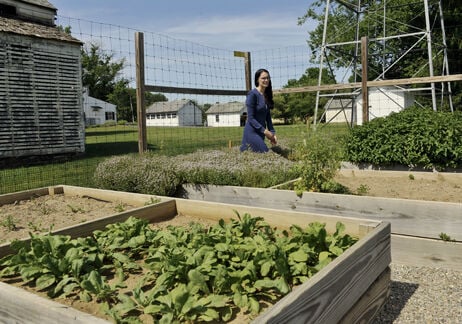
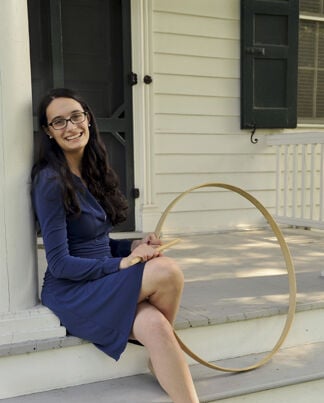
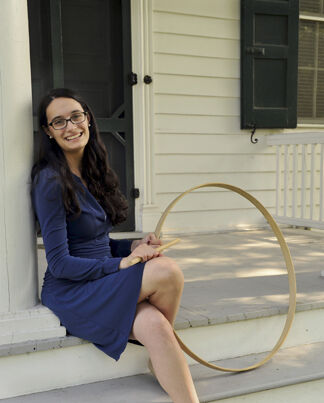
I am enroute to a meeting with Isabel (Izzy) Kasdin, who earlier this year was appointed new executive director of the Historical Society of Princeton, replacing Erin Dougherty, who departed in January for Florida’s Flagler Museum. Kasdin now presides over an almost 80-year-old Princeton institution that has ambitious plans for its new six-acre campus. The society also ruffled some feathers of its own when it moved from its longtime headquarters in Bainbridge House on Nassau Street in the heart of downtown to its new, car-dependent location at the Updike Farmstead on Quaker Road.
At just 24 years of age and only two years out of Princeton University, Kasdin may seem a little inexperienced to not only bring oldtime Princeton residents into this new fold but also engage a new generation in celebrating the town’s past. But, as you learn from studying history, the circumstances aren’t always what they first appear to be.
As it happens, Kasdin already had nearly a decade of experience with the Historical Society, beginning as an intern in high school and most recently as the curator of collections and exhibitions. She had been well-prepared by her predecessor for the role. And like an understudy waiting in the wings, she was more than ready to take center stage.
In an interview in her office in the bucolic Updike Farmstead, Kasdin is happy to share her specific plans. One of the things she wants to emphasize, she says, is continuing HSP’s commitment to historical education. Her take on history is that “it is not a set of information, a list of facts, but a way of looking at information, an appreciation of context. Putting yourself in someone else’s shoes in order to understand why things happened is the basis for human empathy, the ability to see from someone else’s perspective. That’s the value of history education and I would want to continue that.”
Kasdin is keen to take HSP beyond static exhibitions and to argue the relevance of history to those who may not yet be on the “history train.” An appreciation of local history can ground a resilient community, she says. “Many economic studies demonstrate that place-based identities and communities built on memory and a shared sense of place are resilient and cohesive; the sort of emotional connection that you build to a place when you understand its past and where you fit into its historical narrative, ties people to a location, which is why it is so important for us to build community partnerships and do joint projects with other organizations, something we haven’t done so much of in the past.”
She wants to broaden the concept of local history to include individualized reflections that highlight and celebrate people’s connections to Princeton. “This is what HSP is about, celebrating Princeton as a town,” she says. To that end she’s been “toying with the idea of a collaborative memory-based public art project.” While it is too early to say with which organization HSP might collaborate, there is clearly some choice. “What is so wonderful about Princeton is that there are a lot of community-based cultural organizations so there is a lot of potential,” she says.
What especially excites her is the plan to renovate the 19th century barn at Updike Farmstead as a program and event space, for use by the entire Princeton community. “We hope to have that project completed at some point next year and I think that it will truly revolutionize the types of programmatic offerings we provide to the community, and will also provide a unique, historic space for other community organizations to launch performances, lectures, annual meetings, and anything else under the sun. It’s part of the long-term vision of a history campus at the Updike site.”
This is a bold new future for the Historical Society. And it won’t come cheap. HSP is about to embark on a capital campaign for the barn and after that for a research center, where the HSP’s extensive archives can be safely stored and easily accessed. The group raised approximately $500,000 for the first phase of reconstruction of the barn (including a new roof and foundation), which was completed last year. “Our projection for the remaining work is around $1 million, and the fundraising toward that figure is active and ongoing,” says Kasdin.
So how does a 24-year-old kid pull this off? As it turns out, Erin Dougherty’s “understudy” has a deep love of musical theater, something she shares with her father and fellow Princeton alumnus, Jeremy Kasdin, a professor of mechanical and aerospace engineering at the university. As an undergraduate in the 1980s Jeremy Kasdin had been instrumental in taking a show to the Edinburgh Festival Fringe.
After visiting the festival with her father, Kasdin was inspired to do likewise. Two years ago she co-directed Steven Sondheim’s full-length musical Assassins there. A thought-provoking piece that can be uncomfortable to watch, Assassins drew Kasdin’s interest because of its exploration of the emotions, motives, and cultural backgrounds of individuals who assassinated or attempted to assassinate American presidents. It raises an essential question for historians: Whose story is to be told and from whose perspective?
An appreciation of theater and the arts is not the only facet of character Kasdin derived from her parents, both of whom went to Princeton. Her Israeli-born mother Rakefet “Kef” Kasdin, a high tech venture capitalist working mostly in renewable energy and bio fuels, focused her attention on service to others. “My whole life my mother has been on many nonprofit boards and helping to steer nonprofits; she believes that those who grow up with all of the opportunities I had should be dedicated to service in the way that people are in the nonprofit world.”
But when Kasdin volunteered to work with the Historical Society of Princeton as a 15-year-old at Princeton High School, she had little inkling of where it would lead her nine years down the road. (Unlike her identical twin, Alex, who had known since first grade that she would dedicate her life to wildlife conservation, Izzy had so many interests that it was a challenge to settle on one. “The irony now is that we actually do very similar things. Alex preserves natural resources. I preserve cultural resources. I glean a lot of insight from her especially as the environmental movement has been a really cohesive movement for quite a long time, which is not the case with historical and cultural preservation.”)
Kasdin’s knowledge of Princeton, familiarity with HSP, and passion for history, not to mention her outstanding record of academic achievement, made her a great fit for HSP. She graduated with a bachelor’s in history summa cum laude from Princeton University in 2014, earning the Pyne Prize, the highest award the university confers on an undergraduate. Past winners include the late Princeton President Robert F. Goheen, former U.S. Sen. Paul Sarbanes and U.S. Supreme Court Justice Sonia Sotomayor. She was also president of Princeton University Players theater group and co-president of the Princeton University Chapel Choir.
After Princeton she earned a master’s in archaeological heritage and museums at the University of Cambridge in England as a Gates Scholar and then gained practical experience by working for the Ford’s Theater Society in Washington, D.C., the Cambridge Museum of Archaeology and Anthropology and completing her archaeological field school training in Colonial American material culture at the College of William and Mary.
No surprise then Kasdin was the HSP board’s top choice to replace Dougherty. Says Scott Sipprelle, president of the Board of Trustees: “Izzy is very much a known quantity here and her youth is an incredible advantage at a time when every history organization has an existential challenge to make themselves as contemporary and meaningful and relevant as possible to a new, younger, more easily distracted audience.”
Just a month into the job, Kasdin is already considering the future, ever mindful of the small size of the organization’s staff, currently in search of a new fulltime curator of collections and exhibitions to replace her. Besides executive director and curator positions, the organization has a fulltime director of visitor services, a part time office manager, a couple of part time admissions assistants, and a part time research assistant who deals with research requests and archives. “We may be small,” says Kasdin, “but we are more than the sum of our parts and lucky in having an extremely professional staff whose expertise I want to leverage in prioritizing our goals.”
One can readily imagine HSP under her youthful and energetic guidance forming deep partnerships such as with the increasingly popular Pi Day, say for a “Geek Week” when parents could bring their young brainiacs to town for a succession of events at Princeton’s various intellectual hot spots. Could Princeton possibly become home to a series of “historic study centers,” with mini-museums dedicated to the likes of Paul Robeson, Bill Bradley, and Michael Graves?
And does Kasdin see HSP capitalizing on the numerous tour buses that have recently become a feature of the downtown? “Absolutely,” she says, noting the international appeal of Einstein and the Einstein pilgrims. “Now we have parking that can accommodate larger groups, so it would be nice to tap into that interest — that’s something we could work on in partnership with local businesses, which often ask us for materials.”
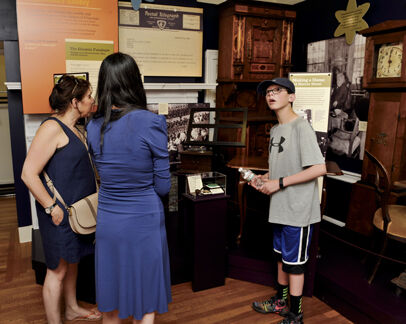
The Einstein furniture collection, including 65 pieces of furniture from the scientist’s home at 112 Mercer Street, donated to HSP by the Institute for Advanced Study in 2004, together with a recent gift of more than 50 Einstein-related items from the personal collection of the late Gillett G. Griffin, represent Princeton’s unique relationship with its most famous resident. Griffin’s gift features, among many items, a photograph of Einstein in fuzzy slippers seated on the steps of his front porch that speak to HSP’s special niche here. “While Israel may have his scientific papers, we can address him as a well-loved and well-remembered Princeton resident; we have a unique relationship to the man,” says Kasdin.
In addition to its Einstein Collection, the Society has material that goes back to the 18th century, including a collection of Stockton Family memorabilia and more than 800 manuscript collections. It is particularly strong in early 20th century material including much related to the controversial development of Palmer Square. Kasdin would like to push that timeline forward to include contemporary material — history as it is happening now — from Princeton’s growing Hispanic community, for example.
“We also have an amazing oral history collection that was conducted during the 1970s as part of the Princeton History Project, which developed The Princeton Recollector, a fabulous resource that we are one step away from getting online.” In addition recent exhibitions on the town’s Italian American and African American communities had oral history components.
While the society would welcome more oral histories, its existing collection stands in need of some TLC. “There’s all kinds of software that I’d like to be able to use in emphasizing place-based history with maps and geo-location. Imagine opening up your phone to find out about the history of the place you are standing in. That would be amazing!”
But first the challenge is to maintain the archive and get material digitized from cassette tapes that are not very stable. “We need to be able to save all of the information from these interviews as well as share this material in a format that doesn’t involve sitting through a two-hour interview.”
Will Princeton be seeing any blue plaques — those historic markers common in many towns that provide capsule summaries of why a particular site is significant? Kasdin laughs. “We could do that but we’ve been toying with something a little more interesting. What is troubling about blue plaques is that they usually denote something already recognizable, a famous person or really important event, but being able to build a narrative around history is more than just highlighting important people and where they lived. So if we were to do some sort of trail, I’d want to broaden it to include more of the storyline of Princeton rather than just stopping points of significant events or people. There are some models we can look at for that.”
What does she have in mind? “We collaborated last year with a digital history course at Princeton University that served as a test case for a unique way that we could share the oral histories by layering them over historic maps of the town so that individual recollections can be associated with a particular place. Imagine clicking on a spot and hearing about a particular restaurant that once stood there and what significance it had for individuals in the community. Or walking past an old school, we can layer this with historic photographs as well. This is place-based history. Imagine a sound bite from someone who remembers a particular locale in the 1900s and then again in the 1940s and again in the 1970s.”
Many Princeton residents lament the demise of an in-town presence for the Historical Society, aside from weekend walking tours that launch every Sunday from Bainbridge House. The building, which dates to 1766 and still has some of its original foundation, is owned by the university, which will renovate it for use as an extension to its art museum education space.
The timing of the Historical Society’s move was also good, says Kasdin, because the Bainbridge House is in need of a thorough historic renovation. The architects who supervised the recent renovation of Maclean House on the university campus have been commissioned to work on Bainbridge House.
HSP’s final exhibition in Bainbridge House, a photographic exhibition, can now be seen in the lobby of Charles Schwab at 132 Nassau Street, a few doors up from Bainbridge House. “What we would love to be able to do is to expand our partnership with local businesses and organizations in town and out of town. We don’t want Updike Farmstead to be the only place where you can experience Princeton history, that should be something that is woven into the fabric of the town. Everywhere you go in Princeton, you should be able to recognize the historic significance of where you are.
“As far as having an exhibition space downtown, I want to think about what we do and how we interpret the past as more than just exhibitions, which are limiting in a lot of ways: in how much material you can present, in the fact that you have a specific type of space that has to be secure and temperature-controlled. I would much rather be able to build transportable, pop-up information stands that you can put anywhere and to cultivate an appreciation amongst everyone that there is this past: can we put one historic photograph of your building up in your store? Or something like that rather than one exhibition space here and one elsewhere.”
The informal, mini-museum of Einstein memorabilia in the back of Landau’s clothing store at 102 Nassau Street is a complement (but not a competitor) to what is in the Historical Society’s Einstein collection on Quaker Road. Landau’s, says Kasdin, “is a great presence of Einstein on Nassau Street.” She adds: “Einstein should not be the monopoly of anyne in Princeton.”
So is Kasdin looking to create a new history ethos in Princeton? In a way, yes, she says. She’s interested in giving residents a way of navigating the Princeton landscape, so that people recognize that they are walking through historical spaces in town that fit into the narrative of Princeton and of the United States.
The refurbished barn is not the only structure on the Historical Society’s horizon. Already approved by the planning board is a research center, which would store the society’s archives and provide access to them by scholars and interested community members. Since moving to Updike Farmstead from Nassau Street, the society’s entire archives are stored at an offsite storage facility that is unable to accommodate researchers. Those engaged in family histories and other research must now make an advance appointment for files to be brought over from offsite, currently just one day a week.
Kasdin is aware of the pressing necessity to put the collection online so that people who are being asked to request materials ahead of time know what to ask for. “Not only will this help us from a logistical point of view in terms of knowing what to pull for people, it is something we should do as a historical organization,” she says. “We have this collection and we need to present it to the world. Our finding aids are not yet digitized but we are better than most similar institutions in that we do know what we have.”
While hardly ideal for researchers, the current offsite arrangement is “fantastic for the collection,” says Kasdin. “The object collection used to be stored about half an hour away and not in the greatest condition for access, making it difficult for us to know what we had and to reflect on or research what we had. The benefit of the offsite facility we have now is that it is all open shelving and everything is out of boxes.”
While the object collection had always been offsite, the document collection had been stored in Bainbridge House crammed into small rooms that, says Kasdin, were probably not the best for maintaining its condition. “We are trying to continue our research program as normal. We had never taken walk-in researchers before despite the fact that all the materials were there and if someone walked in with a question we could just pull material off the shelves. People have been used to having our archives right here. Now we are trying to encourage people to make appointments. It isn’t unusual for archives to be offsite.
“What is incumbent upon us is to build a culture that understands HSP as a real library, a real archive, where if you want to see something you need to make a formal request to see that material. It is a very professional way to work and it allows us to keep records of everything that we are using so then we know what is most particularly interesting to the Princeton community, what are the collections that we are pulling most often and then if it does seem like there is a core group of materials that are being used all the time we have some plans to be able to retrofit space here to store a small amount of the collection.”
This situation could be eased in future with the HSP’s plan to build a new research center with visible storage, already approved for the Updike site. A major benefit of the site is that there is space for a building that would support the entire collection. All of the Einstein furniture would be visible, there would be a reading room and center where people could conduct research.
As a historian, Kasdin is “passionate about HSP being a space where people can conduct serious scholarly research and making that as accessible is a huge priority for us. Most of our research comes from people who cannot or do not necessarily want to come in to the HSP and look at material. We get a lot of requests from all over the world and we do a lot of staff-conducted research. We have a staff member who is a trained archivist and she goes to the collection, does the research and provides a summary of her findings and some scans of the material.”
With captivating enthusiasm and endless energy, Kasdin tells me that her own love of history began with an appreciation for the history of Princeton. The excitement she observes in school children visiting HSP is an opportunity. “They are amazed to learn something they didn’t know before about a place they may drive by every day — local history is about places they recognize and feel connected to.” As she says at another moment: “History is never dead.”
And as for raising funds for future activities, she seems undaunted. “It is a truism that fundraising is about relationship building — about talking to people about what we do and making sure they feel a personal connection to the organization. Because we are local it’s easy to bring people here and say this is your space, this site belongs to Princeton and what we do belongs to Princeton.”
The Historical Society of Princeton, the Updike Farmstead, 354 Quaker Road. The site is listed on the state and national Register of Historic Places within the Princeton Battlefield/Stony Brook Historic District. www.princetonhistory.org.
Freelance writer Linda Arntzenius is the author of “Images of America: Institute for Advanced Study,” published in 2011 by Arcadia Publishing.
,
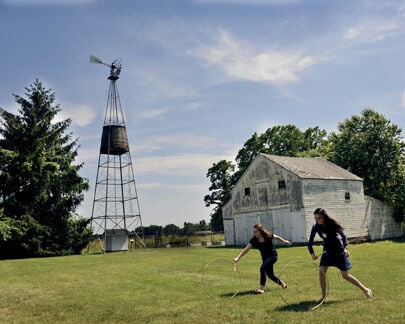
Kasdin challenges colleague Kate Bradley to some 18th century hoop & pole racing.,