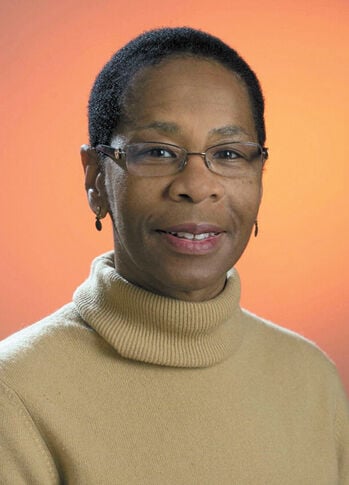
Cheryl Rowe-Rendleman, who was recently named presdient of the board of the Princeton YWCA, knows the importance of being active and involved in her community. It’s a lesson she learned early in her life.
A native of Baltimore, Maryland, Rowe-Rendleman’s mother set an example from her mother’s activism that African Americans need to stand firm in defending their right to fair treatment under the law. She was four when Baltimore City decided to build an expressway through her home on West Mulberry Street, which her parents had purchased in 1938, and her school, Abraham Lincoln School #141.
Given the city’s eminent domain over the property, the people in the neighborhood felt they had no way to fight back, Rowe-Rendleman said, until a group of young Vista volunteers came to town. “They galvanized the neighbors to try to have a voice and at least get a fair price for their property,” said Rowe-Rendleman, who moved to West Windsor 11 years ago.
Her mother led a group of neighbors that held marches and “talked back” to the mayor and to congressmen. “It wasn’t fair,” Rowe-Rendleman said. “These were literally the working poor, and it wasn’t fair to take away their property.” Especially, she adds, if they did not get sufficient money in return to buy another home.
Part of the city’s tactics, she said, was to split up the neighbors by advising them not to tell their friends what price they were getting for their homes. That way, Rowe-Rendleman said, “you wouldn’t know your property was being devalued by the city.”
The fight didn’t end until Rowe-Rendleman was eight, and the family moved to a six-bedroom house in northwest Baltimore’s Forest Park “that had many more rooms than there were kids.”
She and her older brother started asking for baby brothers and sisters, and her parents began taking in foster children “whose families had broken up” and began raising them. And that wasn’t for short term stays—the kids stayed until they reached 21 and left to have families of their own.
In all, they took on seven children, who they educated in a very good school system and took to church, where they attended Sunday school and vacation Bible school. “Those character building things were required in the house, and we didn’t think anything of it,” Rowe-Rendleman said.
Carrying that mindset forward from her childhood, Rowe-Rendleman believes in the importance of veing socially responsible.
In an interview with the News, Rowe-Rendleman referred to YWCA’s of “Eliminating racism, empowering women,” and suggested that the organization’s mission is to also to stand up for social justice, help families and strengthen communities. She also shared some thoughts about current wave of race-related violence sweeping the nation.
“This country has a lot to offer, and every time I see or hear about the type of mass violence that we have witnessed over the past two summers, I am saddened but reminded of how much work that is still needed to protect what we have without giving in to maniacal malcontents with guns, people who abuse their offices of authority without accountability, and people who thrive on discrediting the humanity of others,” she said.
But it’s not only in areas of race relations that Rowe-Rendleman focuses feels a need for social responsibility.
Another formative experience for Rowe-Rendleman was her experience as a Girl Scout, in particular a “wider opportunity” she took advantage of at age 15. She was one of 50 Girl Scouts, one from each state, who in 1976 took part in a program called Scouts on Survival, run by the Coast Guard. At that time women were not serving alongside men in the armed services, and this was one of the experiments being done around the country to find out how women would behave under stressful conditions.
The girls received two weeks of training by the Coast Guard at the University of Michigan on outdoor survival and then were broken into groups of four and dropped on Beaver Island, in the middle of Lake Michigan.
They had to forage for food, build shelters, build fires, cook food and wait until a message was delivered that told them where they would be picked up. She remembers using floss for a fishing line, hairpins for hooks and leftover apples and raisins for bait. They stayed for six days until a helicopter dropped the pickup message.
This experience, too, was a character-building event, she said, and suggests that it was good preparation for her future in business. They learned “how to literally live in a group when you don’t like anyone in the group, how to make that group still work—things people go to management school for now.”
She talked about this experience in her application to Princeton University: “I wrote about the interconnectedness of people and how it wasn’t good enough to be independent … and that if you didn’t realize where your alliances were and how to create those relationships, you would not survive.”
She was admitted to Princeton and studied chemical engineering for her first three years at Princeton, but changed her mind after a summer job as a chemical engineer and switched to biology, doubling up on all the courses she needed to finish in four years.
Her first job was teaching biology to very wealthy students at the Crossroads School in Santa Monica, which focused on both performing arts and science. Her husband, Charles Rendleman, who had been a student with her at Princeton, proposed to her, and she moved to join him in Houston, Texas, where he worked for Exxon.
In Houston, she got another teaching job. “I was bringing in all kinds of science, making many more experiments than there were in any textbook,” she said.
Based on advice from her headmaster she pursued an advanced degree. “There is pedagogy and the nature of science, and I was clearly bitten by the science bug,” she said.
Rowe-Rendleman got into a graduate program at the University of Houston, and the professor she was working with advised her to write up some of her ideas and apply for a grant from the National Science Foundation. The grant she received funded her study of the complications of diabetes, particularly diabetic neuropathy, which is painful nerve damage in the hands and feet caused by the disease .
In her research she looked at how to identify people who were at risk for severe neuropathy and how to keep the people at a level of neuropathy that could be better managed, and she said a couple of drugs, eventually developed by Eli Lilly, for managing pain in diabetic neuropathy came out of her studies.
When she finished her doctorate, she started a postdoctoral fellowship at the University of Texas in Houston, where she began to study ophthalmology, in particular, the neurobiology of the developing eye. She also taught anatomy and disease epidemiology.
Then her husband, a mathematical physicist, was offered a position in California. She followed him after her fellowship was done and gave birth to their son, David, and also started a second fellowship at the University of California San Francisco Medical School. It was also in ophthalmology, but this time focusing on degenerative diseases: macular degeneration and retinitis pigmentosa.
After almost six years of training in these diseases, Rowe-Rendleman was offered a position at Geron, where she worked on a cure for macular generation. The idea was to use stem cells to stimulate the growth of new tissue for patients who had lost vision due to dry macular degeneration. Because these stem cells had to be delivered to the back of the eye, she then worked at Insite Vision in Alameda, where she focused on drug delivery.
After a merger where everyone was laid off, she moved into medical education at Sudler & Hennessey, where she was in the division that educated physicians, nurses and patients about drugs that affect the eye.
“All the work we do as scientists is no good unless it can be communicated properly.” On the one hand, she would see wonderful science that was not going anywhere because it was communicated poorly, and, on the other, “science that is moderately good but so well communicated we all think that is what we should be using.” Not only do you need to be able to “articulate it exquisitely,” she contines, “but so it speaks to people from different walks of life and different backgrounds.”
Rowe-Rendleman did lots of international travel for the company, but with David now 15, and her daughter, Hunter, 8, she realized they needed her, and she started thinking about using her knowledge of the industry and medical communication to do something on her own with ophthalmology. She started Omar (an acronym for Opthalmic, Medical, and Research Consulting) Consulting in 2006. Her first client was an ophthalmology company getting ready to send its first product off to the FDA for approval.
That company was floundering, Rowe-Rendleman said. Operations were not talking to the lab scientists, and regulation was not speaking to the CMC (Chemistry, Manufacturing, and Controls) folks.
She told the CEO bluntly that at his company something was getting in the way of getting a great drug onto the market; then she sat quietly, trying not to be defensive, and he offered her work. She successfully helped them get the drug approved and started getting more clients through word of mouth.
She worked without a partner until 2011, when she brought on a retinologist. She uses contract writers, typically trained in ophthalmology and she works with one cardiologist who does the cardiology assessment for all new drugs.
Three years ago she decided to take the company international and help bring drugs developed elsewhere into the U.S. market. She worked first with Ono Pharmaceutical on a glaucoma drug. The trials were completed in the United States, and then the drug was licensed to a large pharma company for development.
To bring balance into her life, Rowe-Rendleman helps out at organizations in the community. Noting that now the YWCA is her main volunteer activity, Rowe-Rendleman said she first connected with the YWCA in 2013 when she was nominated to be a YWCA tribute winner. After the award, she shared some ideas with Nancy Faherty, director of advocacy and development and soon after was nominated to the board.
In her application to the board, Rowe-Rendleman wrote about her interest in bringing science to girls, something she had done by creating competitive robotics teams with the Girl Scouts in West Windsor. As leader of her daughter’s troop from when Hunter was in fourth grade, she wanted to do something a little different when they were in tenth grade: “I wanted to teach them management, and I wanted them to do something outside of their wheelhouse.”
Her idea was to start a robotics team for younger girls, with her Girl Scouts serving as managers and mentors, and it turned out that the Girl Scout Council of Central New Jersey had received a grant from Motorola to fund and run two all-girl robotics teams.
Given the success of her Girl Scouts robotics team and her interest in bringing science to girls, Rowe-Rendleman pushed to do something similar at the YWCA. They recruited coaches from the staff at Princeton University and the Princeton Plasma Physics Laboratory to teach the girls everything they needed to know about building and designing a robot, but also how to keep a lab notebook and how to work with a team.
The teams for 9 to 14 year olds did well last year, and this year the YWCA will have a third team for girls 14 to 18, sponsored by a community partner, SES, a satellite company. They will provide space for the girls to build their robots and mentor them on how to design and develop their robots and also on skills in project management. The teams are open to every girl, and no minimum grade average is necessary.
Under Rowe-Rendleman’s tutelage, the YWCA has also created NEXTGEN, a board for women under 30, from diverse backgrounds. They will learn how nonprofit boards work, have an opportunity to do community work, and use the board as a way to “jumpstart themselves in different areas of management.” They will decide on their own projects to implement the YWCA’s mission of empowering women and eliminating racism, and then raise them to the full board, who will act as their mentors.
“The things on their agenda may be different from our agenda,” Rowe-Rendleman said. “They will be able to speak to us from a whole different level of experience than some of us have had, and they are going to be able to bring a different way to communicate to the rest of the community.”
Rowe-Rendleman is also very active in Princeton Area Alumni Association, where she started as chair of the student liaison committee, working with students and others who needed an alumni presence at a campus event.
She is also on the board of the Yinghua Chinese Language School.
Rowe-Rendelman moved to West Windsor over a decade ago when her husband was offered a job at D. E. Shaw Research. He also bears an important similarity to her father, a meat packer, who was, she said, “a quiet person who supported the alpha female out there.”
Keeping busy outside of work is essential Rowe-Rendelman said. “You can’t work that hard without playing equally as hard,” she said. “Volunteer work is my play—I do it because I love to do it and because there is a need, and because I can see that people are being helped by the work I am doing.”
,