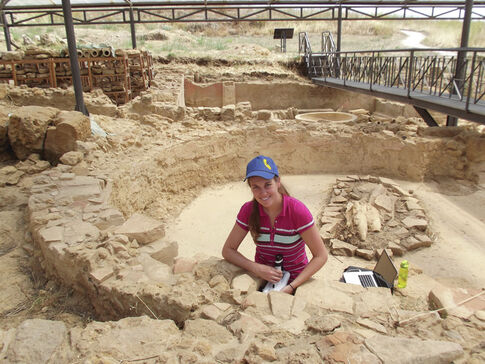
Samantha Stout has always been fueled by her curiosity, driven to explore new places. When she was a child she played soccer and basketball, performed in theater, participated in Girl Scouts—she wanted to do it all.
Her mother, Suzanne, recalls how her daughter even managed to convince officials at Hopewell Valley Central High School to let her skip lunch in favor of taking an extra elective. There were hardly enough hours in the day for Stout to explore everything life had to offer.
So after she studied engineering at Cornell University, it was only a natural fit for Stout to dive into a relatively new field of study and blend two unique passions—engineering and art history—into a career that has allowed her to study some of Europe’s most famous landmarks.
Stout recently completed her Ph.D. in materials science and engineering at the University of California, San Diego, and is now living in Florence studying cultural heritage artifacts. Stout does diagnostic analysis of artwork and artifacts to better understand how they were made, what they are made out of, and, therefore, how they should be preserved to ensure they can remain in tact for future generations to view and enjoy.
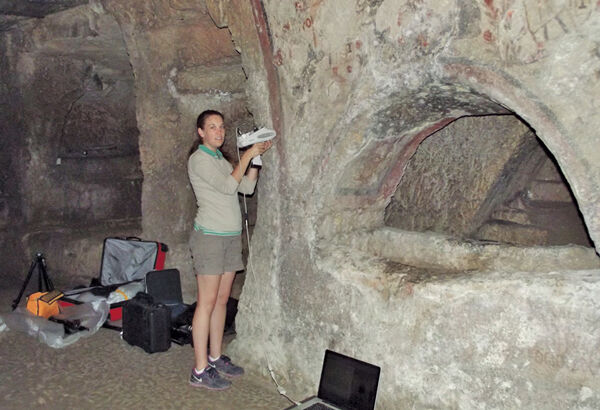
Stout starts studying a work of art by checking the surface for cracks, detachments or other vulnerabilities, often using a spectroscope to measure properties of light, which enables her to identify materials. Using noninvasive techniques to ensure the artwork isn’t damaged is a critical part of Stout’s work, as the art can be anywhere from hundreds to thousands of years old.
“Each work is its own living artifact,” Stout said. “I think that’s one of the most beautiful things, especially how the artists had so much competence to make the creation.”
Understanding how the artist created the painting is one of the first steps in the preservation process, Stout said, because it gives the researchers a better idea understanding of the best way to study the artwork. Since elements of both art history and scientific research are so intertwined in the preservation process, it’s important for researchers to have a solid understanding of both fields.
“I think a misconception could be that you’re either an art historian or you’re a conservator or you’re an engineer, but really all of us are trying to be as multidisciplinary as we can be,” Stout said.
Technical art history has had a huge impact in the art industry. Stout’s work focuses more on the preservation of the art, but the techniques can also be used to prevent art forgery. If scientists can better understand original works of art, then they can better identify false copies.
Stout was always interested in art from an experiential standpoint, visiting the Philadelphia Museum of Art growing up, but she developed a deeper appreciation for artwork when she studied abroad in London.
“Being in the City of London gave me the opportunity to visit many different spaces on the arts and culture scene, especially some of the great museums there,” she said. “I realized that I wanted to make sure that going forward I could also incorporate my love of art in my work and research.”
At the time, however, Stout wasn’t sure how to go about combining art with her engineering background. She knew she wanted to combine different areas of study in her work, but there didn’t seem to be one set field of study that would allow her to follow her interests.
Stout liked that the University of California, San Diego had a strong sense of collaboration between departments, so she traveled to the west coast to start her graduate studies in the school of pharmacy. She quickly discovered she didn’t like the bench work that came with being a chemist, but in an almost serendipitous turn of fate, a professor at the university’s Jacobs School of Engineering, Maurizio Seracini, set up an interdisciplinary research center for scientific studies of works of art.
She finally had an outlet to combine artwork, research and engineering, even though she was warned to avoid such a new field.
“When I entered the field around 2010, 2011 it was a big gamble,” she said. “A lot of people were telling me, ‘You’re never going to find work. You can study it with us, but don’t expect to ever get a job.’”
Despite the warnings, Stout didn’t take their concerns too seriously. “I always would rather prove people wrong than give up on something,” she said.
Her mom was never worried about her daughter finding a job in a field she was passionate about.
“I thought for her it was probably a perfect kind of marriage between the arts and the sciences,” Suzanne said. “It was very new at the time, and I feel as though it’s very important for young people to follow their passion. As long as they are engaged in something they are passionate about, to me, that’s what life is all about. The job and opportunities will find a way to present themselves.”
Moving forward in such a new field yielded incredible experiences for Stout. She met Queen Beatrix of The Netherlands and studied the Catacombs of St. John in Syracuse, Sicily. Stout was part of a research team that did some of the first multispectral documentation of the Catacombs’ wall paintings, which were built between the fourth and the sixth centuries.
“That was quite interesting but very profound, powerful space,” she said. She said it was surreal to be surrounded by dead bodies as she worked to probe colors on beautiful paintings.
Nothing may have been more surreal, however, than Stout’s 2011 search for Leonardo da Vinci’s lost mural, “The Battle of Anghiari.” Through a fellowship from the National Science Foundation, Stout joined the research team that set out to study the most famous piece of art that no one has ever seen.
The painting was rumored to be located in the Hall of the Five Hundred in Florence. As technology advanced over the years, scientists were able to prove that renovations were done to the hall after da Vinci painted “The Battle of Anghiari”—the ceiling was raised and a new wall was built to support it.
The research team was able to identify exactly where the painting was located and find traces of pigments, but they weren’t able to reveal the painting without destroying another. Blocking da Vinci’s painting is a wall featuring one of Giorgio Vasari’s fresco paintings, considered to be another historic work of art. Because they are unable to uncover da Vinci’s painting due to the overlapping fresco wall, the state of “The Battle of Anghiari remains a mystery.
“I highly suspect that [The Battle of Anghiari] is in a great state of decay, but it’s that big unknown that makes it still intriguing to me,” Stout said, adding that the research excursion was one of her most exciting experiences because at any moment, they could have found a part of the painting.
While studying artwork that is hundreds of years old is an ambitious journey in and of itself, Stout decided to use her dissertation to take the research to the next level. This is after all, the same girl who ate lunch in a woodshop class so she wouldn’t miss the opportunity to learn something new in an elective.
For her dissertation she sought to develop a procedure that would quickly and accurately identify the pigments and palette of each artist.
“Essentially, if you were to put these artworks on a conveyor belt going through a scan, which doesn’t harm the artwork, we could rapidly tell the pigment and working palette of each artist,” Stout explained.
She worked to develop the parameters and the experimental conditions of the exam to ensure it was a nonharmful procedure. If museums used this technique and equipment, Stout said there could be a database of all the artists’ palettes, allowing them to track trends of art overtime and identify works that have similar combinations of pigments.
“The technology is just constantly bringing new things that they are able to do,” Suzanne said. “It’s like any other tech-based discipline, it continues to grow by leaps and bounds.”
Suzanne is fascinated by her daughter’s work, and believes Stout’s drive to discover new things runs in the family. Suzanne became a substitute teacher in Hopewell after an 18-year career in the banking industry and her father, Jay, is a technician.
“I’m a lifelong learner as well,” Suzanne said. “I think Samantha may have gotten her love of lifelong learning from me. I’m never not fascinated by anything new that comes along, and since this is an emerging field there’s always new things.”
Stout remained in Florence with Seracini to continue her dissertation work, where she fell in love with Italian culture. Stout is constantly inspired by the artwork and architecture on many of Florence’s historic buildings and landmarks. Italians are also more in-tune with their cultural history than many in the United States, she said.
“Here, I think you can stop almost any young person on the street and have a discussion about Michelangelo and they would be really engaged and know what they’re talking about,” she said.
Stout not only fell in love with Italy’s culture, but its people as well. She married her husband, Antonio, an Italian pianist, in 2014. The two collaborate on many projects together, including a contemporary multisensory concert. Her husband composes the music, while she creates the lighting design to match. During the concert, which is held in venues throughout Florence, perfumes are diffused into the audience to create a full multisensory experience.
“Florence, while it’s always not ideal for contemporary works, we’ve had great audiences here and it’s given us the encouragement to move forward,” she said, adding that they hope to one day bring the concert to the greater Mercer County area.
Even though launching a company and producing a concert keep Stout happily busy, she hasn’t lost her drive to explore new things.
“In the future, I might like to undertake more material studies in an anthropological sense,” she said. Although, for now, Stout is content to see where working and living in Florence takes her.
,