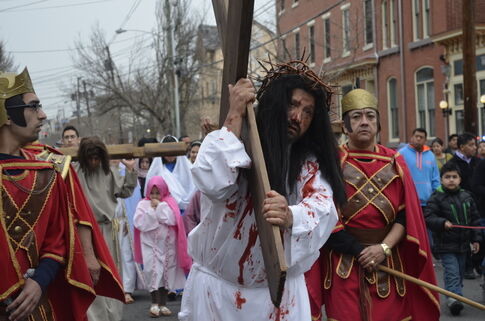
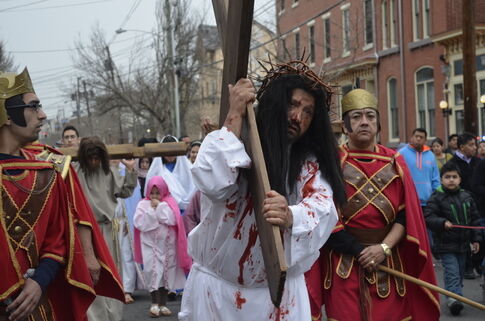
It is an early Good Friday morning at El Centro on South Broad Street in Trenton, and the world is transforming. In one room a handful of Trenton men become Roman soldiers, complete with red cloaks, breastplates, and helmets. In another, women, men, and children become ancient Jerusalemites in tunics, shawls, and keffivehs (head coverings). And upstairs Chambersburg resident Manuel Calvo has become Jesus, in robe, sash, and sandals.
Together they are transforming themselves to recreate Via Crucis, or the Way of the Cross, a devotion that recreates Jesus’ final hours in human form. The ordeal — also referred to as the Passion — is one of Christianity’s most important moments and commemorates when Jesus — believed to be the son of God made incarnate — redeems humankind from sin while being subjected to some of the darkest aspects of humanity: betrayal, hate, and an indifference that led to Jesus’ unjustified death sentence, a humiliating procession through Jerusalem, and an agonizing death on a cross (a favored Roman punishment to induce compliance).
“We are not in Trenton, New Jersey,” Deacon Benito Torres — a bearded middle-aged man with serious face — tells the reenactors as they prepare to start their approximately two-mile police-led journey from Sacred Heart Church on South Broad Street (near Market Street) to Centre Street, then past the New Jersey State Prison on Federal Street, and finally to St. Stanislaus Church (also called Divine Mercy Parish) on Smith. “We are in Jerusalem, the Holy Land. We are not putting on a show. We are living the lives of these people.” The group then joins together and prays for the success of the event.
Via Crucis, which returns to Trenton on Good Friday, March 25, is rooted in Roman Catholicism and traditions that originated in Spain when a 16th-century provincial ruler returned from the Holy Land and institutionalized the re-enactment. Since then it has become part of cultures with links to Spanish heritage, including Trenton where Hispanics represent 33 percent of the population, according to most recent U.S. census.
“I started in (the processions) in 1988 at the cathedral,” Torres tells me earlier, referring to the reenactment that began at Saint Mary’s on North Warren Street and passed through Perry Street. “I’ve done it 10 times at least,” he says, adding that he has played Jesus and soldiers.
On this day Torres, a Trenton resident who has been a College of New Jersey physical plant worker for more than 15 years, is the narrator who describes the 14 stations — beginning with Jesus being sentenced to death and followed by his lifting and carrying the cross, being beaten by Roman soldiers, falling three times, and more. The event ends with the crucifixion.
El Centro program director Roberto Hernandez says that after changes at different churches, El Centro brought Via Crucis to Sacred Heart Church in 2000. “One of the reasons I want to do it is that it is a way to let people know that El Centro is here. We believe in peoples’ resiliency,” he says.
El Centro was founded in 1999 as a nonprofit support service for the Spanish-speaking community. According to its promotional materials, the Catholic Charities project provides free job training and ESL and parenting classes. It also provides immigration services at a “modest” fee.
“We learned that when (Hispanic) men learn English, they get a better job. And they feel better about themselves and become better fathers and husbands. That’s what it’s all about — helping people out,” says Hernandez, whose smiling smooth face complements Torres’ more serious demeanor.
Both the men say the event is to “lift people in faith,” and they share anecdotes of past processions where the reenactors and a crowd of trailing supporters journey through the streets of aging poor neighbors, past bars and the prison.
“So many conversions,” says Torres. “Like the (Good Friday) that a woman taking drugs saw me (as Jesus) carrying the cross. She started shaking. Roberto put his arm around her and gave her a card. She came for counseling and has been clean for seven years.”
Other tales feature drunk men, like the one who comes out a bar, sees the soldiers whipping Christ during one of the commemorated falls, intervenes, and begins carrying the cross, like the Biblical figure Simon of Cyrene. Another one shows up during the crucifixion and starts laughing until Torres — his head covered with stage blood — gazes at him and moves him to silence.
Then there is one of their favorite accounts. “We walked by the prison. When we started singing ‘Amazing Grace,’ the prisoners inside began singing with us,” says Hernandez.
During my time with the procession, I see people emerging from the houses or looking out windows to watch with quiet interest, some blessing themselves and others taking photographs.
Although the event is devotional, both Hernandez and Torres agree that it is rooted in folk theater, an activity that includes deciding who will perform what roles — or in theater terms: casting.
So how do you select Jesus? Hernandez smiles, nods knowingly, and says, pointing to his average waist, “People say to me, ‘Roberto, why don’t become Christ?’ And I say, ‘You can’t be a fat Christ!’”
He then turns serious and continues. “It has to be someone who is spiritual and understands what our lord went through. Before we leave (to begin the procession), we say a prayer. We say we are walking like Jesus did. And people take on the roles seriously. Benito mediates in prayer before he takes the walk.”
Torres agrees and says, “If they’re going to portray Jesus, we want someone who won’t be in the bar tomorrow, someone who can be a role model and not do crazy things. Lead by example.”
One of several projects at El Centro — others include an annual health fair and a “Three Kings Celebration” — Via Crucis requires weeks of rehearsal and preparation.
During my earlier visit a few weeks before the event, a woman performing the role of Mary rehearsed with Torres while her mother looked on. Meanwhile Hernandez was busy tracking down a delayed Jesus and talking about borrowing tunics and robes from another church.
Now on this Good Friday morning the weeks have shown their fruit and a hundred or so viewers — or fellow journeyers — begin gathering in front of Sacred Heart Church.
As the Jerusalemites move toward their places, one of the Roman soldiers, Sandoval Jaquez, a young man employed at a liquor store, tells me, “We do this once a year. This is very important for our history. We keep a tradition alive. It is important for the new general ion — there are a lot of bad habits out there. We have to change. We can help someone. That’s our duty.”
As Torres says before the group leaves the church, we are here for “the hearts in the neighborhood to see and be touched.”
Via Crucis (Way of the Cross), Catholic Charities, El Centro, Sacred Heart Church, 343 South Broad Street, Trenton, free. Good Friday, March 25, 10 a.m. Call 609-954-7487.
,