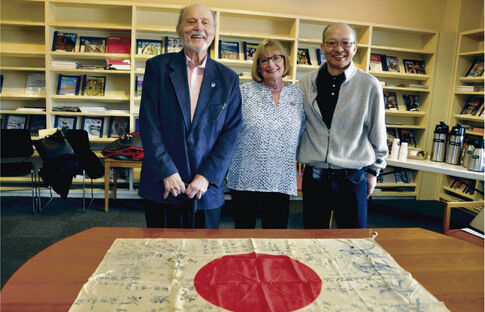
In February 2015, Robbinsville resident Barbara O’Hare met Harold Gross. A year later, the meeting has repercussions halfway around the world, decades in the making.
O’Hare’s father, Ralph C. Muentener, was with the 11th Airborne Division’s 511th Parachute Infantry Regiment in World War II, which participated in the Feb. 23, 1945 Los Baños Prison rescue operation, one of the most successful rescue operations in modern history. He was later sent to Japan as part of the occupation force.
During the rescue operation, various forces, along with Filipino guerrillas, successfully rescued more than 2,000 American civilian internees held behind Japanese lines. There has been an annual dinner on the Saturday closest to Feb. 23 for more than 30 years, honoring the rescue itself, those who participated and the internees. Some internees have attended over the years. Also, participants have invited friends and family to the event. The annual dinner is held at Forlini’s Restaurant in lower Manhattan. Frank Forlini, the owner of the restaurant, is believed to be the only surviving member of the rescue operation.
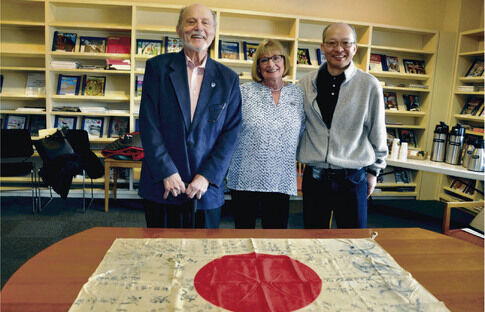
Last year, O’Hare brought a discolored Japanese flag to the dinner, which she believed her father obtained in Philippines during the war. There are handwritten messages in Japanese on the flag. She couldn’t read them, and had hoped to find someone who could.
It was at this dinner that O’Hare met Gross, a World War II veteran. Because of his time in Japan during WWII, Gross took interest in the Japanese language and joined a group devoted to Japanese in his hometown of Westport, Connecticut.
Gross didn’t know what was written on the flag, either, but he suggested that O’Hare bring the flag to one of the Japanese Language group meetings so that I, a native speaker of Japanese, could take a look at the flag. O’Hare came to our meeting in April 2015 with the flag and other items. At the meeting, O’Hare told me she was hoping that she could find surviving family members of the original owner so that the flag could be returned to them.
During WWII, it was very common for the family of a Japanese soldier to ask their relatives, friends and neighbors to put their names on a flag and to give it to the soldier as a farewell gift or perhaps a good luck charm when they sent him off. I have heard about such flags and saw some images in movies, but it was the first time I actually saw a real flag like that in person.
O’Hare had me keep the flag for a while so that I could further analyze what was written on it. Some of the handwritings of Chinese characters (Japanese use Chinese characters as well as Japanese characters when they write) are in fluid cursive style, which I had trouble reading.
I took pictures and sent them to my mother and aunt in Japan, both of whom had studied and practiced Japanese calligraphy, and asked them to tell me what they were.
The messages on the flag are mostly encouraging, statements like “Be brave,” “I hope your luck as a soldier is forever,” “Fight to the end,” and “Be loyal to the country.” One message says, roughly, “Wipe out America and the UK.”
One of the challenges of finding the family is the fact that the soldier’s name is not written on the flag. There is no geographical information, either. My initial impression was that we probably wouldn’t be able to find where the flag was originally from.
Yet, on the flag, there are more than 60 names along with farewell messages for the unidentified soldier. As I finished listing the names on the flag on a sheet of paper, I realized more than half of them share the same last name, Tachigami, which is an uncommon name.
Given that, I thought chances are the soldier’s last name was Tachigami. Also, I felt that he must have been from an area where his extended families and relatives lived nearby. In other words, he is more likely from a rural town or at least not from a major city.
So, my detective work began. First, I searched the Internet and found out that only a few hundred Tachigami households exist in Japan and are mostly concentrated in a small area—in and around Fukuyama City, Hiroshima Prefecture, about 100 kilometers east of Hiroshima City.
I became somewhat optimistic and thought I might be able to find someone who knows who the soldier was. I used social media and made some international calls in hope of finding some leads. But, the effort didn’t get me anywhere. I realized it was not realistic for me to try to find surviving family members by randomly contacting people with the same last name.
Also, it has been 70 years since the war ended, so it is not easy to find someone who is still alive and happens to know this particular individual.
While I was not sure what to do next, I learned from one of my wife’s friends that Japan’s Ministry of Health, Labour and Welfare in Toyoko had an office that might be able to help us find a surviving family member of the soldier.
I contacted the office immediately and then sent pictures that show details on the flag with my comments, observations and analysis. I was not sure how helpful they could be. As time passed, my hope faded, as we had not heard from the government agency for a while. But in mid-November, seven months after we started this search, a letter arrived from Japan. The government agency had located Hideko, the oldest daughter of the soldier. I later confirmed that her name is on the flag. I was able to tell the handwriting was one of a child.
The family is indeed from Fukuyama City, Hiroshima Prefecture, and still lives there. I called O’Hare and let her know the news. She was very excited about it.
Mr. Kobayashi of the government agency, who located Hideko, told me that, from his experience, he too thought there was very little chance that they could find a family member. He agrees that the fact the name, Tachigami, happens to be not common and found mostly in Fukuyama City helped narrow the search.
Hideko is now 81 years old. She is the oldest and the only surviving daughter of Kakuichi Tachigami. I learned that Kakuichi was in the Japanese Navy and sent to Philippines. Hideko was 10 or 11 at the time the war ended, so she must have been much younger when Kakuichi left his family. He probably died in Philippines where the 11th Airborne Division was at that time. The flag must have been one of his most precious belongings. It was clear he had kept it with him all the time, nicely folded.
I have not been able to speak with Hideko directly, but spoke with Hideko’s son, Kazuhisa, and daughter-in-law over the phone. Hideko seems to be suffering from some type of dementia and spends a couple of days a week in a special care facility. While she has good days and bad days, her son told me that she does remember the flag.
We need to send the flag to the Tachigamis through the Ministry of Health, Labour and Welfare sometime soon since that is the agreement. O’Hare and I are scheduled to speak about our search at the annual Los Baños Prison rescue dinner Feb. 27. There, she planned to hand flag off to me, and I will send it to Japan. We are hoping the media in Japan will also cover this story, so that we can have some pictures of the Tachigamis with the flag.
,