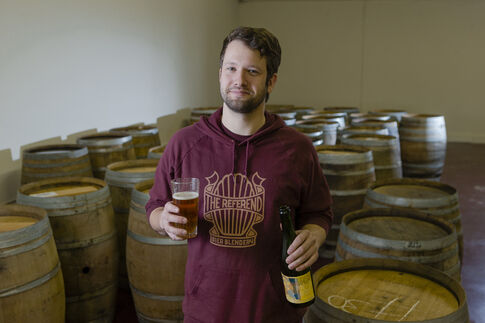
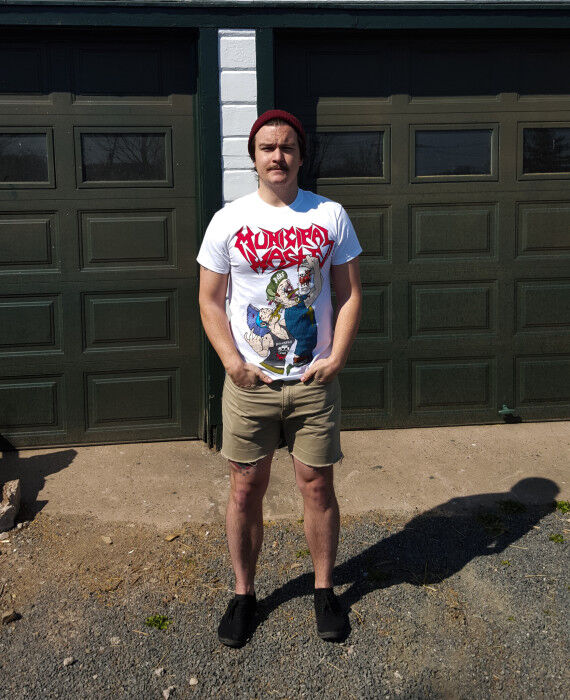
James Priest and Alex Helms had never met before a few months ago, but in a way they’ve been traveling on the same road for some time.
They have each spent the last several years on a mission to learn everything there is to know about the business of craft brewing. They’ve moved from place to place, working long hours for low pay, doing all sorts of jobs at some of the top breweries, restaurants and wineries in the country. Now both are preparing to start new brewing operations in the Hopewell Valley. And neither has yet reached his 30th birthday.
If all goes well this summer, the entrepreneurs will double the count of beer producers in Mercer County, from two to four. But rather than replicating the success of New Jersey’s 47 other breweries with their familiar portfolios of ales and lagers, they are hoping to take local beer to another level.
Independently of one another, each has developed a business plan that involves taking risks where others have played it safe. They are both committed to producing beer in styles that are sought for their character and complexity. One could say that Helms, at Troon Brewing, and Priest, at The Referend Bier Blendery, aim to do nothing less than to elevate the tastes of beer drinkers throughout the region.
* * *
Until a few years ago, Alex Helms thought he was on the path to becoming an executive chef. Helms, 25, grew up in Montgomery and graduated from The Pennington School before attending Wheaton College in Massachusetts. He spent his first few years after graduation moving about the country, working in restaurants. He lived with friends on a farm in Essex, Vermont for a while, then moved to Casco, Maine, outside Portland.
He had done some homebrewing in college, but it wasn’t until he lived in Maine and got to know Portland’s lively bar scene that he really started becoming interested in craft beer. He tried to get a job with the Maine Beer Company, but they didn’t have any openings.
He left Maine for Austin, Texas, where he again lived with a friend. He was working as a cook at a food truck, but he still had the itch to get involved with craft beer in some way. Jester King, a brewery 25 minutes outside the city specializing in farmhouse ales and spontaneously fermented beers, was growing rapidly, and gave him a volunteer job helping with bottling and packaging. He was paid in beer.
When Jester King began retail operations, Helms was hired as a bartender. It was around then that he decided that instead of a professional chef, he wanted to be a professional brewer.
“Working in fine dining was really fulfilling. You feel good when you leave for the day. But I felt like I needed to make a decision if that was where I was going to end up,” he said in a recent interview. “I think with a brewery there’s more room for being sustainable while maintaining creativity than in running a restaurant.”
He moved briefly to Miami to help out a cousin, then to Orson, Pennsylvania, outside Scranton. In August 2014 he was back in Montgomery visiting his parents when he saw an article in a local paper about Jon and Robin McConaughy and their ambitions for Double Brook Farm on Hopewell-Rocky Hill Road.
He visited Brick Farm Market and was impressed. He emailed Jon McConaughy, pitching him his idea for a brewery, and McConaughy agreed to meet. “We got along, and went from there,” Helms said.
Troon Brewing, still early in the construction phase, will be one of three businesses operating in old farm buildings on the McConaughy property, along with the wildly popular Brick Farm Tavern, which opened last year, and Sourland Mountain Spirits, also in the planning stages. (Co-publisher Jamie Griswold is an investor in Sourland Mountain Spirits.)
The plan is for Helms to brew “tavern beers” which will be on tap both at Brick Farm Tavern and in a little package store and market at the farm that will have a liquor license for selling both bottled and draft beer. The businesses are separate entities, but New Jersey law allows breweries to self distribute. So technically, Brick Farm Tavern will be a retail client of Troon Brewing.
The tavern beers will for the most part be familiar beer styles: India pale ales, stouts and porters, but he will also be featuring a heavy rotation of seasonal offerings as well as oak-aged farmhouse ales and saisons, which he brews with a proprietary mixed culture of yeasts not found in ordinary beer. But his real passion is for experimentation.
“I look at the new level of dining in the Princeton and Hopewell area and see a demographic that responds well to taseful and well executed dishes that would have been ‘extreme’ here 10 years ago,” Helms said. “In the same way, I hope that they also have an interest in what else can be done with beer.” An example of this would be a sour stout that he recently blended with barrel-aged brown ale aged on cherries.
Once the brewery is built out and the brewing license obtained from the Alcoholic Beverage Control, Helms looks forward to working on new interpretations of a variety of beer styles. He feels that a small brewery, he has almost an obligation to push the edge of the envelope in terms of what can be done with beer.
“I’m running this as a sole venture. I just think it affords me opportunities to make beer that someone who is focused on the bottom line might not be able to do,” he said.
* * *
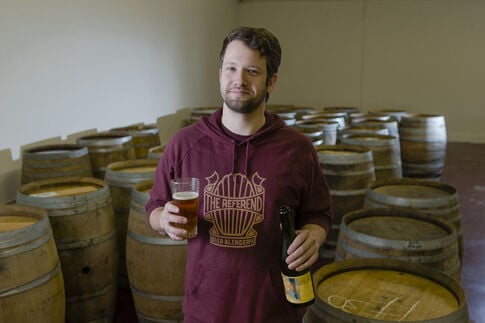
The Referend is not a typical brewing operation. For starters, the Reed Road startup is not a brewery. It’s a blendery.
Chicagoland native James Priest’s ambition is to do something that very few American beermakers are doing: produce exclusively spontaneously fermented beers. Priest plans to use a process very much like Belgium’s méthode lambic, a painstaking sequence that takes as many as four years to complete. A number of breweries, notably Allagash Brewing in Portland, Maine, produce some of their beers by spontaneous fermentation, but Priest knows of only one that makes them all that way — De Garde Brewing in Tillamook, Oregon.
At the stage of the brewing process when most brewers would be pumping their boiled wort — a prefermented mixture of water, steeped grains and aromatic hops — into stainless steel fermentation tanks, Priest will be pumping his outdoors, into a large, shallow pan called a coolship, where wild yeast and bacteria will settle on it overnight.
Since Priest doesn’t have his own brewing equipment, this part of the process will take place at a nearby brewery that will make the wort to his specifications, under his supervision. The Referend’s coolship, which was custom fabricated by Trenton Sheet Metal, sits in a truck that he will drive from location to location.
The next morning, after the wort has cooled, it will be put into aged oak barrels and racked in the blendery, at which point fermentation will begin. Then it’s time to wait. And wait.
Where most beer is fermented by commercially cultivated yeast — and the presence of bacteria would be seen as ruinous for any batch that was infected with it — spontaneously fermented beer depends upon the unpredictability of the yeast and presence of microflora to impart upon it a singular aroma and flavor profile. It takes years for the beer to fully mature and mellow.
The style of beer produced by this method is well known in Belgium, where it is generally known as lambic. Lambics made by Belgian breweries such as Cantillon, 3 Fonteinen and Gueuzerie Tilquin are some of the most highly sought beers in the world.
They are also among the most misunderstood. The combination of wild yeast and microflora yields much more assertive flavors and aromas than traditionally fermented beer, along with a tart or sour aftertaste. Terms like leather, hay and horse blanket are often used to describe the taste and smell of a lambic. Some descriptors are not even that complimentary.
While people tend to wrinkle their noses and furrow their brows upon first tasting a wild ale, many find themselves strangely drawn to these beers that at first seemed to be full of “off” flavors. Well-made lambics, while always funky, are more tart than sour, with clean, refreshing, vinous profiles that come across like a champagne, cider or carbonated wine. Wild beers are an acquired taste, but it’s a taste that Priest, as well as more and more American beer enthusiasts every day, have acquired.
* * *
After a few months, enough fermentation will have taken place for the young beer to resemble lambic. But the yeast and bacteria need more time to develop lambic’s signature complexities of flavor and aroma.
In New Jersey, breweries can sell their products directly to consumers, and The Referend will be no different. Within six months, Priest will be able to start selling a beer he’ll call Jung, as in young lambic. At that point, the yeast will still be producing too much carbonation for the beer to be bottled, but he can pack it in special pouches that would enable customers to take it home to drink.
Priest is committed to giving the majority of his beer the time it needs to develop, but that means it will be at least two years before he is really able to start selling his signature product. He estimates it has cost him and his dozen or so investors about $100K to get The Referend to this point. He has a blendery full of barrels waiting to be filled, at this point, but is waiting on the Division of Alcoholic Beverage Control to grant him a license to make beer.
Once he has the license, he can begin making lambic and some other styles, like Berliner Weisse, that can be made via spontaneous fermentation, but don’t take as long as lambic.
The true art of lambicmaking is in the blending. Lambics do not have to be blended, but most are. (Geuze, on the other hand, is always a blend of lambics of different ages.) While each barrel has its own characteristics, skilled blenders work to give their beer a fairly consistent character. Connoisseurs can detect differences from year to year and even from bottle to bottle, but a consistent blending process yields a dependable product year after year.
At the Referend, the job of blending will belong to Priest, who but for a twist of fate might be looking to open a jewelry store rather than a blendery.
He first developed a taste for good beer when he was a student at the University of Colorado in Boulder. Greater Denver has long been known for its craft breweries, including Avery, Breckenridge and Oskar Blues. He graduated in 2010 with a degree in English.
Later that year, he moved to Maine, where his girlfriend, Melissa Ducommun was a senior at Bates College. It didn’t take long for him to realize that moving to Maine as winter approached was not a great idea.
“There are not a lot of jobs in winter in Maine,” he said. “I applied for everything. I applied to be a snowcat operator at a cross-country ski resort. I got an interview at a jewelry store.”
He finally landed a job doing packaging and sales for Baxter Brewing Company in Lewiston, Maine. “I was into beer then, but I definitely took the job because it was the only one I was offered,” he said.
Ducommun graduated from Bates and moved to Philadelphia, where she was and is a Ph.D. candidate at the University of Pennsylvania School of Medicine. Priest went along, taking a job at Tria, a wine bar with a training program for employees. Later, he was a beer buyer for Hawthorne’s Beer Cafe.
Priest spent some time in the Frederick, Maryland area as packaging manager for Flying Dog Brewery before returning to Philadelphia, where he worked at some area wineries. “At the wineries I learned barrel care, cellaring techniques, bottle conditioning — all things I need to know for what I’m doing now,” he said.
He began conceiving of The Referend Bier Blendery while he was working for Flying Dog. At that time, the market for spontaneously fermented beer — also known as wild ale or sour ale — was tiny. “There were only eight or nine breweries that had coolships,” he said. “Now I’m constantly finding breweries that have them.”
As Priest sees it, the competition can only help. Lambic-style ales are prized by a small percentage of American beer drinkers, but if they are to become more popular, they will need to be more prevalent. “It’s beer I feel we don’t have enough of. Not enough for my liking,” he said. “If this were as available as anything else and as affordable as anything else, I would want more of it.”
When he first learned that Alex Helms was planning to open Troon Brewing a few miles to the north, and that Troon would also be working with wild yeast, he was anything but disappointed. “I think we were both really excited about it,” Priest said about meeting Helms and learning more about his plans. “His focus is wild saisons. A litle more approachable. We can send people there and he can send people here.”
* * *
Helms sees tremendous potential in Hopewell’s vast and diverse agricultural resources. “I’d love to create very New Jersey-centric beers,” he said. “I feel sometimes that going local is a compromise, where you know there’s a high quality product out there, but you’re choosing to limit yourself to what’s nearby. But in Hopewell, with the range of well run farms in the area, staying local involves no sacrifices.”
Both Helms and Priest intend to make seasonal beers using local fruit and produce, such as a sour ale Helms recently made conditioned on Terhune Orchards raspberries and cherries.
And both Priest and Helms know they have some work ahead of them to bring customers up to speed about their products. “New Jersey is a little young as a craft beer scene,” Priest said. “People will come by and I won’t have anything that they think of as beer,” Priest said. “Every brewery and brewpub required to give tours, which I think is a good thing because it gives me a chance to explain what we’re doing and how it’s different. For a lot of casual consumers, this beer only makes sense in contrast to normal beer.”
On the Web: thereferend.com and troonbrewing.com.
,