The hardest thing about autism is often the stigma.
“Some people think of the movie ‘Rain Man,’” says Peter Bell, president and CEO of Eden Autism Services. “They ask autistic people, ‘What is your savant skill?’ The truth is, few autistic people have those kinds of savant skills.”
Woven into this misperception that autistic people can recite the phone book from memory is the belief that all autistic people are the same. It doesn’t help that it’s only been a couple decades since non-autistic people started realizing that there are many points along the autism continuum. And it’s an even more recent trend to see autistic people not so much as a group of people, but as individuals.
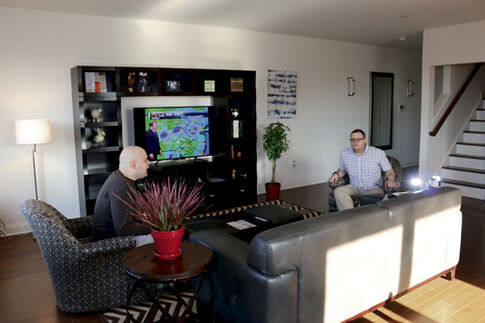
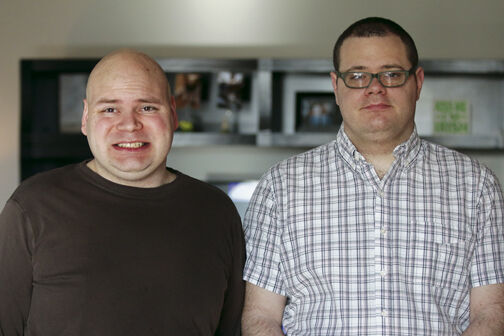
In March, Eden and Robbinsville Township helped usher in the next step toward weaving autistic individuals into the fabric of the community. At the Lofts in Town Center is a new pair of residents named Spike and Gregory, two longtime friends who met as children in Eden’s school program and who now share a 2,113-square-foot residence amid the semi-urban-style vibe of Robbinsville’s downtown.
Officially named the “Lofgren Loft” in tribute to Spike Lofgren, its initial resident, the space is a two-bedroom, two-bath, two-floor condo with an office on the second floor and an open floor plan on the first level. Spike and Gregory (whose last name Eden withheld for privacy reasons) essentially live by themselves. Bell said a care provider is always with them.
The idea, he says, is to allow Spike and Gregory to live independently, but to also have someone around for them in case they need it. While both men are high-functioning—each is in his 20s and works for Wawa, though not at the same store—and quite verbal, Bell says, they cannot be expected to live 100 percent on their own.
They can, however, be expected to live in a way in which they feel comfortable, and as individuals. Bell says the trend in autism care, particularly as far as living and housing goes, has steered far away from large group residences that functioned like asylums and hospitals towards what Bell calls “person-centered planning.”
Not that these large group places don’t still exist. In fact, New Jersey is still peppered with larger centers for the developmentally disabled that Bell says has taken the better part of 30 years to phase out. But these days, the trend is to realize that autistic people are actually people with their own individual tastes and likes, own abilities and needs, own ideas and hopes.
Take, for example, the things Spike and Gregory have to say about their new living quarters. “I love the loft,” Spike says. “I like to see everything happening out the windows. I like the fast internet. I like having Greg around. I like being near the good cupcake place and pizza store.”
Gregory says, “I like my new apartment because it is nice and cozy.” His favorite aspects of living there are that it’s “easy to go out to different restaurants,” he says. “I also enjoyed watching the St. Paddy’s Day parade.”
So, did you catch it? Two completely different sets of answers from two individuals? That’s the point. Spike and Gregory are what Bell calls “a good match.” While they are very similar in their ages and occupations and abilities, they are quite different in a lot of ways.
The fast internet thing, by the way, is no small issue. For Spike, Bell says, it was most important for him to not give up on his ability to connect to the internet and watch shows and stay in touch online. Spike told Bell, in fact, that as long as there would be fast internet, he was good to live in Robbinsville.
“That was a big deal to him,” Bell says. “For us, maybe that’s not as important as who will our neighbors be, but to him, that was very important.”
This level of understanding is a new thing all around, if not for Eden itself. Eden has been working for 40 years to integrate autistic people into the world when its feasible and to care for autistic individuals in general. Eden, in fact, provides residences for about 90 individuals, most in smaller pairings of two to four, across 22 residential properties throughout Mercer County.
Eden selected Robbinsville Town Center for its latest resident project for a very simple reason—it’s a community, not a facility. Those centers for people with developmental disabilities historically have tended to be buildings set apart from the cities and suburbs, which, Bell says only served to make autistic individuals seem like some group that should be kept away from the world at large. Even when such facilities were made to be more integrative, like an existing house in a town, those houses tended to be obvious and still apart, on the edges of neighborhoods.
The plan with Town Center has been to wholly integrate autistic individuals into a community without it being obvious. In fact, Eden’s strict privacy policies for its residents and students notwithstanding, no one would even know that their neighbors, Spike and Gregory, were under any kind of care at all. So far, Bell, says, the plan is working out swimmingly.
For Fried, the approach is just one more step in the township’s efforts to provide affordable housing for residents in general and barrier-free housing for residents with disabilities.
“Robbinsville helped birth the whole concept to incorporate residents,” he said. His comment refers to Robbinsville’s work to help Project Freedom, a Hamilton-based nonprofit that provides supportive services for self-directed people with disabilities to live independently in a non-medical environment.
“We’ve always made sure that all of our affordable housing was part of the community,” he said. “And 10 percent of the town is affordable housing. That’s more than Princeton.”
Though neither Fried nor Bell would say where the Lundgren Loft is exactly, they both said the space is above Town Center’s retail storefronts. Eden does not own the building, but does own the condo and pays the HOA fees.
As for the living arrangement, Bell says Spike and Gregory are both doing extremely well and have adjusted to living with each other. And though they’ve yet to meet the neighbors, Gregory says he is looking forward to going outside as the weather gets nicer.
“I hope this will help dispel some of the myths about autistic individuals,” Bell says, referring to the push toward integrative living in the world at large. “And I hope this will be a sign of the future, how we really can integrate people into the community.”
,