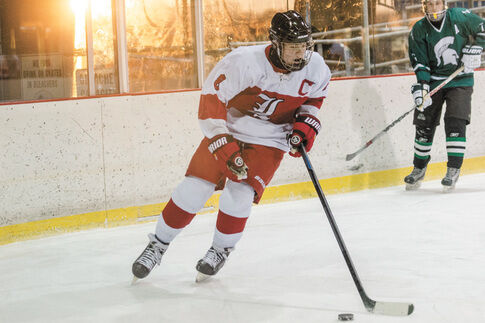
It’s no secret that ice hockey numbers are dwindling in Mercer County—the number of co-op teams in the Colonial Valley Conference alone tells that story. Teams across the county, like Lawrence and Hightstown, Nottingham and Hamilton West, and Robbinsville and Allentown are forced to combine due to low player turnout. That has been the case for several seasons.
So, a group of CVC coaches recently gathered together to discuss the state of ice hockey in Mercer County. Their goal was simply to brainstorm—what can be done to get more kids playing the sport at the high school level? Assisted by the Lawrence Flames travel hockey program, they figured it out, and launched a new outlet for local kids to access the sport.
The discounted program is open to new and inexperienced players 4-12, to be placed in separate divisions based on age: Atoms and Mites (4-8) and Squirts and Pee Wees (9-12). In addition, the Flames also launched the Lawrence Heat, an in-house, limited travel program intended for players (born 2004-5 for Pee Wee and 2006-7 for Squirt) just learning the sport. The program’s home rink is Louckes Arena at the Lawrenceville School.
Robbinsville/Allentown head coach Dan Bergan said the Heat will give children a “second chance” to get involved with the sport.
Competitive travel hockey is an integral part of success at the high school level, and the Heat’s goal is to give players two or three years of that experience that they might not have had otherwise before they enter ninth grade. Without that experience, they’re already at a disadvantage going up against powerhouse schools from areas like Bergen and Morris counties.
“In the past, high school coaches have just expected the talent to come to them, but in Mercer, the time has come for the high school coaches to take an active role in trying to promote, participate [in] and encourage hockey,” Lawrence/Hightstown head coach John Ritchie said.
Bergan called it an opportunity for kids who might not make elite travel programs, or athletes who got off to a late start playing hockey. The idea is that the more kids who enter high school with prior hockey experience, the more competitive CVC teams can become.
“The lack of participation at a younger age is what has caused our county’s teams to struggle,” West Windsor-Plainsboro North head coach Andrew Ferencevych said. “Many other counties have strong feeder programs, have leagues for middle school teams, and provide more opportunities for players to try hockey when they are younger. Early participation leads to increased amount of practice to hone skills.”
Lacrosse has seen a local renaissance over the last several years, and he said that younger kids might be more prone to gravitate toward that, as well the typical popular sports like baseball and soccer, rather than hockey.
Ferencevych also added that Mercer County teams had strong programs when IceLand had a sizeable house league, which allowed kids to at least try hockey. Now, they don’t have the option to test the waters.
“Where there were numerous travel programs feeding the local high schools, there are now very few,” Bergan said. “The sport is still healthy and strong as seen by the dominance of Jersey Shore teams. For the local high schools, teams that have been eligible for state tournaments have not been very successful, indicating we are in a bit of a down cycle and need to address that.”
The coaches hope to change that with the new Flames programs.
The majority of players from the top schools in other counties flow in through feeder programs. Here, though, they’ve dwindled over the last few years.
But those feeder programs are essential. Bergan added that if a child is athletic and a good runner, he or she can pick up most other sports fairly quickly. For hockey, though, players need two or three years’ worth of skating lessons before they’re considered skilled enough to start developing stick skills and taking part in contact play.
“Many potential players don’t realize what a great thrill it is to play the game until they are a little older,” Bergan said. “It has the hand-eye of baseball, the athleticism of basketball and the intensity of football, all rolled into one, all while flying over the ice at speeds unmatched by other sports. Because it takes those couple of years to be effective as a skater, perhaps the ‘immediate gratification’ factor lags a bit behind. But that is also what makes ice hockey players so special.”
The state of the economy, Ritchie added, has limited which sports are willing to try because tuition, ice time, and equipment can be expensive for a family unsure of whether or not their child will want to keep up with hockey. But prospective players eschewing hockey in favor of other less expensive (or less time consuming) sports is part of the down period it’s currently in.
But Bergan stressed the current situation is not “grave”—periods like this are normal, he said.
“All sports go through up and down cycles two to four years at a time,” he said. “I think hockey can be robust again without without this initiative, but this will certainly help us become more competitive on a statewide basis. I think the current Shore Conferences are a good benchmark…It’s simply time we take a proactive stace, rather than just taking whatever talent the pipeline feeds us and be satisfied with that. We’re taking a look at what top statewide programs do and hoping to duplicate that.”
The Atom and Mite programs cost $500 per player per season. The Heat program costs $600 per player and $300 per goalie per season. Half of the payment is due with registration and the remaining half is due by Dec. 31. Jerseys and socks are included with the price. For more information, call the Lawrence Flames organization at (609) 731-3083 or e-mail Rich Dickinson at rdickinson1625@gmail.com. On the web: lawrenceflames.org
,