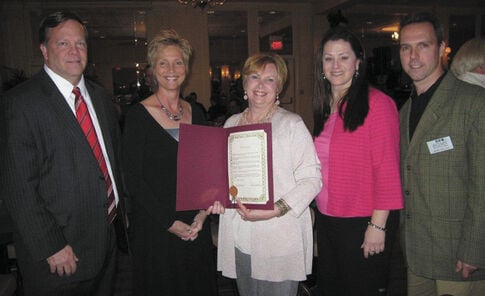
Over the last decade, Ewing’s animal shelter has been transformed from a rundown warehouse overflowing with animals to EASEL, a non-profit animal welfare organization. While the creation of EASEL was a group effort, many people in town agree it wouldn’t have been accomplished without the driving force of one woman—Kathleen Tuttle.
Tuttle, who founded EASEL—the Ewing Animal Shelter Extension League—in 2006, died on April 24 at the age of 65. Born in Hoboken, Tuttle lived in Ewing since 1989 and dedicated herself to giving back to her town. Tuttle became a constant presence in town, always getting involved with local organizations and fighting for animal rights.
“I think her passion is something that until it’s not there you don’t understand how much you miss it,” James McManimon, township business administrator, said.
McManimon was friends with Tuttle since the 1990s and worked with her during the early days of EASEL. “You always need someone who can raise the issue, and then you need someone who can complete the project. And we wouldn’t have the completed project without Kate raising the issue,” he said.
Mark Phillips, who took over as executive director of EASEL when Tuttle stepped down in 2011, worked with Tuttle and Georgia Arvaniti to form the organization. They met through a local citizens committee that Tuttle spearheaded.
The goal of the committee was to address a wide range of issues within the township, ranging from taxes to violence, but eventually the group disbanded due to a lack of overall interest. However, one of the committee’s goals was to revamp Ewing’s animal shelter, and Tuttle was determined to see the project through.
“She was very active, it wasn’t just animals. She was very vocal,” Phillips said. “She wasn’t shy. She’d go and get things done the right way, so whenever there was a problem at the old shelter she’d step in and start talking to council, mayors and that kind of stuff to get things going.”
The shelter was located in an old warehouse on West Ingham Avenue, right on the Trenton border. Phillips said the area had a such bad reputation for being a neighborhood filled with violence and crime, even those who wanted to volunteer their time didn’t want to go to the shelter.
The warehouse did have a lot of room—capable of holding 28 dogs and 120 cats compared to the current shelter’s 13 dogs and 25 cats—but Phillips said even that wasn’t necessarily a good thing. The goal is to find animals quality homes as quickly as possible, and the shelter was almost always overflowing with animals.
The combination of a lack of volunteers and a lack of people visiting the shelter to adopt led to it always being at capacity. Despite all this, Tuttle saw past the poor location and subpar conditions and instead saw animals capable of loving new families if they were just given the opportunity.
“She had an optimism that I don’t think I’ve ever seen in anyone else,” said Karen Azarchi, president of EASEL. “Her goal was going to be achieved no matter what it took, and she did not take no for an answer. She was quite clear that she was going to get her shelter, and it was going to be what she wanted it to be.”
Before EASEL, Tuttle first founded a small animal advocacy committee and met with the township’s animal control officer and health officials to find a better way to treat the animals, which were being euthanized because the shelter was running out of space.
Tuttle’s vision for the shelter was a lofty one—she wanted the animal advocacy group to run the township’s shelter. This finally occured in 2015, when the township and EASEL reached an agreement—the first of its kind in the state—to manage the municipal animal shelter.
“What we are now—I’m not going to say it’s unprecedented, I’m sure it’s happened before—but for a rescue group to run a municipal shelter is usually like oil and water,” Phillips said.
Phillips explained that animal rescue groups and municipal shelters often have two different overall goals for the animals. Rescue groups want to save and protect all animals, while the municipalities want to get the animals off the streets due to resident safety concerns. Tuttle was the driving force behind Ewing’s two groups coming together.
“The reason we’ve had such great success is because Kate had inroads to people who mattered and made it clear to them we were there to help, as opposed to be an opponent,” Phillips said. “And that helped us get to where we are now.”
Everyone in town, from the mayor to health officials, knew Tuttle’s number one priority was to help save the animals.
Despite preferring the company of dogs over cats—she owned a few dogs with her husband Bill—she fought tirelessly for the rights of all animals in Ewing Township and beyond. It wasn’t long before her passion as known all throughout town.
“Kate became very active, very vocal about how the animals that we care for should be taken care of,” McManimon said. “Animals were her children. She and her husband didn’t have any children, he traveled the world with the military, so her pets were as close as she could come.”
By the time Tuttle founded EASEL in 2006, everyone in the township respected Tuttle as the ultimate voice for Ewing’s animals. If something needed to be done, she wouldn’t hesitate to make calls or attend council meetings to help get it done.
“You can’t really fault her and tell her to stop because she was trying to save something. She was unyielding,” Azarchi said.
Her hard work paid off, with the shelter eventually moving from the warehouse to a spot right next to Ewing’s municipal building.
“It’s a community setting,” McManimon said. “You have dog training going on on Saturdays by volunteers, people can walk dogs around town hall. The animals love it.”
With a new location much more accessible to the public, both animal adoption and volunteerism rose, which allowed Tuttle to turn her attention elsewhere in the animal world.
Tuttle was the driving force in getting the Trap-Neuter-Release resolution passed in Ewing. Rather than euthanize Ewing’s feral cats—a population which Phillips estimates is anywhere from 2,500 to 3,000—the TNR program traps cats to spay and neuter them, as well as give them a rabies shot, and then releases them back where they were found.
New Jersey has now endorsed TNR as a safe and effective way to control stray cat populations, but in 2010 it was a new concept for towns—one that wasn’t always favorable. People in town were skeptical of its success, but Tuttle was able to help educate officials about the practice and help pass the resolution.
“She was the animals’ best friend, especially Ewing Township animals, because she would fight for their right not to be euthanized for no good reason,” Azarchi said.
Tuttle compassion wasn’t just for animals, however. She was also the founder and president of the Family Support Group for the First Battalion 150th Aviation at the Trenton Mercer Airport. She was awarded the Outstanding Civilian Support Medal from the Army for being voted the number one family support group in the state.
“She was the spouse of a veteran who was all over the world, so she’d work to make sure military families were taken care of as well,” McManimon said.
Tuttle would organize events to show support for military families and help raise money for anyone that needed food or money to help cover expenses.
McManimon said the military and animals became her world, and she treated every military family and dog in the shelter like they were part of her family, because in a way, they were.
As EASEL continues to grow, its members will make sure to carry on Tuttle’s legacy of volunteerism. The ultimate goal for EASEL, Azarchi said, is to build their own regional shelter to house even more animals.
When the shelter is built, they plan to dedicate it to Tuttle.
“We’ve grown since she left, but all of that was because of what she started,” Phillips said.
,